

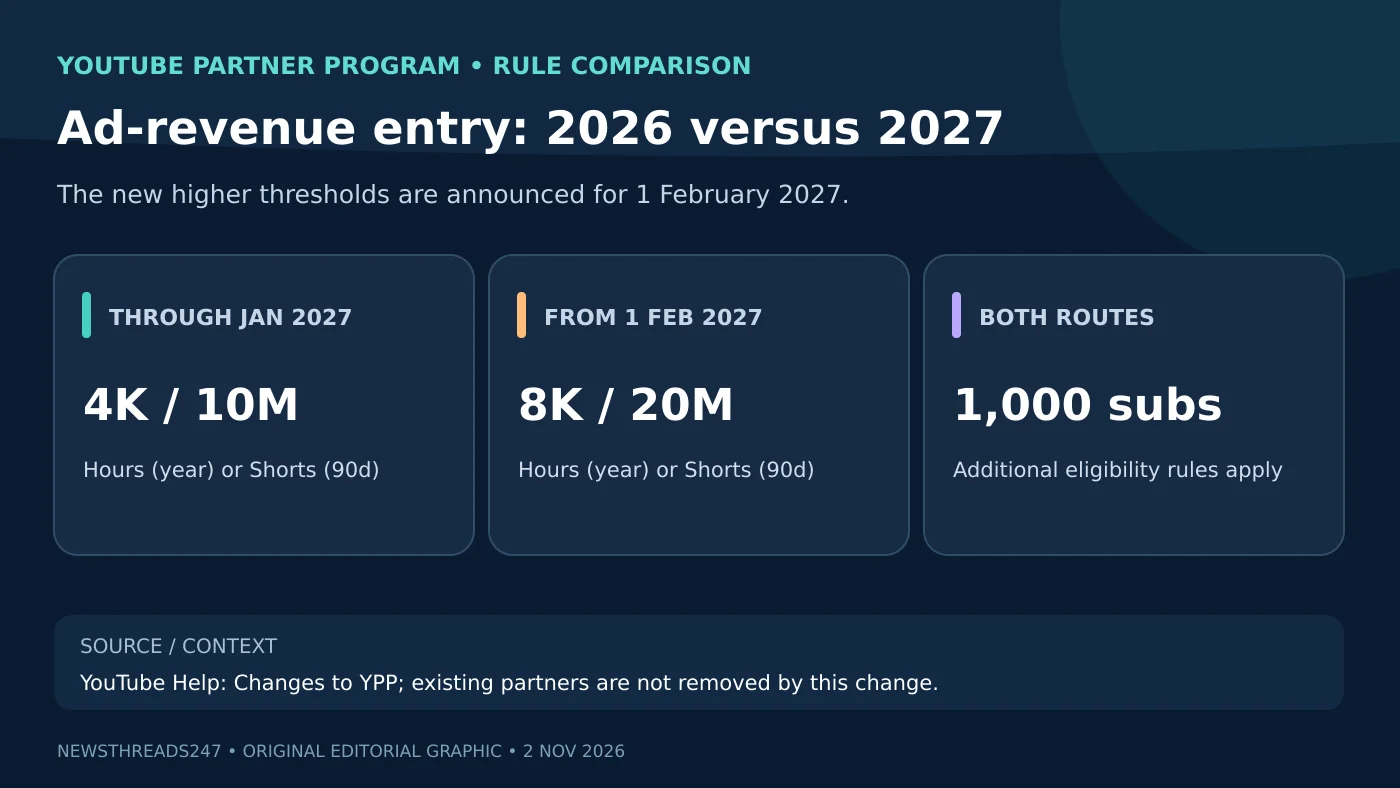
YouTube has announced major changes to monetization eligibility beginning 1 February 2027, but the higher ad-revenue thresholds are not the rules already in force on 2 November 2026. Its published update says new applicants will need 1,000 subscribers plus either 8,000 qualified watch hours in the preceding 365 days or 20 million qualified Shorts views in 90 days. The currently listed entry criteria remain 1,000 subscribers plus 4,000 qualified watch hours or 10 million qualified Shorts views.
The changes also include updated partner terms, activity requirements and Shorts-related features. The official YouTube changes notice is the controlling source for the announced future rules, while YouTube’s current Partner Program overview describes eligibility at the date of this article. The distinction matters if someone is planning months of uploads or deciding whether to apply now.
The 2026 versus February 2027 comparison
| Question | On 2 November 2026 | From 1 February 2027 (announced) |
|---|---|---|
| Ad and Premium revenue: subscribers | 1,000 | 1,000 |
| Long-form route | 4,000 qualified public watch hours in 12 months | 8,000 qualified watch hours in 365 days |
| Shorts route | 10 million qualified Shorts views in 90 days | 20 million qualified Shorts views in 90 days |
| Expanded YPP/fan funding | 500 subscribers; 3 uploads in 90 days; 3,000 hours or 3 million Shorts views | YouTube says this route does not change |
| Existing YPP members | Maintain eligibility and policy compliance | Threshold change does not remove current YPP status |
The two paths are alternatives, not cumulative requirements: meeting the eligible long-video watch-hour route does not also require 10 million Shorts views. Watch time from Shorts viewed in the Shorts Feed does not count towards the conventional long-form watch-hour threshold, according to YouTube’s current eligibility documentation. All numeric targets are subject to the platform’s definitions of qualified views and hours and a channel review for policy compliance.
What changes for a new creator planning a channel?
The calendar matters. Someone who reaches 1,000 subscribers and 4,000 qualified public watch hours while the existing route is in force may meet the presently listed numerical requirement, subject to review; the rules announced for the future are not a promise that every application will be approved or that approval is instantaneous. From 1 February 2027, YouTube says a new channel seeking ad and Premium revenue through the long-form route faces 8,000 qualified hours, or 20 million qualified Shorts views via the alternative route.
A stronger planning decision is to build a sustainable publishing format rather than manufacture traffic to hit a milestone. It is useful to compare the average watch time, repeat viewership and production cost of well-researched long videos with the discovery potential of Shorts. View counts are not earnings guarantees. A creator’s country, policies, audience demographics, ad suitability and monetized playbacks can all affect what they eventually earn.
What does not change: earlier-access creator features
YouTube explicitly states that fan funding, Creator Partnerships and YouTube Shopping entry requirements are unchanged by the 2027 announcement. In eligible countries and with other conditions met, the expanded Partner Program currently allows a creator to apply at 500 subscribers with three valid public uploads in the previous 90 days and either 3,000 qualified watch hours in the prior 12 months or 3 million qualified Shorts views in 90 days. This earlier tier is not the same as full ad-revenue sharing.
Eligibility is not granted solely by crossing a number. The channel must meet its Community Guidelines and monetization rules, have required account verification and an appropriately linked AdSense for YouTube account, and pass review. Readers should open the Earn tab inside YouTube Studio for the status specific to their channel rather than relying on an earnings calculator or a viral screenshot.
Existing partners: the January 31, 2027 terms deadline
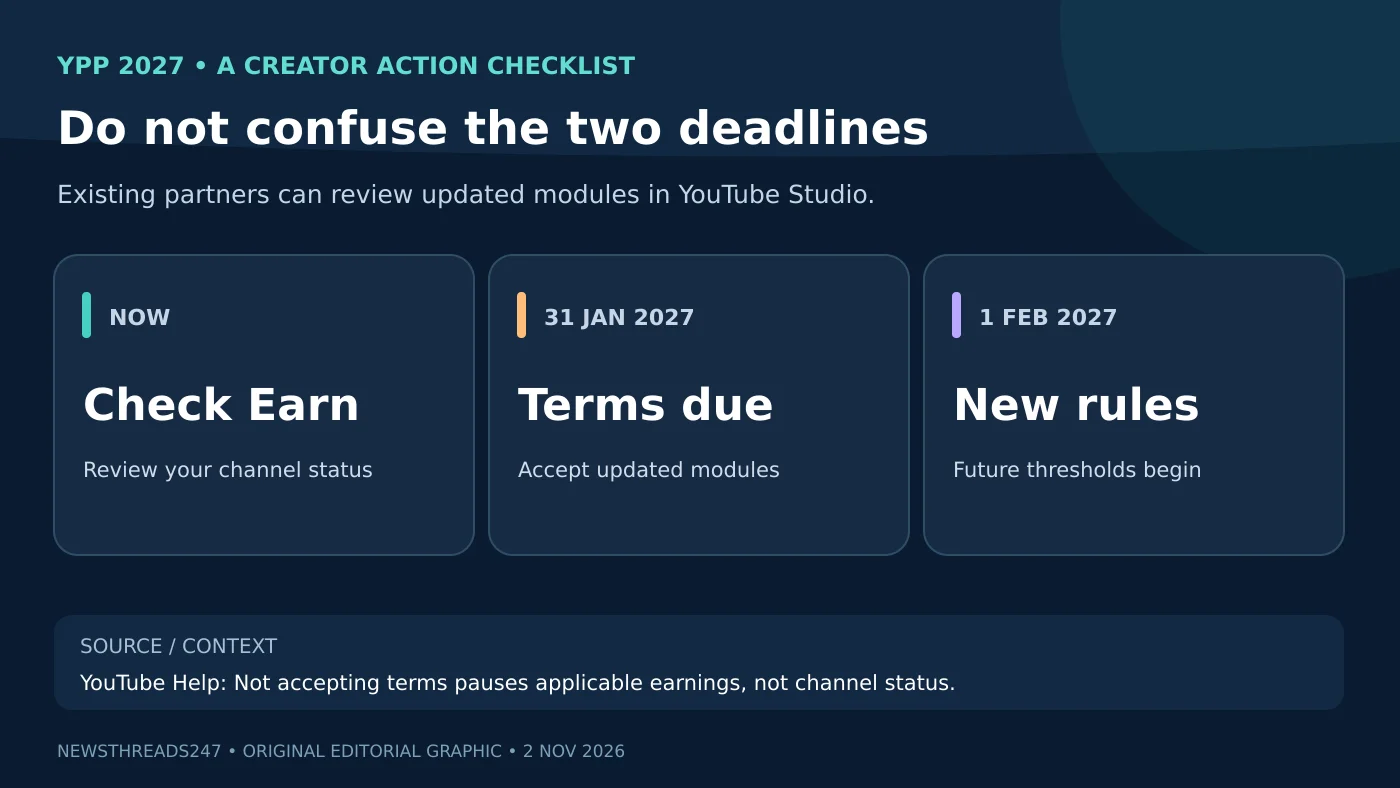
YouTube asks existing partners to review and accept updated monetization terms in YouTube Studio by 31 January 2027 to keep relevant features earning continuously. Its help page says missing this deadline can suspend earnings from the associated modules from 1 February, but it does not automatically remove their channel from YPP. The creator can accept the terms afterward to restore access to the relevant features. This is not a request to click a link in an unsolicited email.
- Open YouTube Studio directly and inspect the dashboard or Earn section for the terms notification.
- Read each applicable Watch Page, Shorts or Commerce module; choose which to accept after reviewing the terms.
- Submit the acknowledgment within Studio and check that each desired monetization module shows the expected status.
- Keep an independent reminder before 31 January 2027, and treat any third-party “instant approval” offer as unverified.
A separate 2027 update: activity requirements
The announcement says YPP channels will be regarded as active from February 2027 if they meet at least one stated route: 1,000 qualified watch hours in 365 days, 1 million qualified Shorts views in 90 days, or two long-form uploads or five Shorts in 90 days. It also describes a 90-day restoration window for channels falling below the relevant ongoing activity benchmarks. These are activity provisions, not the same as entry requirements for a new creator.
A channel posting meaningful videos every month can be more resilient than one that briefly gains a large audience and then goes silent. But volume alone is not a sensible target if it creates near-identical videos with little viewer value. The official monetization policies emphasize originality, authentic content and avoidance of mass-produced or reused material without significant added value.
Shorts earnings and Premium Lite: what is actually stated
The official announcement also discusses revised Shorts earnings opportunities and the expansion of Premium Lite. It describes a creator pool representing 60% of net Premium Lite subscription revenue and a separate 30% pool for Premium views. These are platform-level revenue-pool descriptions; they do not mean an individual creator receives 60% of a viewer’s subscription price or can predict a fixed per-view payout. Avoid repeating such a formula without the detailed policy context.
The sensible reader takeaway is that ad revenue, Shorts, Premium and fan funding have distinct eligibility, contracts and calculations. Published platform figures cannot be converted into a universal monthly salary. If YouTube revises the detailed terms, the then-current official contract and the creator’s Studio dashboard take precedence.
What to do now without chasing misleading shortcuts
- Audit your Earn tab and save the official eligibility and current module status.
- Build an original content library that solves specific audience questions, with honest thumbnails and retention-worthy explanations.
- Document licenses for music and footage; account verification, copyright and monetization are separate checks.
- Track the correct analytics window (12 months/365 days for hours; 90 days for Shorts) and recheck the February rule date.
- Do not buy subscribers or views, reupload other people’s clips as a shortcut, or promise guaranteed monetization.
For creators who have not launched, our first-video channel setup guide describes a realistic starting workflow without expensive gear. The numbers on this page should shape expectations, not create pressure to upload filler.
Frequently asked questions
Do I need 8,000 watch hours to monetize on 2 November 2026?
No. As of this article’s publication, YouTube’s current guidance lists 4,000 qualified public watch hours or 10 million qualified Shorts views, along with 1,000 subscribers, for the conventional full ad-revenue entry route. The increase is announced for February 2027.
Does the 500-subscriber tier unlock full advertising revenue?
No. The earlier-access program has separate features and conditions; YouTube says those entry numbers are not changing in this announced update.
Will existing monetized channels lose YPP status on February 1?
The company says the new entry threshold does not affect existing YPP status. However, updated contract modules still need acceptance for continuous earnings from the relevant features.
What is the January 31 deadline?
It is the stated latest date to accept the updated YouTube Partner Program terms before the February 1 changes begin. Check the message inside YouTube Studio.
Bottom line and source date
YouTube’s announced 2027 thresholds are substantially higher for new full ad-revenue applicants, but existing 2026 eligibility, the unchanged 500-subscriber feature tier, and the contract deadline are different issues. This article compares the official future-rule notice against current eligibility guidance as reviewed on 2 November 2026, IST. Recheck both before making a decision after any later policy update.
Editorial method: We report the platform’s own published rules rather than earnings forecasts. The lead image is an AI-created conceptual scene and the supporting graphics are original explanations, not official YouTube interfaces.