
Before approving a windscreen replacement on a car with driver-assistance cameras, ask whether the quote includes the calibration required for your exact vehicle. New glass and a clear dashboard do not, by themselves, document that the camera system has been checked and the specified procedure completed.
For an owner in India, the useful first step is to give the workshop the vehicle identification number, model year and details of the fitted driver-assistance system. Then ask it to identify the current manufacturer procedure. “ADAS calibration included” is a starting point for a conversation, not a complete repair record.
Find out what sits behind the glass
A windscreen may be part of the viewing path for a forward-facing camera used by driver-support functions. The glass, camera mounting and manufacturer instructions therefore matter together. Avoid deciding from the size of the crack alone or assuming that reusing the old camera removes every calibration requirement.
One model-specific example is Volvo India’s 2019 V60 support manual. It calls for workshop recalibration of the camera and radar unit when the windscreen is replaced. The page was updated in March 2020; it is an example of the repair requirement for that vehicle, not a new rule issued in October 2026 or a procedure for every car.
That distinction protects you from two bad shortcuts: assuming every car needs the same calibration, and assuming yours needs none because a different model did not. Ask the workshop to connect its answer to your car’s equipment and service information.
Make the two quotes cover the same work
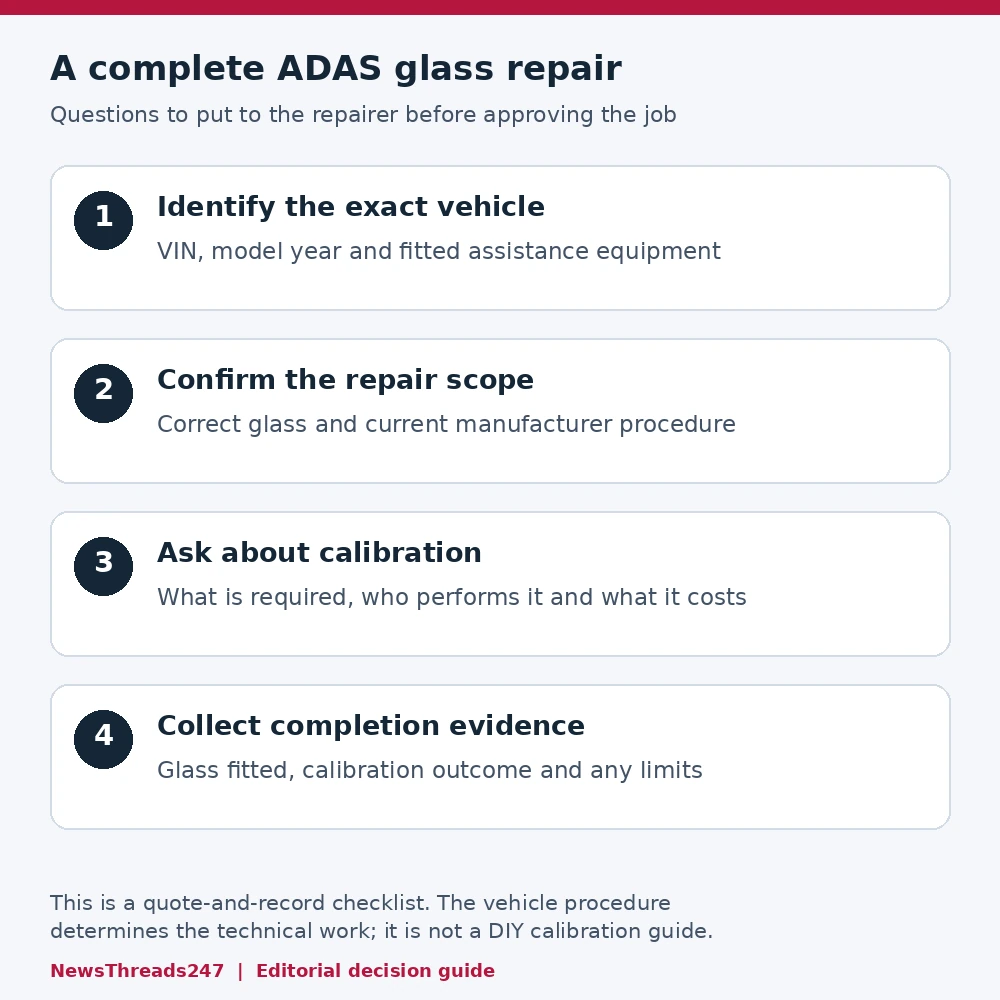
A cheaper quote is difficult to assess if one workshop is pricing glass installation and another is pricing installation plus required camera work. Request a written breakdown with glass identification, installation materials, calibration where required, related checks and applicable taxes. Ask what happens if the calibration cannot be completed at the first appointment.
Here is a practical comparison without invented prices. Workshop A says “windscreen replacement” and gives a single total. Workshop B identifies the glass, states the required camera procedure and includes a completion report. Before choosing, ask A to price the same scope. Until then, the totals answer different questions.
Also separate who performs the work from who sells the appointment. If the installer uses another specialist for calibration, ask who arranges the transfer, how the car is handled between the two stages, and who provides the final record. Subcontracting is not automatically a defect; an unexplained gap in responsibility is the issue to resolve.
Use the vehicle procedure to judge the glass
Do not accept “it fits” as the only evidence that a windscreen is appropriate for a camera-equipped vehicle. Ask for the part identification and confirmation that it meets the applicable manufacturer requirement. Keep the response with the quote rather than relying on a verbal statement after the old glass has been removed.
I-CAR’s Volvo glass-replacement update points to Volvo’s position on genuine glass, installation materials and calibration, with vehicle-specific service procedures controlling the work. That is a Volvo requirement described by a repair-training organization; it does not establish that every other brand has the same glass policy.
If a shop proposes another glass option, ask it to explain how that option satisfies your manufacturer’s current procedure and any relevant insurer requirements. Avoid treating an insurance authorization as proof of technical suitability, or a technical recommendation as a promise that an insurer will pay. Get the respective answers from the workshop and insurer.
Ask which calibration procedure is required
Calibration may involve a stationary setup, a prescribed driving procedure, or both, depending on the vehicle. Safelite’s explanation of its recalibration service distinguishes these approaches and says the manufacturer determines which is needed. Its US service description is useful context, not an Indian price quote or a booking recommendation.
For you as the owner, the important question is whether the workshop can complete the applicable method under the required conditions. Ask before booking, especially if the job is offered at your home. A convenient location is helpful only if the complete repair can be carried out appropriately.
Ask the installer separately when the glass installation is ready for the car to be moved or driven. Do not substitute an arbitrary waiting period from an online article for the instructions applicable to the adhesive and installation being used. Calibration scheduling and glass-installation readiness need to fit together.
Collect evidence of completion
Before accepting the car, request a record identifying the vehicle, the work performed, the calibration procedure where required, its result and any outstanding issues. If scan reports form part of the repair, ask for them too. A line on an invoice saying “ADAS” is less informative than a record explaining what was completed.
Keep the glass invoice, part details and relevant reports together. If a warning appears later, this gives the next workshop a useful starting point. Describe the warning in your own words and when it appeared; do not ask a technician to infer the entire repair from a payment receipt.
If calibration was required but has not passed or has been deferred, ask for clear written next steps before relying on the affected driver-support functions. Do not test automatic braking by driving toward an obstacle, or lane support by deliberately drifting. Those are not safe owner checks.
Keep the driver’s responsibility in view
A completed calibration does not turn driver assistance into autonomous driving. Continue to follow the owner’s manual and remain responsible for driving. Our Level 2 assistance explainer discusses that distinction in the US context; your own car’s operating instructions remain the reference for its features.
The decision before booking is concrete: can the provider identify the correct glass and repair procedure, include the required calibration in the agreed scope, and document the outcome? Resolve those points before comparing headline prices. You should not need to become a calibration technician to ask for a complete repair.
Documentation checked on 30 October 2026. This is an ownership explainer, not a hands-on vehicle test, repair procedure or insurance-coverage guarantee. Requirements vary by model year, equipment and manufacturer instructions.
Visual credits: NewsThreads247. Featured and contextual images are AI-generated conceptual illustrations of generic equipment; the checklist diagram is an editorial graphic.