
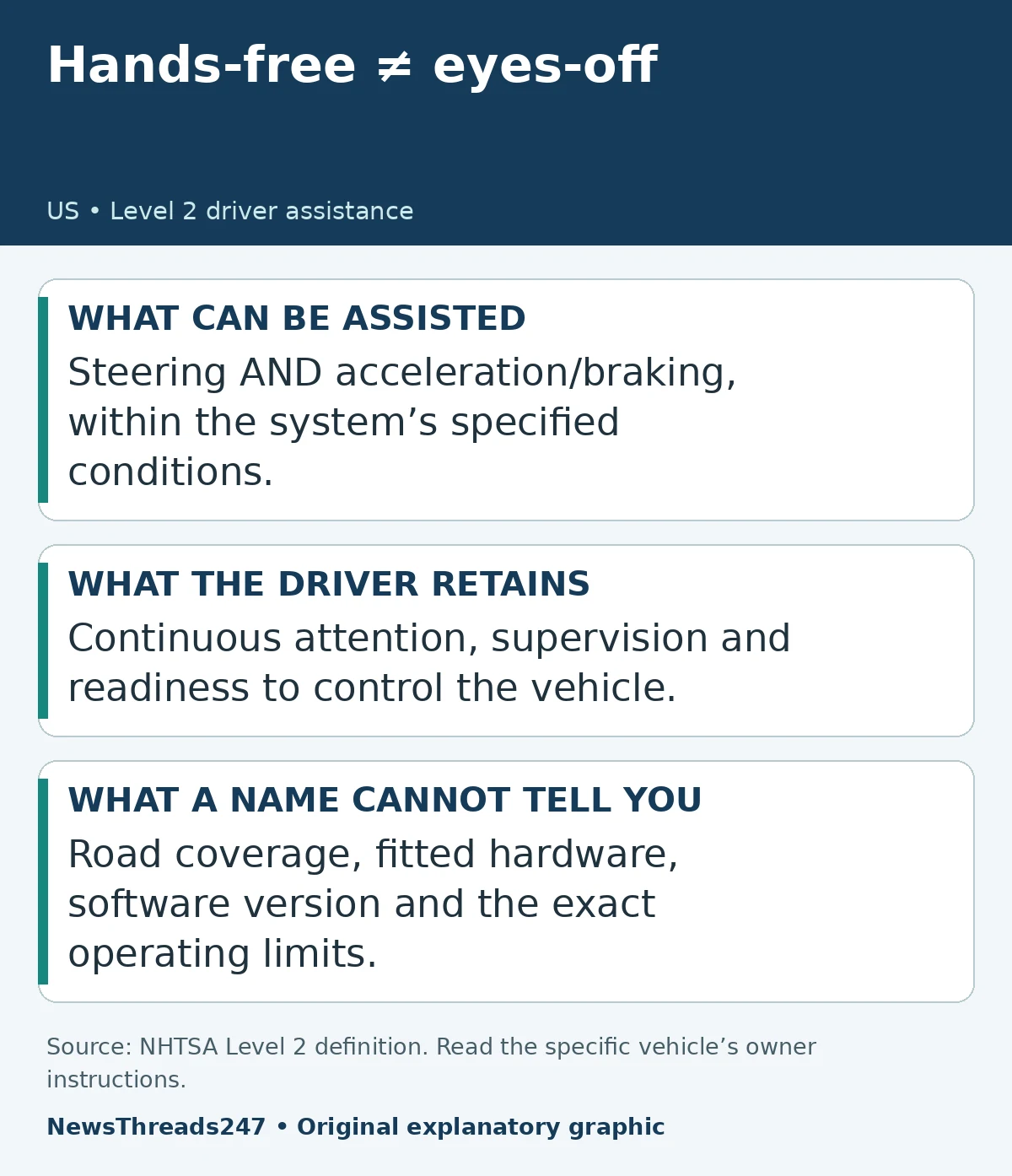
A car can help steer, accelerate and brake while still requiring you to watch the road continuously. That is the central distinction for US motorists considering Level 2 driver assistance: hands-free operation, where specifically permitted, does not make the journey eyes-off.
The distinction has a serious recent example. On 31 March 2026, the National Transportation Safety Board said driver overreliance contributed to two fatal 2024 crashes involving Ford BlueCruise. Its findings support a practical buying question that deserves more attention than the feature’s name: what must the person in the driving seat keep doing?
Separate the task the system performs from the job you retain
NHTSA’s explanation of Level 2 describes continuous help with both steering and acceleration/braking while the driver stays fully engaged and attentive. Continuous assistance with only one of those functions falls into its Level 1 description. A momentary warning or emergency intervention is another kind of assistance.
The level describes the driving task and supervision arrangement. It is not a score out of five for overall vehicle safety. A bigger number in a brochure also cannot tell you which roads, weather or maneuvers the particular feature supports. Those details require the exact owner’s manual and equipment specification.
Put the distinction into a short sentence before a demonstration: “The system does these tasks, on these roads, while I monitor and remain ready to control the car.” If the explanation instead becomes “the car can drive me,” ask for the missing conditions. This is an information check, not a request to challenge the feature on a public road.
What the 2026 investigation established
The NTSB examined two crashes involving 2022-model-year Mustang Mach-E vehicles in San Antonio and Philadelphia. Its March release says the partial automation failed to stop for stationary vehicles and identifies overreliance as a contributor. It recommended better attention monitoring, measures addressing excessive speed and stronger federal performance requirements.
These are dated investigation findings about identified crashes, not a new October crash report or a claim that every current vehicle behaves identically. A recommendation is not the same as an enacted rule or proof that a software change has been installed on your car. Keep the finding, proposed response and actual vehicle version separate.
For an owner, that leads to a concrete next step: find the installed software version, read the applicable instructions and ask the manufacturer about relevant updates or notices. For a buyer, obtain that information for the actual vehicle offered. An advertisement for a newer feature package does not establish what is active on an older demonstrator.
Read hands-free permission narrowly
As one current manufacturer example, Ford describes BlueCruise as hands-off, eyes-on highway assistance in designated Blue Zones. Its page describes a driver-facing camera tracking eye gaze and head position. That is the manufacturer’s account of its feature, not an independent assurance that monitoring will catch every attention lapse.
Use that example as a reading method for any system: find where use is permitted, how availability is indicated, what monitoring expects and how to resume manual control. Do not assume another brand has identical controls or operating limits. A familiar-looking steering wheel icon can hide a different set of conditions.
A hypothetical weekend route might contain a supported highway section, an interchange and an ordinary street at the destination. Permission on one section does not extend itself across the whole journey. Plan where assistance can end before reaching a complicated section, using the manual’s instructions.
A warning feature and a driving-control feature are different
NHTSA distinguishes collision warnings from interventions. A forward-collision warning alerts the driver; it does not itself take avoiding action. Automatic emergency braking can intervene in a collision risk, but that does not turn it into a promise to recognize and stop for every obstacle. Read which features are fitted and enabled.
For a showroom explanation, ask the representative to name each feature rather than saying “it has ADAS.” Does it warn about lane departure, help keep a lane, control following speed, or combine steering with speed assistance? Which functions remain active when a different feature is switched off? Request the manual section that answers those questions.
Do not attempt a demonstration by approaching a stopped vehicle, letting the car drift or ignoring a warning. A controlled explanation can cover controls and limits without manufacturing a dangerous situation. If the behavior is unclear, get clarification while safely parked.
Look at safeguards as well as smooth steering
The Insurance Institute for Highway Safety’s safeguard ratings examine attention monitoring, reminders, emergency procedures and other design choices. Their purpose is different from a crashworthiness rating. IIHS also cautions that partial automation is a convenience feature, with risks when it allows attention to wander.
A smooth demonstration is therefore only one observation. Ask what happens when attention is lost, what warnings escalate and what the documented emergency response is. These are questions to answer from the instructions and relevant test findings, not experiments to perform by deliberately looking away.
Read the rating row carefully: model years, tested configuration and software version matter. An older test can identify a concern worth investigating without proving the same result for every later update. Equally, a new product name is not evidence that a known issue has been resolved. Seek documentation for the change.
Make a five-question note before paying
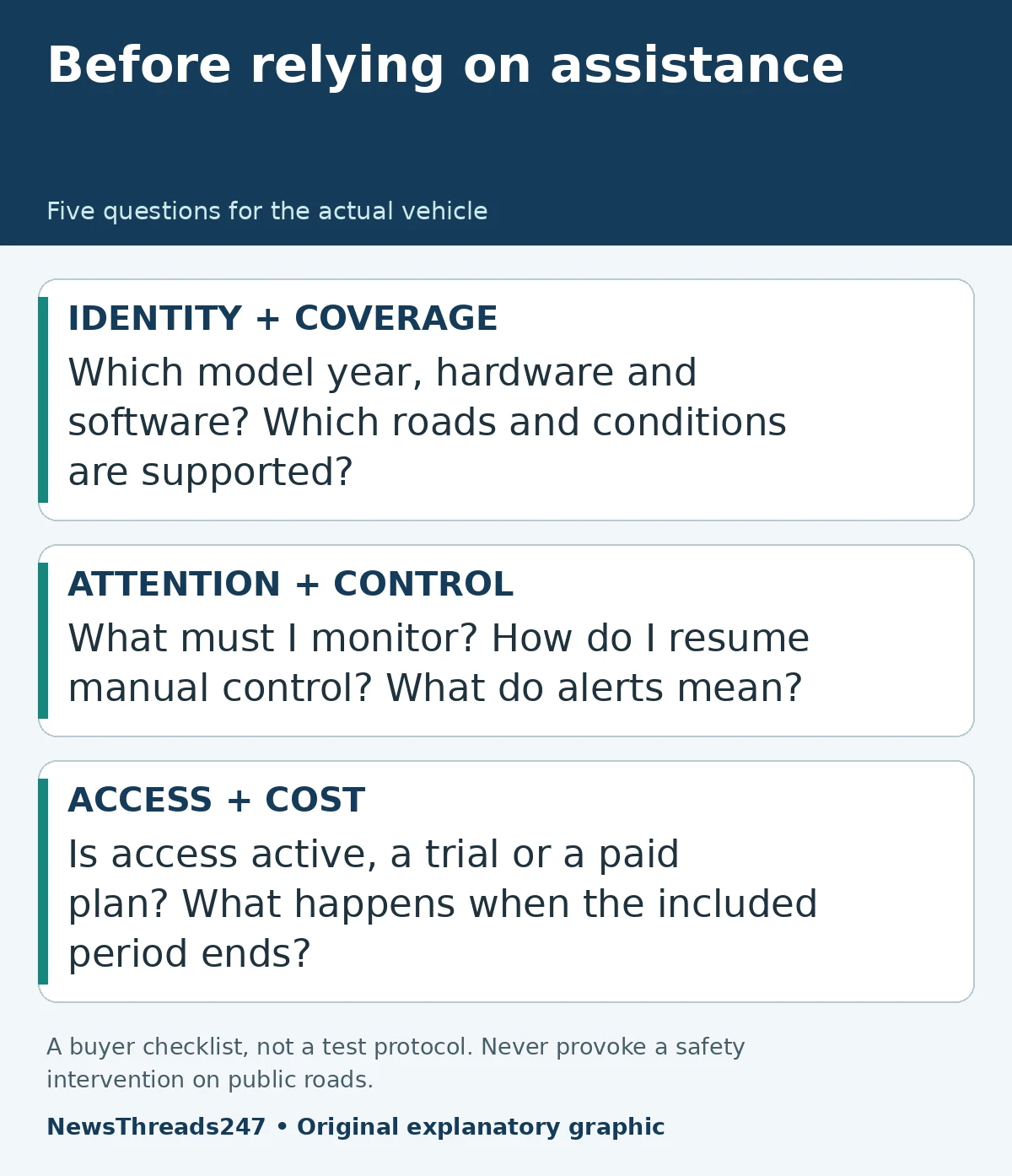
Record five things: exact vehicle and feature version; supported roads and conditions; the driver’s continuing duties; the method of taking control; and the cost and duration of access. Keeping these on one page makes two offers easier to compare without letting a brand slogan decide the purchase.
For example, imagine Car A includes a trial that ends soon, while Car B offers an optional package. A fair comparison needs written confirmation of what happens when the trial ends and whether the second car actually has the necessary hardware. Do not infer either answer from the presence of a menu item. This is a hypothetical purchasing example, not a price comparison between named cars.
If your journeys mostly fall outside supported roads, that changes the practical value even if the feature works as described elsewhere. Write down the trips you actually make. Convenience on a road you rarely use should not automatically outweigh comfort, visibility, running costs or other equipment you use daily.
Keep responsibility clear after the purchase
Set the route and learn controls before moving. Leave phone use, reading and other competing tasks for a safe stop. Assistance is not a substitute for an alert, unimpaired driver. If you are too tired to supervise driving, changing a software setting does not solve that problem.
Review instructions after relevant updates and before lending the vehicle to someone unfamiliar with it. Explain the actual controls and supervision requirements; do not introduce the car as one that “drives itself.” A brief, accurate handover can prevent the next driver from relying on assumptions made from a feature name.
When something behaves unexpectedly, prioritize safe control of the vehicle. Once safely parked, record the circumstances and contact the manufacturer through its official support process. This article does not diagnose a particular car or certify any system’s safety, and NewsThreads247 has not conducted a road test for it.
On a used car, feature availability is also separate from physical condition. Our US used-car flood-damage guide explains why history records and an inspection answer questions that an equipment list cannot.
Sources and visual credits
Primary references checked on 27 October 2026: NHTSA’s driver-assistance definitions, the NTSB’s 31 March findings, Ford’s current BlueCruise description and IIHS’s safeguard-rating framework. Named investigations provide documented context; route and purchase examples are fictional. Featured artwork is an AI-generated generic cabin illustration, not a named vehicle or crash photograph. Both diagrams are original explanations.