
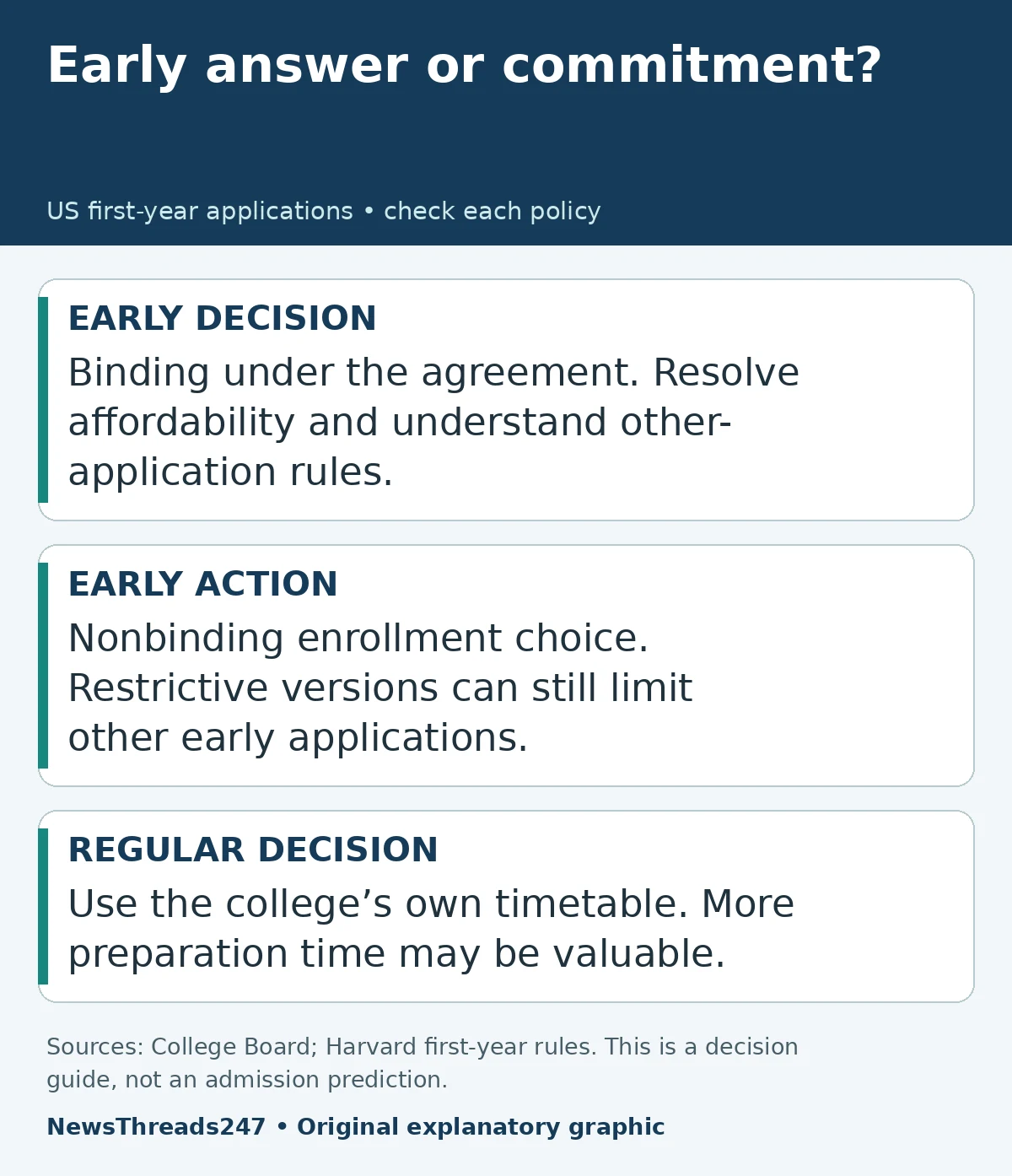
An earlier college decision can be useful. An earlier promise to enroll is a different choice. For US first-year applicants preparing fall 2026 applications, the question is whether the chosen plan leaves enough room to compare costs, finish a strong application and follow every college’s restrictions.
There is an immediate reason to check now: Harvard’s current first-year admissions page lists a November 1 restrictive early action deadline, with the applicant’s portion due at 11:59 p.m. in the applicant’s local time. That is one institution’s rule, not a national deadline. Other colleges, programs and supporting documents can have different dates.
Separate an early answer from a binding choice
The College Board distinguishes early decision from early action by commitment. Early decision is binding when admission and an adequate aid package are offered under the plan’s terms. Early action provides an earlier response without requiring an immediate enrollment commitment. Specific policies still belong to the college, so read the agreement rather than relying on an abbreviation.
Put three questions beside every institution on your list: when must I apply, when must I decide, and what other applications does this plan permit? A deadline chart that answers only the first question is incomplete. Two colleges can both use the word “early” while leaving you with very different choices after an offer arrives.
Do not treat ED II as a way around the commitment. Where offered, its later application timetable does not make early decision nonbinding. Check the institution’s current ED II conditions and your obligations under any earlier application before choosing it. “Later” describes timing; it does not settle whether the plan fits your circumstances.
Nonbinding does not always mean unrestricted
Harvard’s restrictive early action plan is nonbinding, but its current rules prohibit other private early applications and binding public early programs, with specified exceptions. It permits nonbinding early applications to public universities, military academies and universities outside the US, among other stated exceptions. Read its complete policy before combining applications. Another college’s restrictive plan need not have the same exceptions.
Here is an original planning example. A student writes “EA” beside College A and “ED” beside College B, assuming only an acceptance will create a conflict. The right check occurs before either submission: does A restrict applying early elsewhere, and what does B’s agreement require? The shorthand in a spreadsheet cannot answer those questions. Save the official policy link next to each row.
If the rules appear inconsistent with your intended combination, ask the admissions offices and your school counselor before submitting. Describe the exact plans and deadlines involved. A general question such as “Can I apply to other colleges?” may produce an answer that misses the restriction you actually need clarified.
Resolve the affordability question before the signature
College Board warns that ED limits the opportunity to compare financial aid offers. That matters even when a university promises substantial need-based support. An estimate, an eventual aid offer and the amount your family can pay are separate pieces of information. A binding application deserves a discussion of all three.
Use the institution’s net price calculator where applicable, keep its inputs and date, and list any assumptions that do not fit your household. Then ask the financial aid office how it handles the circumstances that make the estimate uncertain. Do this before the application deadline, rather than hoping a later award will resolve a gap no one has discussed.
Imagine a family that can contribute a fictional $18,000 a year but obtains an illustrative $25,000 net-cost estimate. The $7,000 gap is a question to investigate, not evidence that admission will produce an extra scholarship. Ask what costs the estimate includes and what options genuinely exist. Neither number is a college quote, and borrowing is not the same as receiving a grant.
If an actual ED aid package is inadequate, contact the college promptly about its review and release process with your counselor involved. Do not assume an unaffordable offer must simply be accepted, or that you can silently ignore the agreement. The institution’s stated terms and response matter.
Keep admissions and aid calendars side by side
A completed admissions form does not establish that financial aid documents are complete. Babson’s explainer, updated August 11, 2026, emphasizes meeting aid deadlines and distinguishes the flexibility of EA or regular decision from ED. Use that as a reminder to consult the actual financial aid instructions for each school.
For a practical checklist, make separate fields for the application, school report, recommendations, testing requirements, aid forms and any program supplement. Give each field an official source and a due date. Mark it “submitted” only when you have a confirmation, and distinguish that from “received” or “complete” in the college’s portal.
A parent and counselor may have tasks of their own. Common App’s first-year guide says parents complete part of an early decision agreement, while counselors provide school materials. Invite the relevant people early enough for them to read the conditions. An invitation sent is not evidence that their part is finished.
An acceptance rate is not your personal probability
A higher published early-round admit rate cannot by itself show what switching your own application round would do. The applicants in the two pools may differ. College Board explicitly cautions about interpreting those differences, and Harvard says its higher early rate reflects the strength of that applicant pool rather than an advantage from applying early.
Choose the round around a ready application, a clear preference and a workable financial plan. If an extra month would materially improve your essay, give a recommender time or clarify affordability, put that benefit beside the appeal of an earlier answer. Neither an early submission nor a particular plan guarantees admission or aid.
Use a final decision sheet
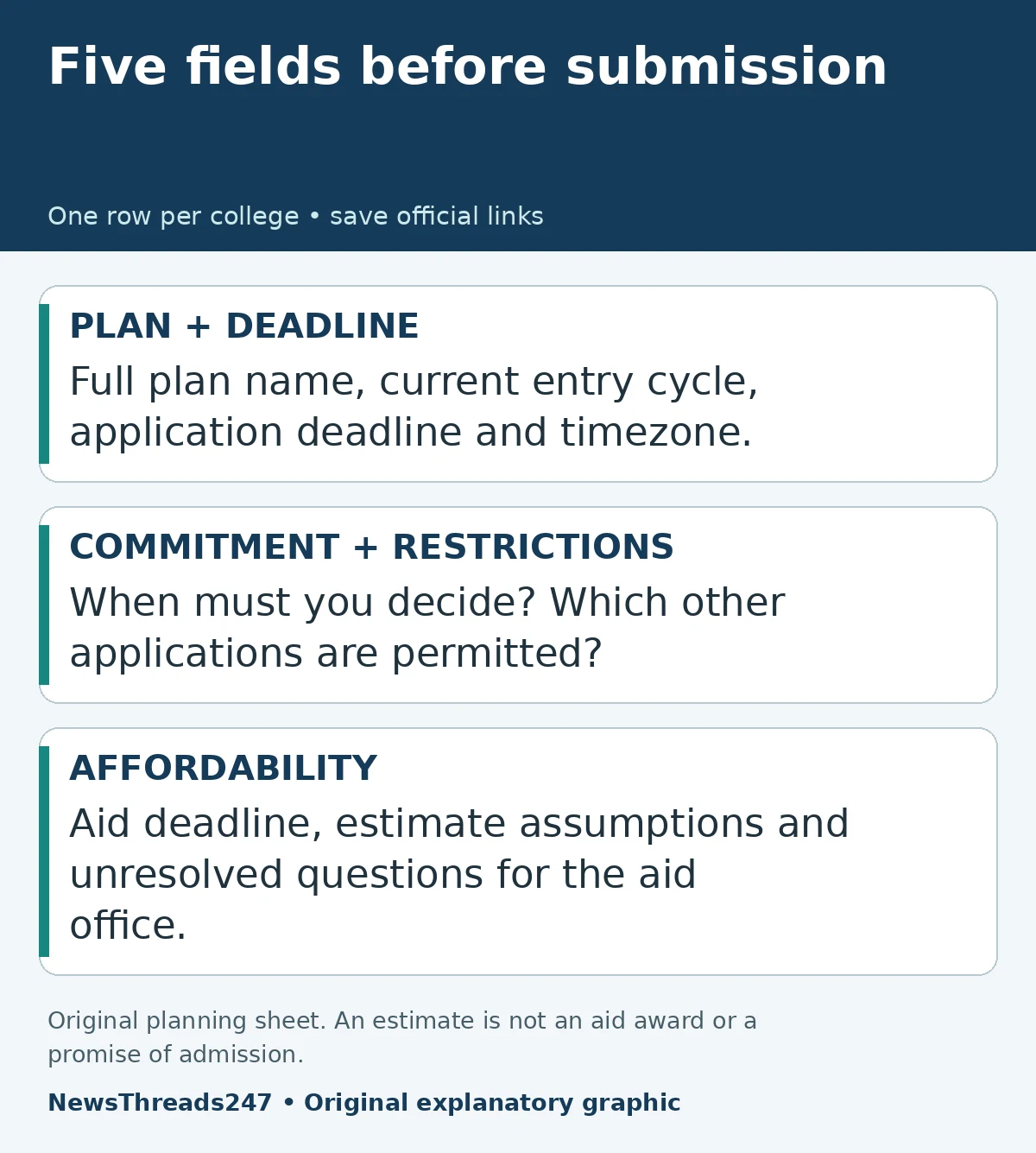
Before submission, write down the plan’s full name, the current-cycle deadline and timezone, the enrollment commitment, the restrictions on other applications and the aid deadline. Add one unresolved question and who will answer it. This makes the decision reviewable by the student, family and counselor without pretending that a generic checklist replaces a college’s policy.
Keep preparing permitted alternative applications while waiting. If the first college defers or denies the application, follow the decision letter’s instructions; do not assume that those outcomes have the same consequences. If an ED offer and adequate aid require withdrawing other applications, act under that agreement rather than waiting for additional offers to accumulate.
For the cost comparison itself, our US college net-price guide separates grants, loans and the expenses a quoted figure includes. Use it to organize the numbers, while the college supplies the actual offer.
Sources and visual credits
Checked October 27, 2026: the linked College Board guidance, Harvard first-year rules, Babson explainer and Common App guide. This is an application-planning explanation, not an admission prediction or individualized aid assessment. Examples and the decision sheet are original. Featured art is an AI-generated family planning scene, not a photograph of applicants or a university. Both explanatory graphics are original.