
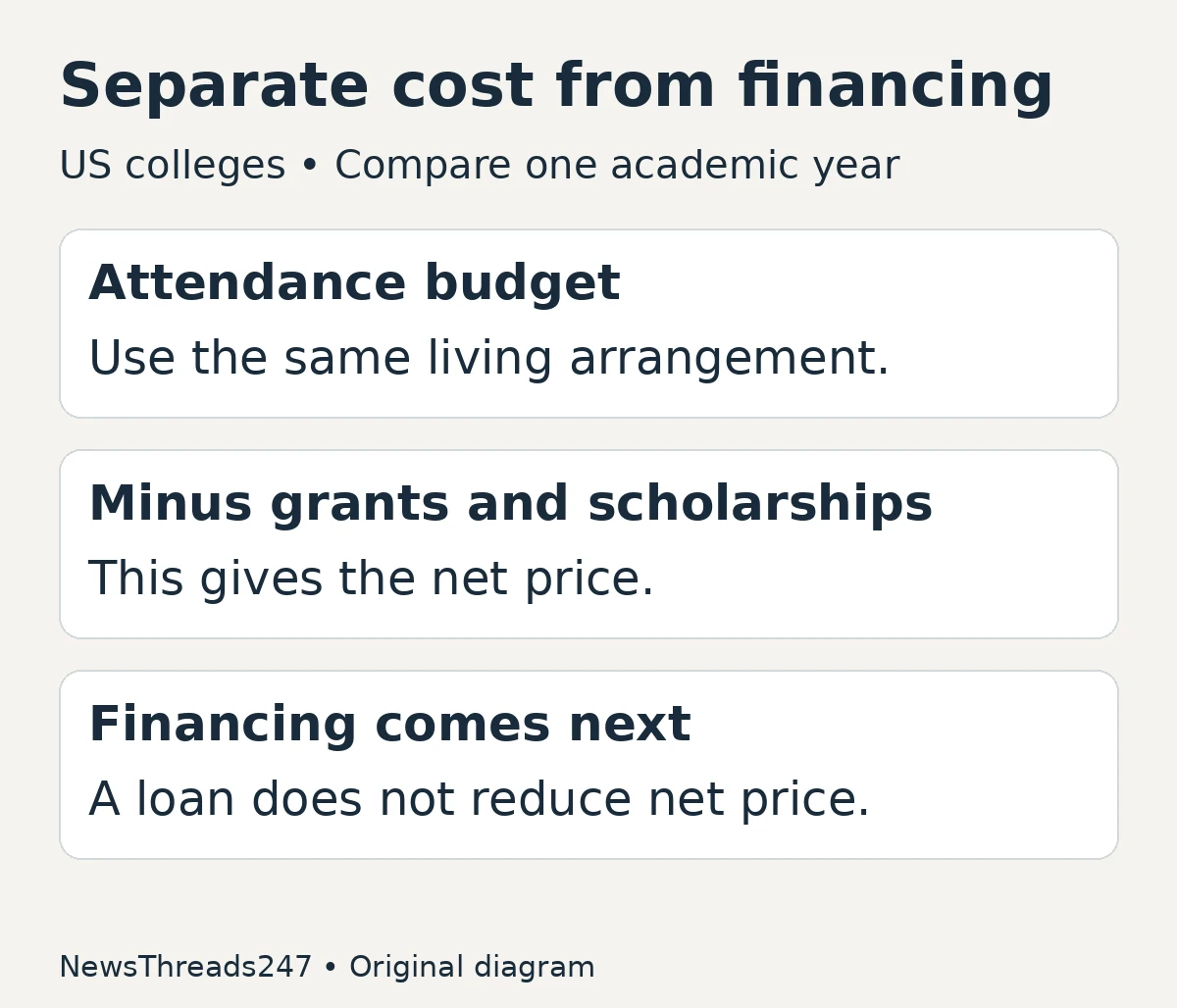
A college with the higher published price can still leave a student with a smaller amount to cover after grants and scholarships. The reverse is possible too. Before removing a US college from your shortlist, calculate comparable net prices rather than ranking tuition figures alone.
The US Department of Education’s Net Price Calculator Center defines annual net price as attendance cost after subtracting grants and scholarships. Borrowed money is a way of financing a cost; it does not make that cost disappear. Keep that distinction visible when a financial-aid offer lists several types of support together.
Start with one academic year and one living arrangement
A useful comparison needs matching boundaries. Record the academic year, whether you plan to live on campus, off campus or with family, and the programme you are considering. A tuition-only number beside a full attendance budget is not a like-for-like comparison.
USAGov’s college-cost guidance recommends checking costs beyond tuition, housing and food and points readers to College Navigator, College Scorecard and school net-price calculators. Use these tools for different questions: finding suitable institutions, comparing reported data and estimating a household-specific cost are related tasks, but they are not identical.
Create a list of the costs included in each school’s estimate. Then note expenses your circumstances add, such as travel home or a longer commute. Keep these additions explicit so you do not mistake a personal budget adjustment for a published university charge.
Subtract grants and scholarships before considering borrowing
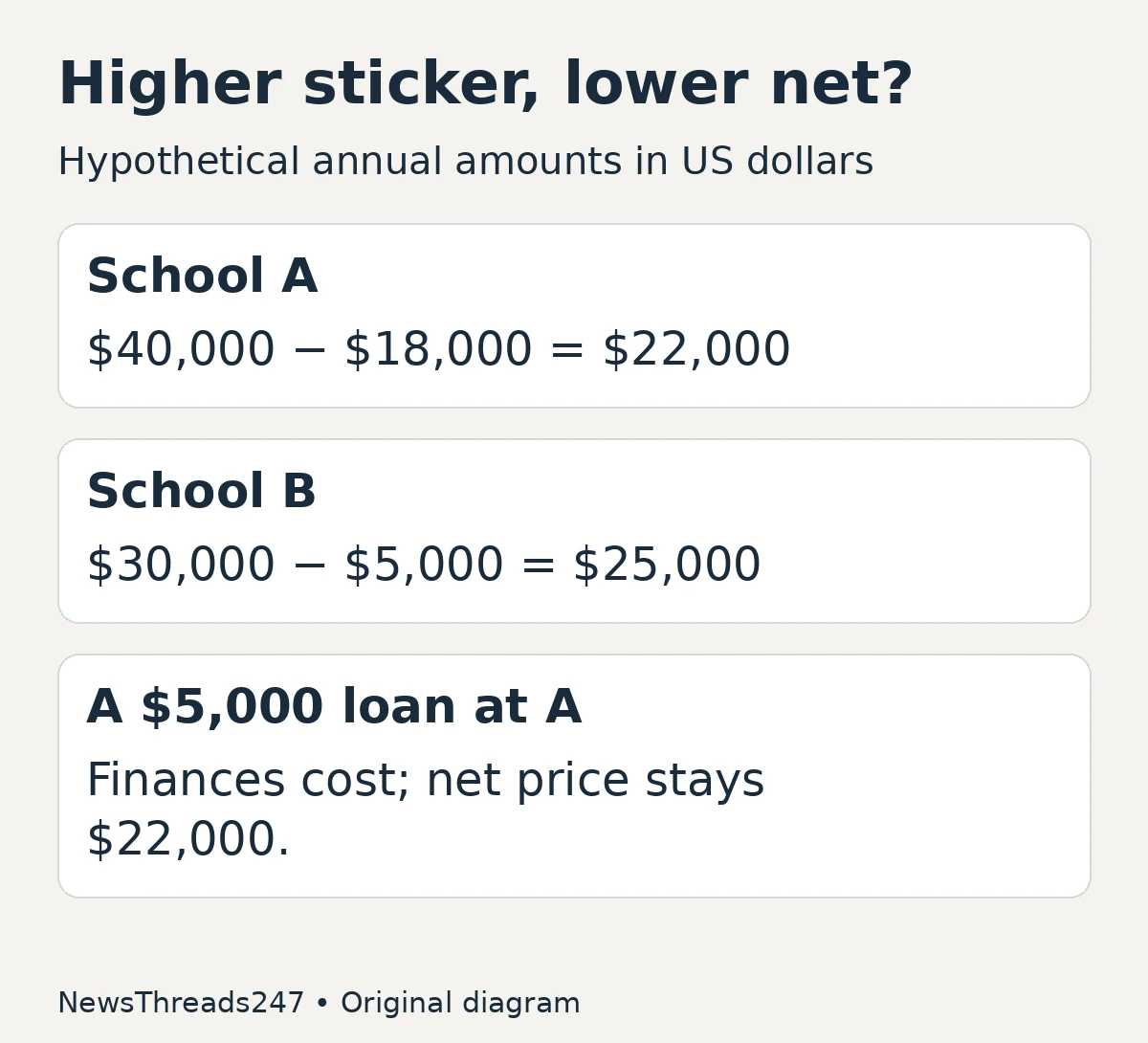
Here is a hypothetical annual comparison, not an offer from any college. School A has an attendance budget of $40,000 and grants or scholarships of $18,000: its net price is $22,000. School B has a $30,000 budget and $5,000 of those awards: its net price is $25,000. The higher sticker price produces the lower net price in this example.
If School A also offers a $5,000 loan, the net price in that example remains $22,000. Borrowing may help pay part of it, but it creates a separate repayment obligation. Do not describe the remaining $17,000 cash requirement as the full cost of attending while omitting the debt.
Similarly, distinguish an award from money that must be earned. The Federal Student Aid guide to evaluating offers separates money that need not be repaid, earned money and borrowed money. Read the conditions of each item rather than treating the offer’s grand total as a single discount.
Use a net-price calculator as an estimate
The Department of Education explains that school net-price calculators use information about the prospective student to show what similar students paid in the previous year after grant and scholarship aid. They are useful before applying, but that description is not a guarantee of your admission, award or final bill.
Use the calculator linked from the institution’s own site or the federal calculator directory. Save the date, inputs and result. If you change an input between schools, note the reason. A comparison becomes hard to interpret when one estimate assumes living with family and another assumes residence-hall costs.
Check the calculator’s scope before relying on it. An international applicant, transfer student or applicant to a particular programme should ask whether the tool represents that situation. Do not assume an estimate designed for one applicant group establishes another group’s aid eligibility.
An aid offer changes the evidence available
Once admitted and offered aid, replace provisional figures with the institution’s actual offer and current cost information. Federal Student Aid notes that offers have no standardised format and that an offer does not necessarily show every attendance-related expense. Read the amounts and types of aid carefully.
Ask which awards apply for one year, which may be renewed and what conditions govern renewal. Record the answer beside the award, rather than assuming the first year’s grant repeats unchanged through graduation. Also ask how a change in enrolment or living arrangements would affect the budget and aid.
If a figure is unclear, contact the financial-aid office using the school’s official contact details. A focused question—whether a particular award is renewable and under what conditions—is easier to resolve than asking whether the college is generally affordable. Save the written reply with the offer.
Make the comparison useful for a decision
Use separate rows for attendance budget, grants and scholarships, net price, available savings or contributions, borrowing considered, and unresolved costs. This keeps a lower immediate payment from being confused with a lower overall cost. It also makes disagreements within a family easier to discuss using the same figures.
Consider the full intended course of study, but label future-year numbers as planning assumptions. Do not multiply a first-year estimate and present the result as a guaranteed four-year bill. Tuition, living costs, awards and the time needed to complete a programme can change.
Cost is one decision, and educational suitability is another. Check whether the programme supports your intended qualification and career path; our US accreditation guide explains why institution and programme checks can differ. For a parent invited to help with a FAFSA form, our FAFSA contributor guide separates supplying information from becoming a borrower.
Sources and visual credits
References checked on 26 October 2026: Department of Education net-price definition and calculator directory, USAGov college-cost tools, and Federal Student Aid’s offer-comparison guide. Dollar figures are original hypothetical arithmetic, not college quotes or personalised financial advice. The campus illustration is AI-generated and represents no institution; diagrams are original NewsThreads247 explanatory graphics.