
A dealer offers a large saving on the outgoing car just as the updated version reaches the showroom. The useful question is not whether old stock is always a bargain. It is whether this particular car, at this final price, meets your needs better than the alternative you can actually buy.
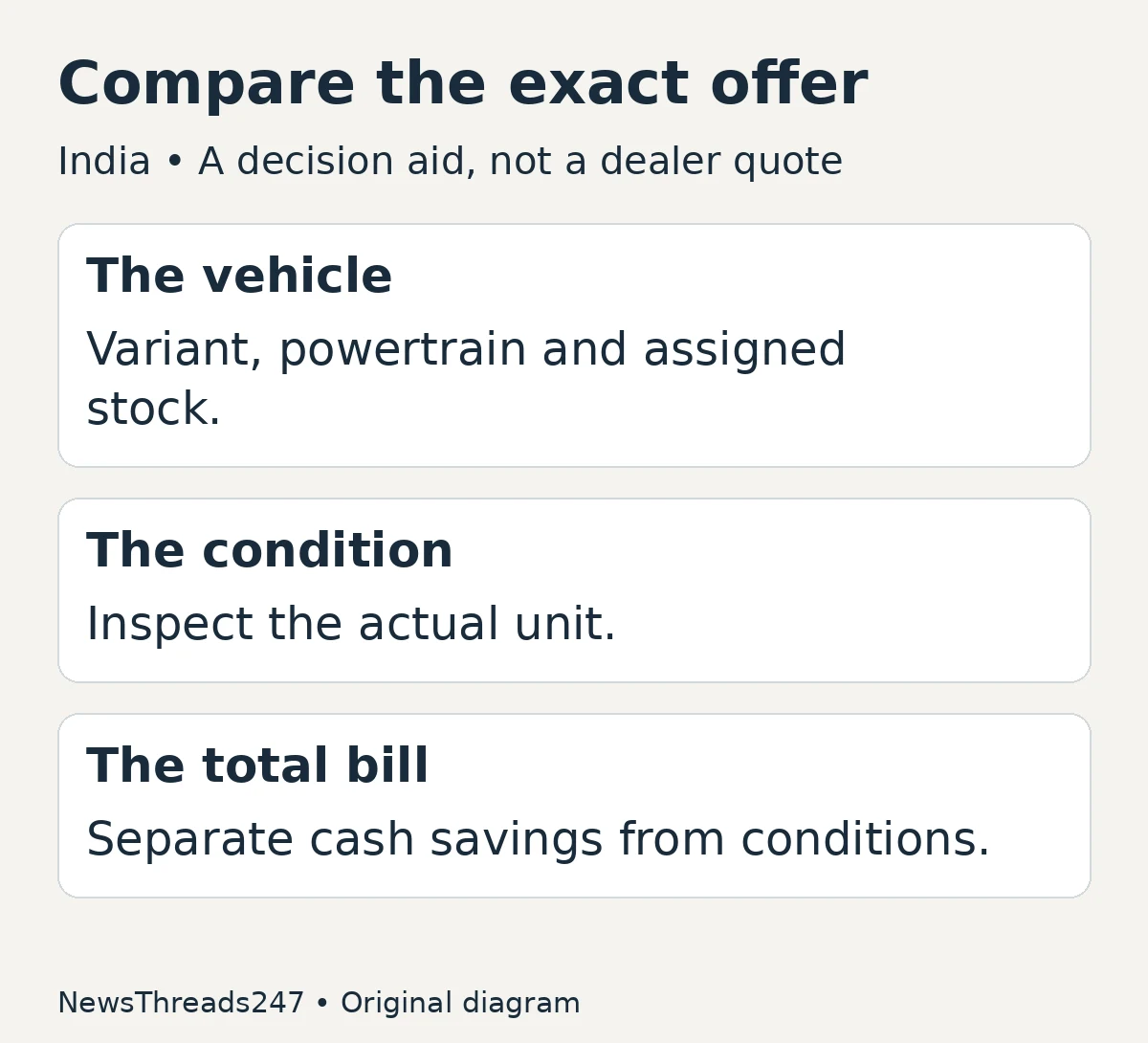
For buyers in India, compare the exact variant, engine, transmission and stock unit before comparing discounts. A facelift badge does not establish which features changed, and an offer advertised as total benefits may include conditions you do not meet. This is a buying framework, checked on 26 October 2026, rather than a report of a specific dealer’s offer or a test drive.
Put the two exact cars on the same sheet
Record the full variant name, powertrain, transmission, manufacture month and year, colour, quoted delivery date and whether the vehicle is unregistered stock, a demonstrator or previously registered. Ask the seller to identify the proposed unit rather than discussing an unspecified car that may be allocated later.
Then obtain the manufacturer’s equipment information for each version. Compare the safety equipment and the features you will use: seats, parking assistance, lights, connectivity, spare-wheel arrangements or charging capability where relevant. Mark every item as standard, optional or unavailable for the exact variant. Do not substitute the top variant’s brochure photograph for the equipment of the car being offered.
Separate a missing feature you can comfortably live without from a requirement that makes the car unsuitable. A discount cannot resolve inadequate seating or a powertrain that does not fit your routine. Conversely, a new design alone need not justify extra spending if the outgoing specification already meets your requirements. That is a personal purchase trade-off, not a universal verdict.
Compare the payable price, not a benefits banner
Ask both dealers for dated, itemised quotations for the same registration location. Keep the vehicle price, registration-related charges, insurance, accessories, service packages and financing items separate. Identify what is optional and ask for a revised quote without unwanted extras. Keep the written offer and its validity date.
Check whether each advertised benefit is a cash reduction, an exchange condition, a loyalty benefit or an accessory package. If you are not exchanging a car, a conditional exchange amount is not a saving available to you. An accessory bundle is also not automatically equivalent to cash you would otherwise spend.
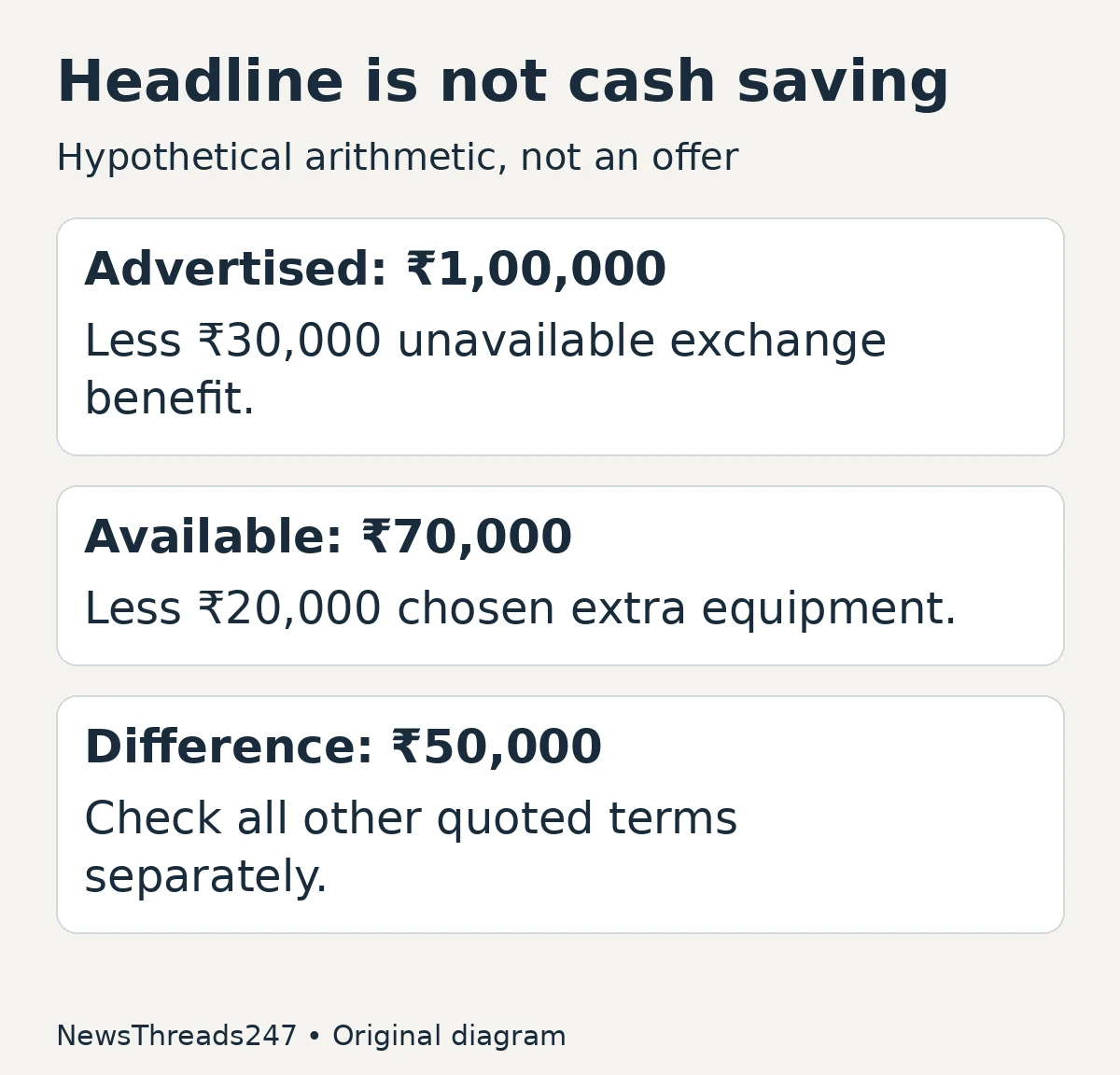
Consider a hypothetical comparison, not a market price: the outgoing car’s headline discount is ₹1,00,000, but ₹30,000 depends on an exchange you will not make. The available price reduction is then ₹70,000 before considering any other terms. If you choose ₹20,000 of additional equipment that is not included, the remaining difference is ₹50,000. Change the figures to the actual quotations; do not use this illustration as a dealer entitlement.
An older build date needs questions, not an automatic rejection
Inspect the actual vehicle before accepting delivery and ask how it has been stored and maintained. Check the body, cabin, displayed distance, warning messages and the condition of tyres and other visible items with qualified help where needed. Record defects and promised remedies in writing. A clean display car and the unit assigned to you may be different vehicles.
Ask what explains the displayed distance and whether the unit has been used for demonstrations or other purposes. If the seller’s description, documents and physical condition do not agree, resolve that discrepancy before treating the discount as the deciding factor. This guide does not provide a mechanical clearance or a way to diagnose hidden damage remotely.
Verify the warranty start and the parts it covers
A manufacture date and a warranty start date need not answer the same question. For example, Hyundai Motor India’s published warranty policy says its new-vehicle warranty begins on delivery to the first purchaser, subject to model-specific terms and exclusions. That is Hyundai’s policy, not a rule to assume for every manufacturer or a previously registered demonstrator.
For the car offered to you, obtain written confirmation of the warranty start, remaining cover, distance limits and servicing requirements. Ask separately about tyres, batteries and accessories: the same Hyundai policy identifies certain items as covered by their respective manufacturers. An extended warranty or service package also needs its own scope and exclusions.
Keep financing and future resale assumptions visible
If borrowing, compare the loan amount, tenure, total repayment, fees and conditions in the lender’s written documents. A lower vehicle price combined with a different financing arrangement cannot be assessed from the monthly instalment alone. Do not assume the dealer’s preferred financing is necessary for every quoted benefit; ask which conditions apply.
Treat future resale value as uncertain. Rather than inventing a guaranteed depreciation percentage, write down how long you expect to keep the vehicle and which current differences matter to you. A resale prediction should not conceal a feature compromise or an unexplained stock-history issue.
Before choosing, you should be able to explain the difference in one sentence: which exact car you are getting, what you give up or gain, and the actual price difference after conditions. For crash-test information, our Bharat NCAP guide explains why the tested variant’s applicability needs a separate check.
Reference and visual credits
Primary reference: Hyundai Motor India warranty policy, used only for the clearly identified warranty example. Other comparisons are original decision aids and hypothetical arithmetic, not manufacturer specifications, dealer quotes or resale guarantees. Featured illustration is AI-generated and represents no named model; explanatory graphics are original NewsThreads247 diagrams.