
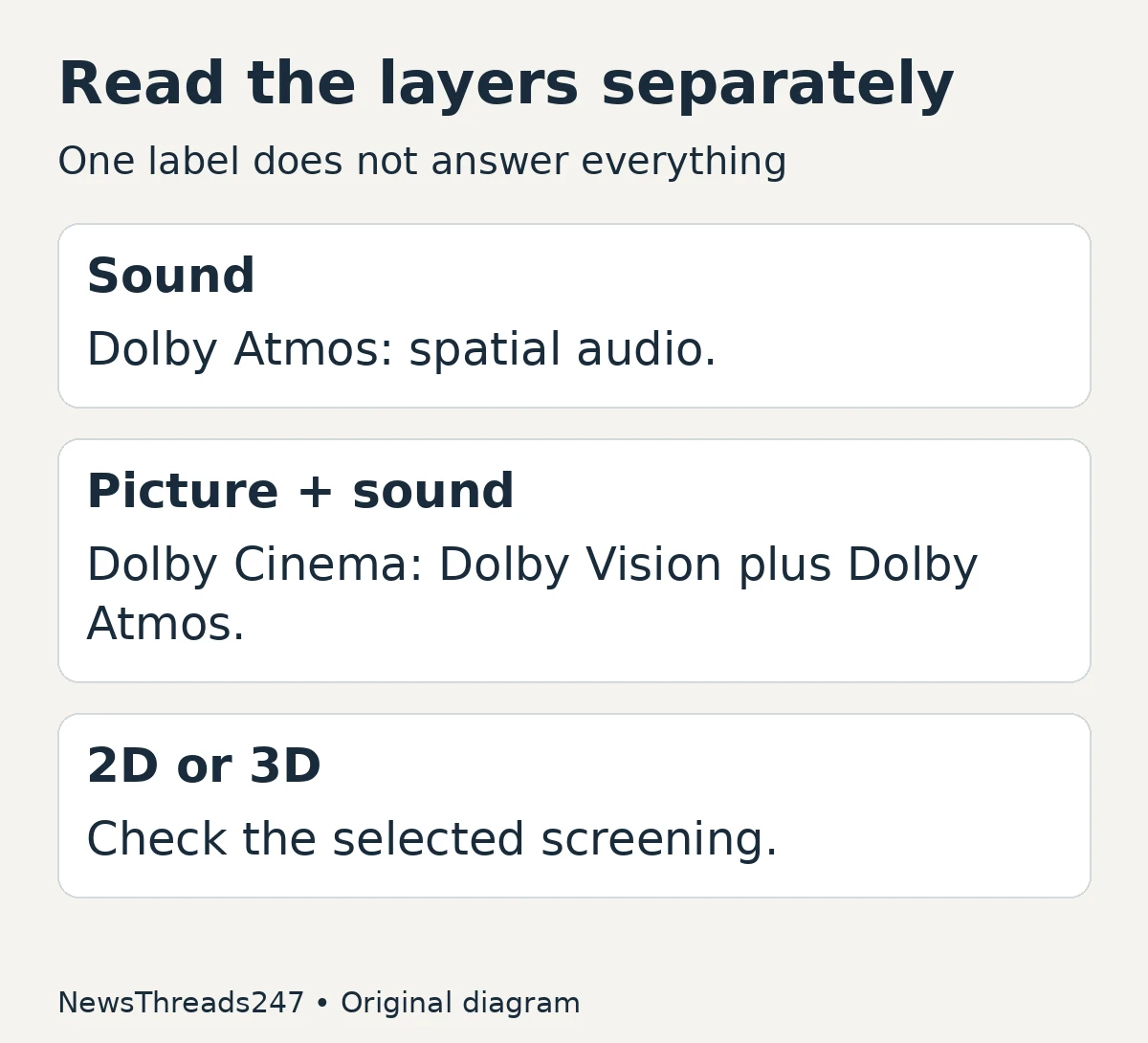
A cinema listing marked Dolby Atmos tells you about sound. It does not, by itself, tell you that you are booking Dolby Cinema, an IMAX presentation or a 3D show. Treating those labels as interchangeable can mean paying for a feature you did not actually select.
For moviegoers comparing tickets in India, the useful first step is to separate three things: the picture-and-sound presentation, the audio format, and whether the screening is 2D or 3D. The technologies are also used internationally, but a particular auditorium, language version and show must be checked locally. There is no universal winner for every film or viewer.
Dolby Atmos is an audio format
Dolby’s cinema-audio explanation describes Atmos using audio objects and overhead speakers. Instead of treating every sound only as part of a fixed channel, a soundtrack creator can place and move individual sounds through the cinema’s three-dimensional space. The cinema processor maps that information to the available speaker system.
That is a description of sound reproduction, not of screen size, projector resolution or whether you need 3D glasses. If your listing says Atmos, look elsewhere in the show details for those picture-related facts. Do not fill in missing specifications simply because the audio label is familiar.
It also helps to separate equipment capability from the film presentation. Ask whether the particular show is being presented with the stated audio format. A building can contain several auditoriums; the feature promoted for one room should not be assumed for every screen in that multiplex.
Dolby Cinema combines picture and sound
Dolby’s own Dolby Cinema description combines Dolby Vision imaging and Dolby Atmos sound. Its presentation page identifies a Dolby Vision dual-4K laser projection system and discusses both 2D and 3D films. Dolby Cinema therefore names a broader presentation than the Atmos audio label alone.
For a purchase decision, the exact wording matters. “Dolby Atmos” and “Dolby Cinema” are not two ways of writing the same specification. If you specifically want Dolby Cinema, confirm that designation for the venue and screening instead of treating an Atmos icon as proof.
Manufacturer descriptions explain the technology’s intended capabilities. They are not an independent review of the seat, film or auditorium you are considering. We have not tested the cinemas in this guide, and do not rank their brightness, loudness or comfort from a booking label.
IMAX is another presentation to verify at the auditorium
IMAX combines picture, sound and theatre design rather than simply naming a 3D effect. As a concrete example, IMAX Victoria’s own presentation guide describes its laser projection, sound and theatre geometry, and explicitly discusses both 2D and 3D. The Canadian venue’s specifications are evidence about that venue, not a specification sheet for an Indian IMAX screen.
The buying lesson is to ask a precise question. If you care about laser projection, the screen’s presentation capability or a particular release format, verify that detail with the actual cinema. A broad brand name does not establish every equipment detail you may have read about at another location.
Similarly, do not assume that every IMAX booking is 3D. Read the selected show’s 2D or 3D designation. That simple check can matter more to someone who prefers watching without 3D glasses than a general comparison declaring one premium brand superior.
Read two hypothetical listings without inventing missing features
Imagine one option reads “2D • Dolby Atmos” and another reads “IMAX • 3D”. These are illustrative descriptions, not current shows. The first establishes the stated 2D presentation and audio format; it does not establish Dolby Cinema. The second identifies the stated IMAX and 3D presentation; it does not establish Dolby Cinema or Dolby Atmos.
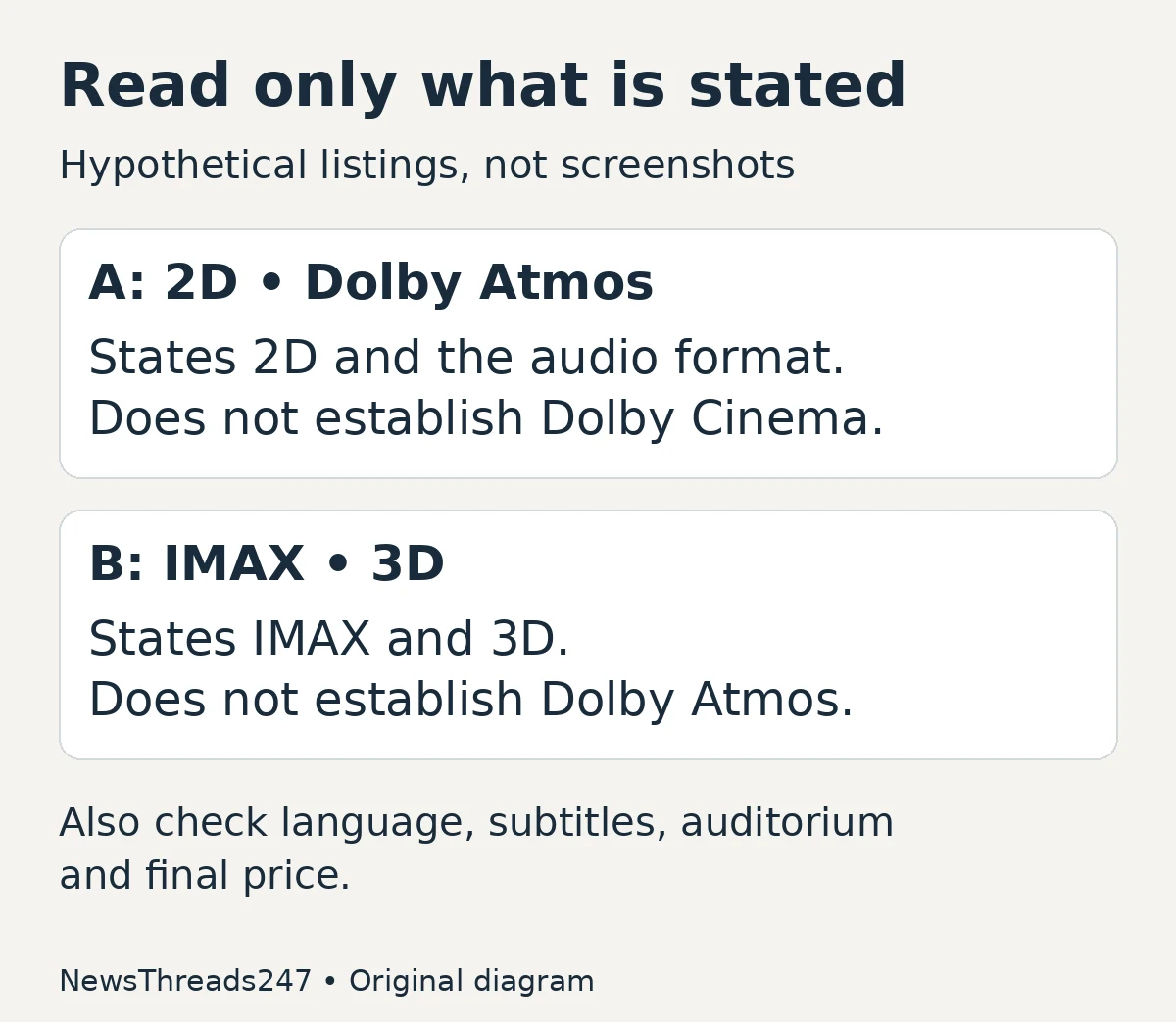
Neither abbreviated description tells you the language, subtitle availability, seats remaining or final bill. Complete those checks before comparing the surcharge. A technically attractive show in the wrong language or at an impractical time does not solve the viewing problem.
If the listing is ambiguous, save the exact show date, time and auditorium and ask the cinema to clarify. Asking “Is this show Dolby Cinema?” is more useful than asking whether the theatre “has Dolby”, because the latter can be answered with an audio feature while leaving the picture question unresolved.
Compare the extra cost against the feature you want
Make the comparison for the same film, date and language where possible. Note the final payable price, the seats you can actually select and the presentation feature you value. A cheaper front-row seat and a more expensive central seat introduce a seating difference as well as a format difference; do not attribute the whole choice to technology.
Whether a premium ticket is worthwhile depends on the feature you want and the actual alternatives. If your priority is the stated sound format, compare shows that identify it. If you want a particular picture presentation, verify that designation. If you prefer 2D, filter for that requirement first, then compare the remaining options.
Subtitles and access requirements deserve their own check. A premium picture or sound label does not answer whether the selected language version has the text or access provision you need. Ask about the exact show and any required device or arrangement, rather than inferring accessibility from premium branding.
Keep presentation and suitability separate
A screen-format label is not age guidance or a content warning. For a family outing in India, read the film classification and content information separately; our UA film-rating guide explains that decision. A larger screen cannot settle whether a film suits a particular child.
Before paying, check the cancellation terms too. Choosing a different presentation later may require a separate purchase; do not assume the original seats can be exchanged. Decide the film, language, presentation, time and seats together, then review the transaction conditions.
Sources and visual credits
Technical references: Dolby Atmos for cinema playback, Dolby Cinema, and IMAX Victoria’s venue-specific explanation, checked on 26 October 2026. The featured auditorium is an AI-generated conceptual illustration, not a real cinema or technical installation diagram. The two explanatory graphics are original NewsThreads247 diagrams; their example listings are hypothetical.