
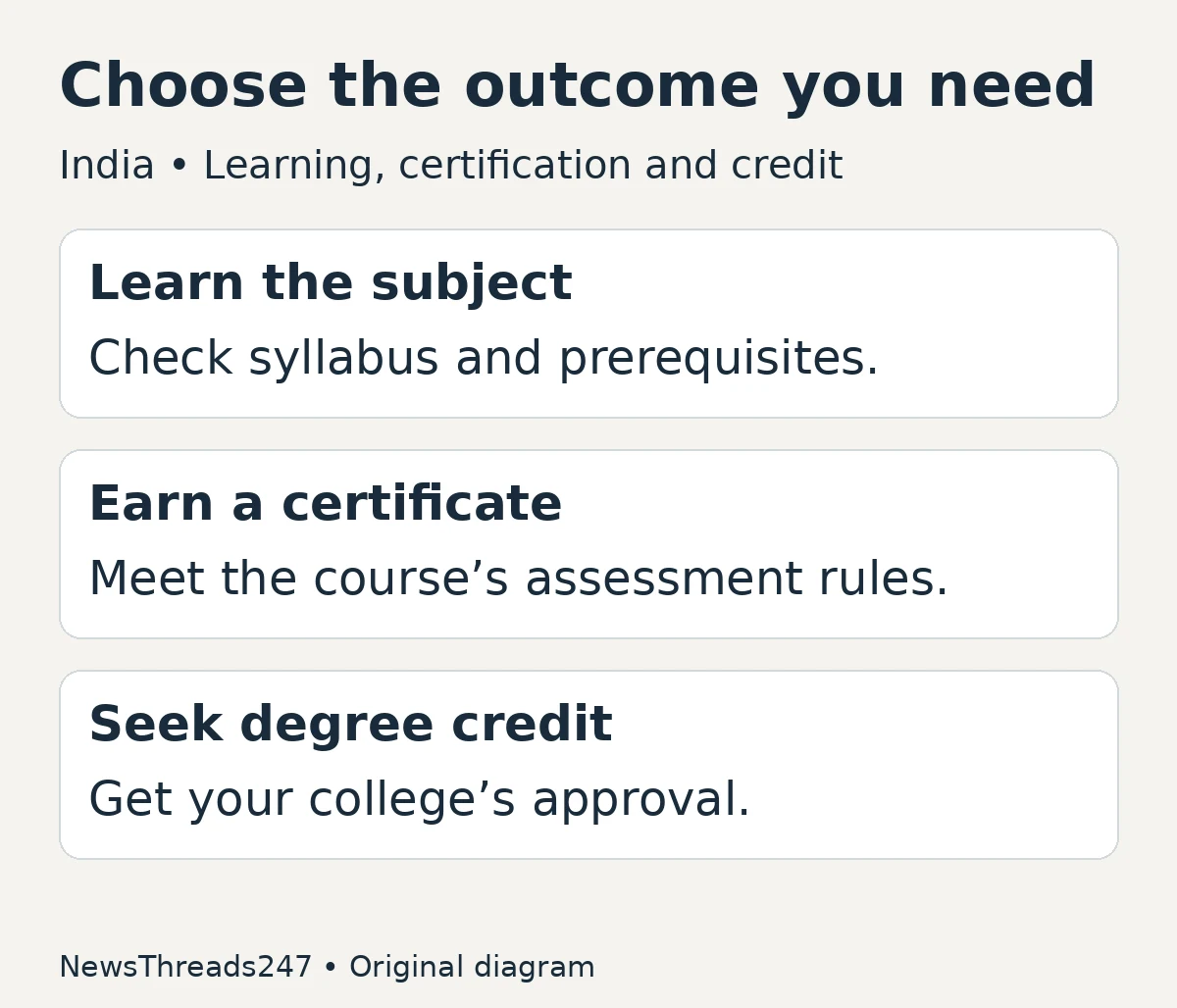
You can spend weeks completing an online course and still find that it does not replace a subject in your degree. On India’s SWAYAM platform, free access to learning, earning a certificate and obtaining college credit are separate outcomes. Decide which outcome you need before choosing a course.
SWAYAM’s official platform description says learning access is free, while learners seeking certification generally register for a fee-based final proctored examination. It also says certificates depend on the criteria published for the course and that approving colleges and universities can use the marks or certificate for credit transfer. These statements should not be compressed into “every free course automatically gives degree credit”.
Choose the outcome before choosing the course
If your aim is to understand a topic, begin with the syllabus, prerequisites, language and weekly workload. A useful learning experience need not be selected solely for a certificate. Read the material and assessment arrangements to decide whether the teaching fits the gap you want to address.
If you need a certificate, check the precise completion criteria and examination arrangements. If you need a subject counted towards a degree, contact your college before treating the online course as a replacement. Those choices can lead to different courses even when their titles look similar.
Write your objective in concrete terms: “learn this topic”, “meet this certificate requirement”, or “seek approval to replace this named course”. A vague goal such as collecting credits can conceal the fact that no receiving department has approved what you plan to take.
Free course access is not the same as free certification
The official FAQ distinguishes learning access from the proctored examination used for certification. It warns that arrangements may vary by national coordinator and semester and directs learners to the relevant course page. Use that page for the current fee and requirements; do not carry a fee or deadline from another course into yours.
Record the course title, coordinator, semester, enrolment status, examination-registration deadline, assessment components and certificate conditions. Keep enrolment and examination registration as separate checks. Access to videos does not by itself prove that you have registered for the required examination.
Budget for the practical arrangements too. If an examination requires attendance at a designated centre, check where you can attend and whether the date conflicts with college examinations or work. Use the specific course’s instructions rather than assuming that every online course is assessed from home.
Ask your college what it will recognise
For academic credit, send the relevant department or authorised coordinator the course link, syllabus, credit information, semester and proposed equivalent subject. Ask whether it is approved for your programme and batch and what result or documents must be submitted. Keep the response in writing.
The UGC’s published regulations compendium describes SWAYAM-based online credit courses and certificates issued with grades after the end-term proctored examination. That framework does not let a learner choose a replacement subject without the institution’s applicable approval process.
A similar title is not enough for a meaningful equivalence decision. The receiving institution may need to compare content, level, credits and the role of the course in the programme. Ask what is accepted before spending a semester on an assumption; do not substitute a friend’s experience in another college for your own approval.
Three learners can use the same course differently
Consider three hypothetical students. One wants a clearer explanation of a subject and uses the learning material. Another needs a certificate and plans around the published assessment requirements. A third wants academic recognition and first obtains the college’s decision on the course and required result. Their use of the same platform does not mean their outcomes are interchangeable.
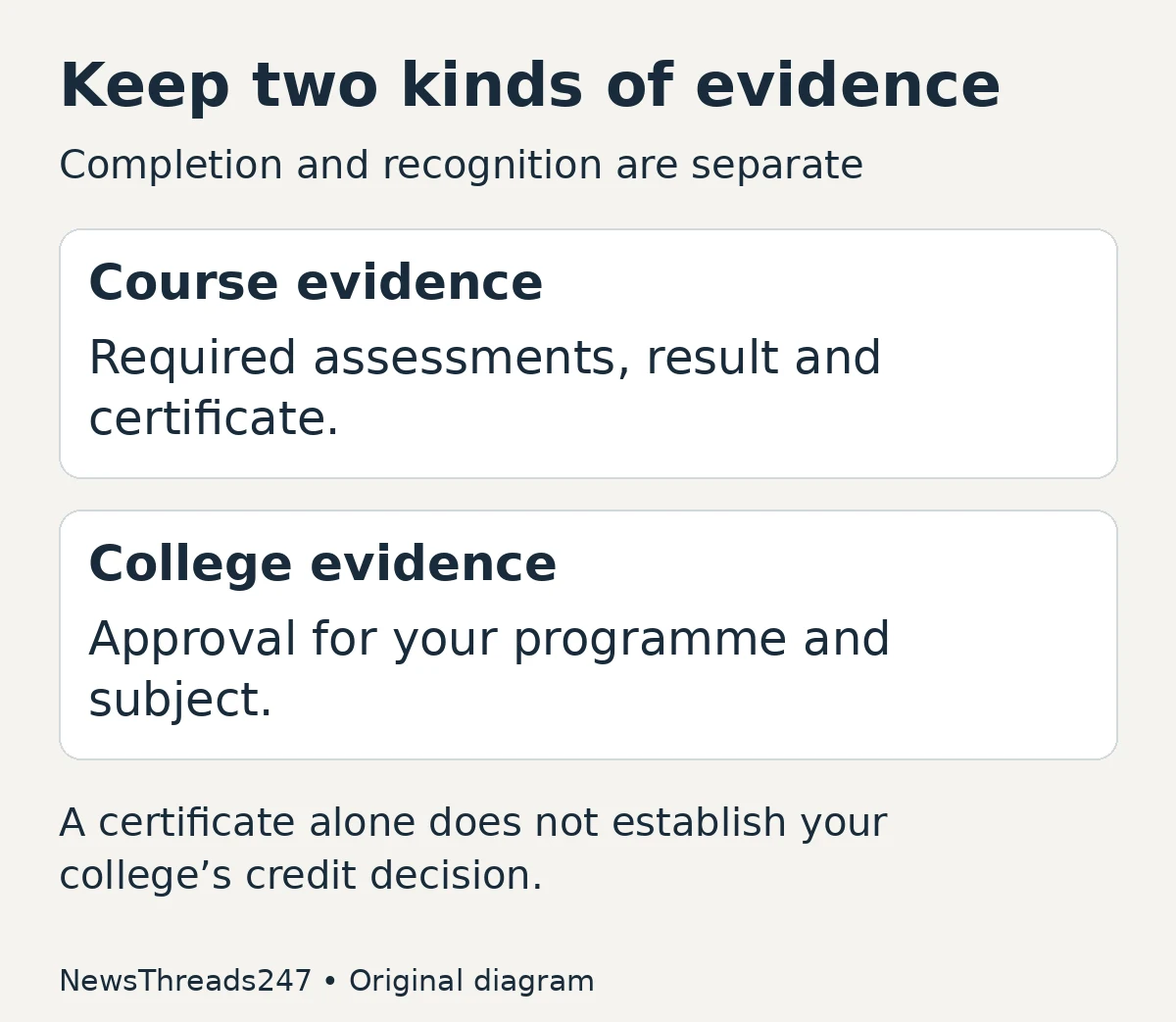
For the third student, a useful record has two parts: evidence of meeting the course’s requirements and evidence that the receiving institution accepts it for the intended purpose. A completion document answers the first question; the institution’s academic decision answers the second.
Keep a short record from enrolment to recognition
Save the official course page and instructions, your enrolment details, any examination registration and payment confirmation, assessment records, result and certificate when issued. For degree credit, add the institution’s approval and its instructions for submission. Use official support routes if a record or result is missing.
If your plans change, check what remains possible under the current course instructions. Do not assume that watching archived material opens a past examination-registration window or that a later course run has the same assessment conditions. Distinguish a useful learning resource from an active certification opportunity.
When reporting the course on an application, describe what you actually completed. Course participation, an earned certificate and recognised degree credit should not be presented as the same qualification. If an employer or another institution requires a particular credential, verify its acceptance with that organisation.
Where this fits with other education records
This guide concerns choosing and completing a SWAYAM course. It is separate from checking whether a full online degree is recognised. For that decision, read our UGC online-degree verification guide. Our ABC and APAAR guide explains the different role of student identifiers and credit records.
Sources and visual credits
Primary references checked on 26 October 2026: SWAYAM platform description, official FAQ and UGC regulations compendium. This is a course-selection guide, not an examination notification or a promise of credit approval. The study illustration is AI-generated, not a SWAYAM interface or an awarded qualification. Diagrams are original NewsThreads247 explanatory graphics.