
A college application fee should not be confused with tuition, an enrollment deposit or a financial aid application charge. For first-year students applying to US colleges through Common App this fall, a fee waiver addresses the application fee. It does not award a place, a scholarship or a promise to cover the cost of attendance.
The useful question is not simply “Did I click the waiver box?” It is whether you used the right process, supplied the required confirmation and checked the receiving college’s record. Those can be different stages, especially near an admissions deadline. Treat them separately so a request does not get mistaken for a completed file.
Start with the fee for the actual application
Common App’s application-fee resource explains that colleges choose whether to charge and how much. It points applicants to College Search, College Information under My Colleges and the requirements grid. Check the relevant applicant category; domestic and international amounts may be listed separately.
Make a row for each college and record the application platform, the fee shown, the waiver route and the deadline. Do not multiply the fee from one college across the whole list. Some may charge no application fee, while others use a different amount or an institutional process. An old screenshot or a friend’s application is not a current fee schedule for you.
Check before paying. If the fee is a hardship, review the waiver instructions while there is still time to ask questions. This is not a recommendation to miss a deadline while waiting for a reply; it is a reason to identify the applicable submission rule early and retain the office’s guidance.
What the Common App request does
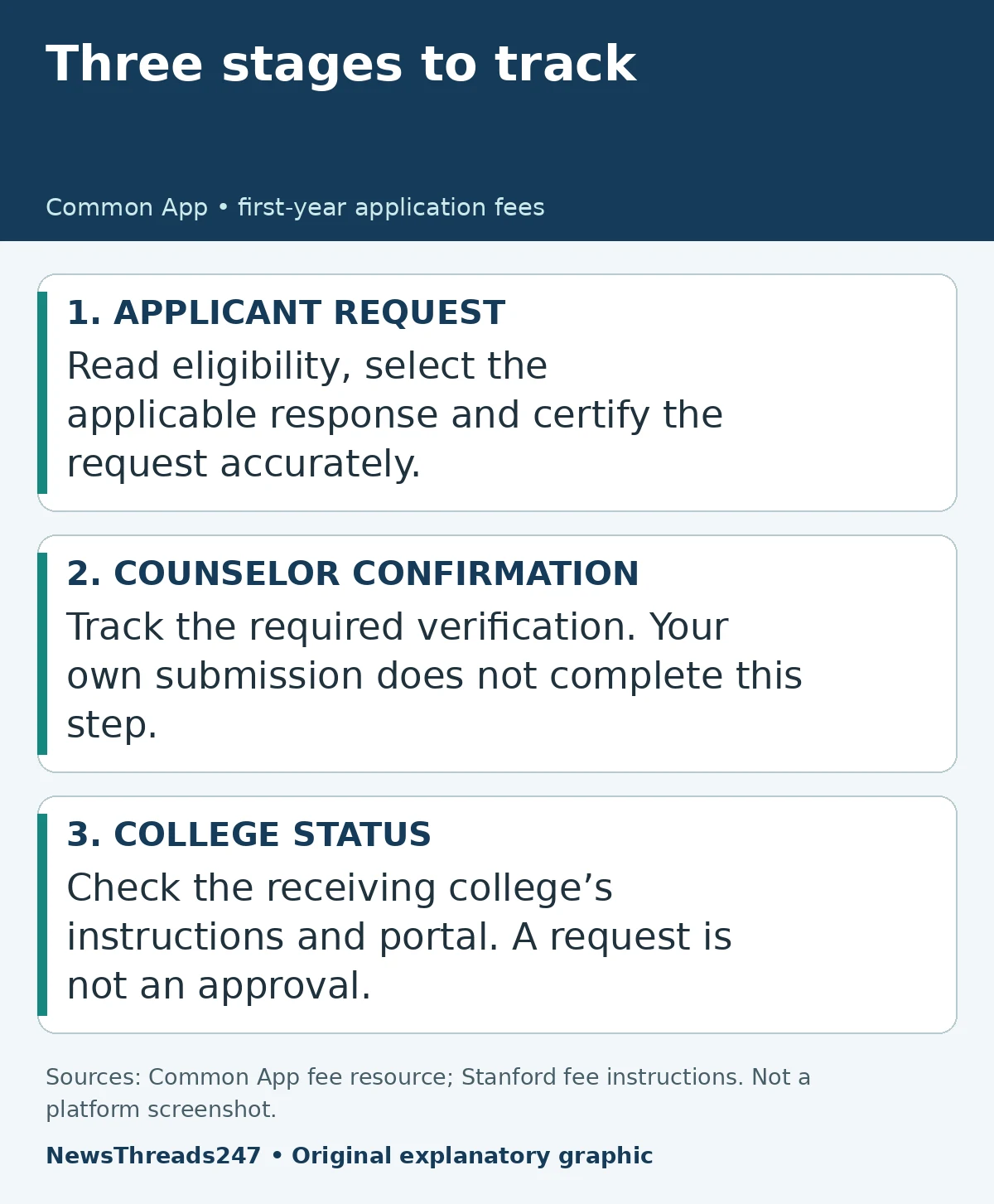
The official resource places the Common App Fee Waiver in the Profile section of My Common Application. An eligible applicant answers the waiver statement and signs to certify the request. The counselor is then asked to confirm eligibility. Common App says an application can be submitted without paying while that confirmation is pending.
Read the current eligibility statements before certifying anything. This guide does not supply a universal household-income cutoff or determine that you qualify. If your financial circumstances do not fit an obvious category, ask your counselor or the college which documented route applies. Do not select an inaccurate statement to move past a payment screen.
Common App’s first-year guide also distinguishes its counselor-confirmed waiver from a college-specific waiver. A form or code issued by one institution should not be assumed to cover every school on your list. Keep the exact route beside the college’s name.
Request sent is not the same as confirmation completed
A useful way to track the process is with three separate entries: applicant request, counselor confirmation and college status. Record when you completed your own part; ask whether the counselor’s part has been submitted; then follow the college’s portal instructions. A missing check mark needs investigation, not an assumption that the waiver has been rejected.
Imagine an applicant with three fictional entries. College A has no fee, College B has a Common App request awaiting counselor confirmation, and College C has an institutional waiver request under review. All three might appear on the same application list, but they require different next actions. A needs no invented waiver request; B needs the required confirmation; C needs its own status check.
The same distinction helps when a deadline is close. Write down the date and time of your submission and retain the confirmation. A deadline for the applicant’s form may differ from a rule governing school documents or processing. Check the actual college’s wording rather than treating a general platform explanation as an extension of every deadline.
Two current college examples show why details matter
Stanford’s first-year fee page, updated September 11, 2026, lists a $100 nonrefundable fee or a waiver request. It accepts the Common App waiver for eligible US and non-US applicants and requires counselor/school-official verification online or its described NACAC-form route. It says applicants need not wait for approval before submitting.
Stanford also explains its portal checklist: a green check records payment, while a gray check records an approved waiver. Its instructions identify steps for a remaining red X. That is a Stanford-specific status explanation, not a color key for every university. Use the receiving institution’s own checklist definitions.
The University of Central Florida’s current FAQ lists a $30 fee and separates Common App applicants from people using its institutional application. For the latter it identifies acceptable documentation uploaded with the application. A route that works inside Common App therefore should not simply be copied into a different platform.
These are dated examples of published procedures, not recommendations to choose either college. Before acting, reopen the college’s current fee page and confirm the rules for your applicant type and entry term. A first-year guide should not be applied automatically to a transfer or graduate application.
If you need another route
NACAC provides a first-time undergraduate application fee-waiver form for applicants with financial need. Its instructions call for an authorized official to verify economic eligibility and direct the completed form to the college using the method that institution accepts. The college decides whether to approve the request; NACAC’s form is not an automatic entitlement.
Ask about acceptance before sending it. NACAC’s instructions discuss one form per institution and a maximum of four universities, while its FAQ recommends limiting use to four and discussing additional requests with the authorizing official. Follow the current instructions with that official rather than treating the form as an unlimited platform waiver.
International applicants should check each institution’s policy explicitly. Stanford’s stated acceptance for eligible non-US students does not establish another college’s rule. NACAC explains an international request route based on economic need, but approval remains with the institution. A general statement that “international students get no waivers” is no more reliable than a promise that every college grants one.
Keep the record useful and private
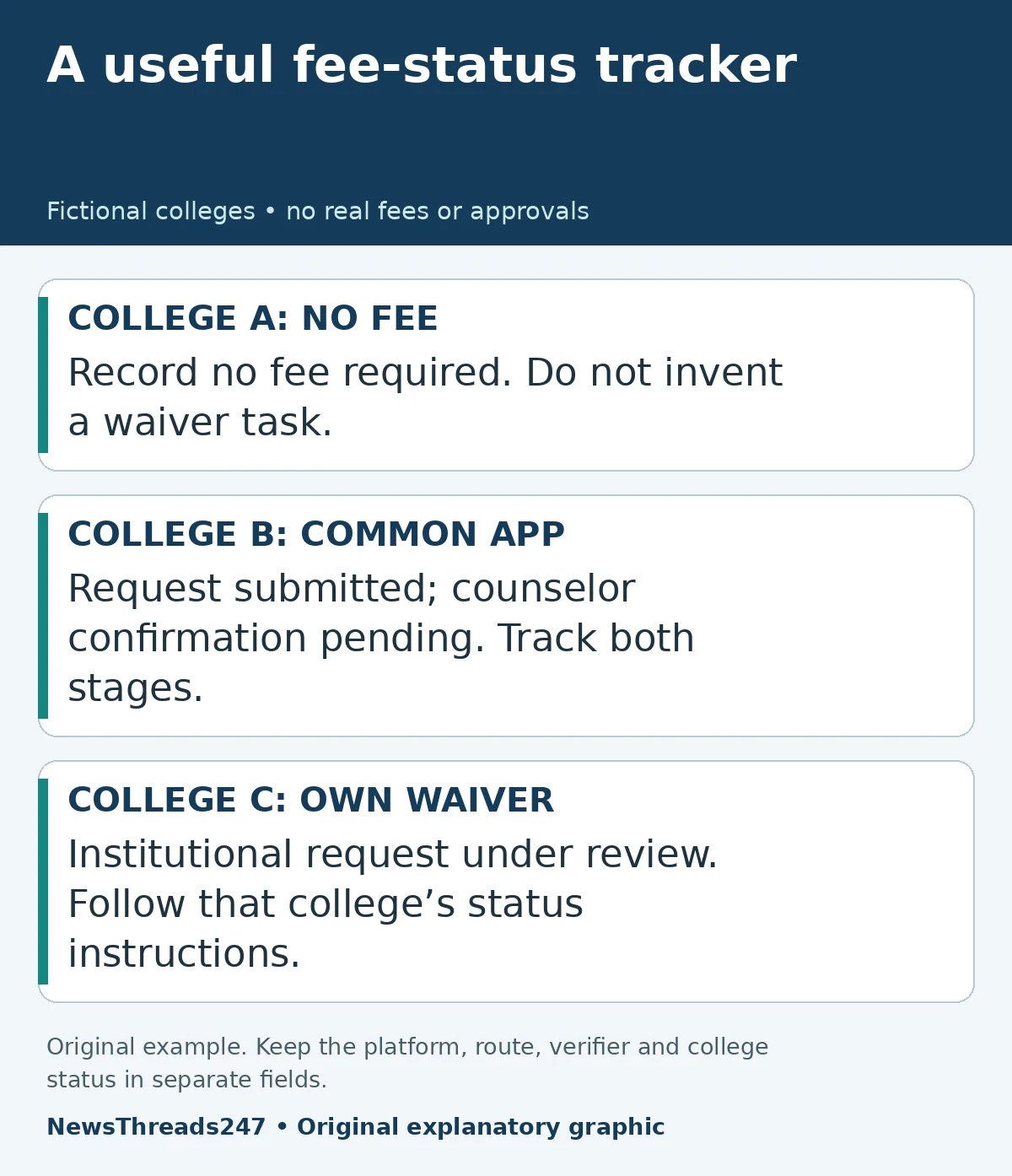
Use a simple tracker with college, platform, fee/waiver route, applicant submission date, required verifier and college status. In a shared planning sheet, record the status and a secure reference rather than copying tax records, identification numbers or detailed household finances. Send sensitive supporting documents only through the institution’s specified channel.
If the portal still shows a fee problem, ask a focused question: which document or confirmation is missing, who must submit it, and by when? Include the application identifier through the college’s official contact route. Do not send passwords or pay an unofficial person for a purported approval code.
After resolving the application fee, continue the separate aid and admissions checklists. A waived fee does not submit financial aid forms, complete recommendations or change the academic requirements. The result to verify is narrower and concrete: the college has the required fee or an accepted waiver, and no unresolved fee item is holding up the file.
For a separate question about aid forms, our FAFSA contributor guide explains why an invitation to contribute information is different from becoming a borrower. Keep that task separate from the admissions application fee.
Sources and visual credits
Official references checked October 27, 2026: Common App’s first-year and fee resources, Stanford’s fee instructions, UCF’s FAQ and NACAC’s first-time applicant guidance. Their procedures can differ; no eligibility or approval is guaranteed here. The three-college example and tracker are original. Featured art is an AI-generated conceptual counseling scene; the two explanatory graphics are original and are not application screenshots.