
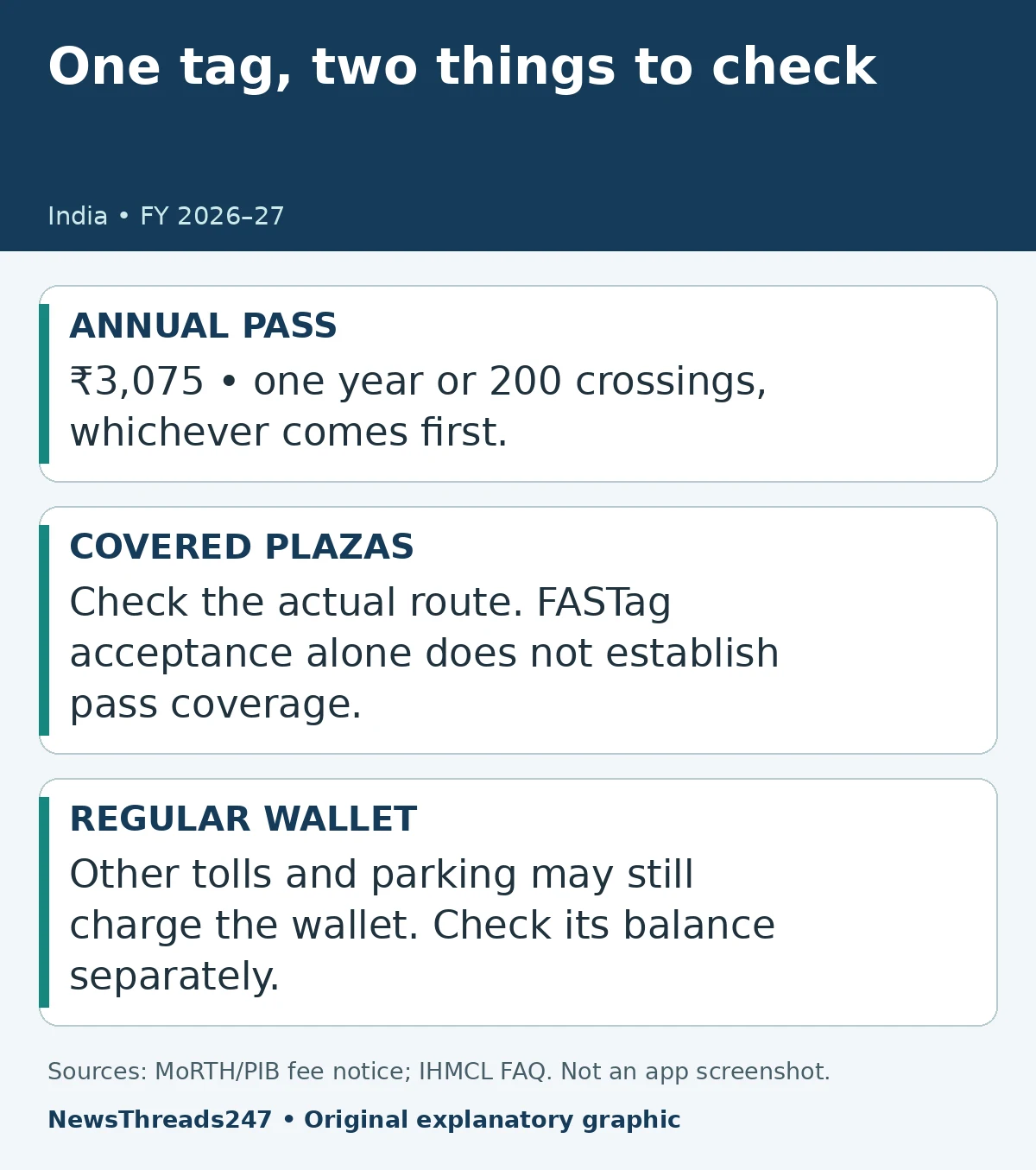
India’s FASTag Annual Pass is not unlimited toll travel on every road. At the FY 2026–27 price of ₹3,075, the useful buying question is how much eligible toll spending it will replace before either its one-year validity or its 200-crossing allowance ends.
NHAI reported on 28 September 2026 that passes issued had crossed one crore. That is evidence of uptake, not proof that the pass saves every motorist money. A family taking a few long journeys and a commuter crossing several plazas daily can reach very different conclusions.
Use the current price, then check the vehicle
The 15 March 2026 government announcement raised the fee from ₹3,000 to ₹3,075 from 1 April 2026. The older ₹3,000 figure belongs to the launch financial year. Check the amount displayed through the official purchase route before paying; a saved screenshot is not a current quotation.
The IHMCL Annual Pass FAQ specifies private, non-commercial cars, jeeps and vans. It requires an eligible, functional FASTag affixed to that vehicle’s windscreen and linked to its registration number. A tag registered only against a chassis number needs its vehicle registration number updated first. The pass cannot be transferred to another vehicle.
Start with those records before calculating savings. If a newly delivered car still has temporary paperwork in the tag account, resolve the registration linkage through the issuer. Paying for a travel product and correcting the vehicle identity are separate jobs; one should not be assumed to fix the other.
Draw the route before counting the savings
The pass applies at designated National Highway and National Expressway fee plazas. The FAQ distinguishes state-government or local-body roads and parking, where ordinary FASTag charges may still apply. A lane accepting FASTag is not, by itself, proof that this annual pass covers that location.
Make a short route sheet with the plaza name, whether it is covered, the charge you would otherwise pay and the expected number of crossings. Confirm coverage through the official Rajmargyatra service. Check each plaza on a mixed route instead of classifying the whole journey from the word “expressway” in its name.
For example, imagine a journey that includes two covered point-based plazas and one uncovered charge. Keep the uncovered charge outside the pass-savings column. You would still incur it after buying the pass. Counting it as a saving would make the purchase look more attractive without changing your actual bill.
A trip is not necessarily a day out
For point-based tolling, the FAQ counts each plaza crossing as one trip; returning through it counts again. For closed tolling, one entry-and-exit pair counts as one trip. Those are different counting arrangements. Use the rule for the road you actually travel.
Consider a hypothetical route with three covered point-based plazas in each direction. One return journey uses six crossings, not one. Thirty such return journeys use 180. Three more take the total to 198, leaving two crossings. A fourth complete return journey cannot fit inside that remaining allowance.
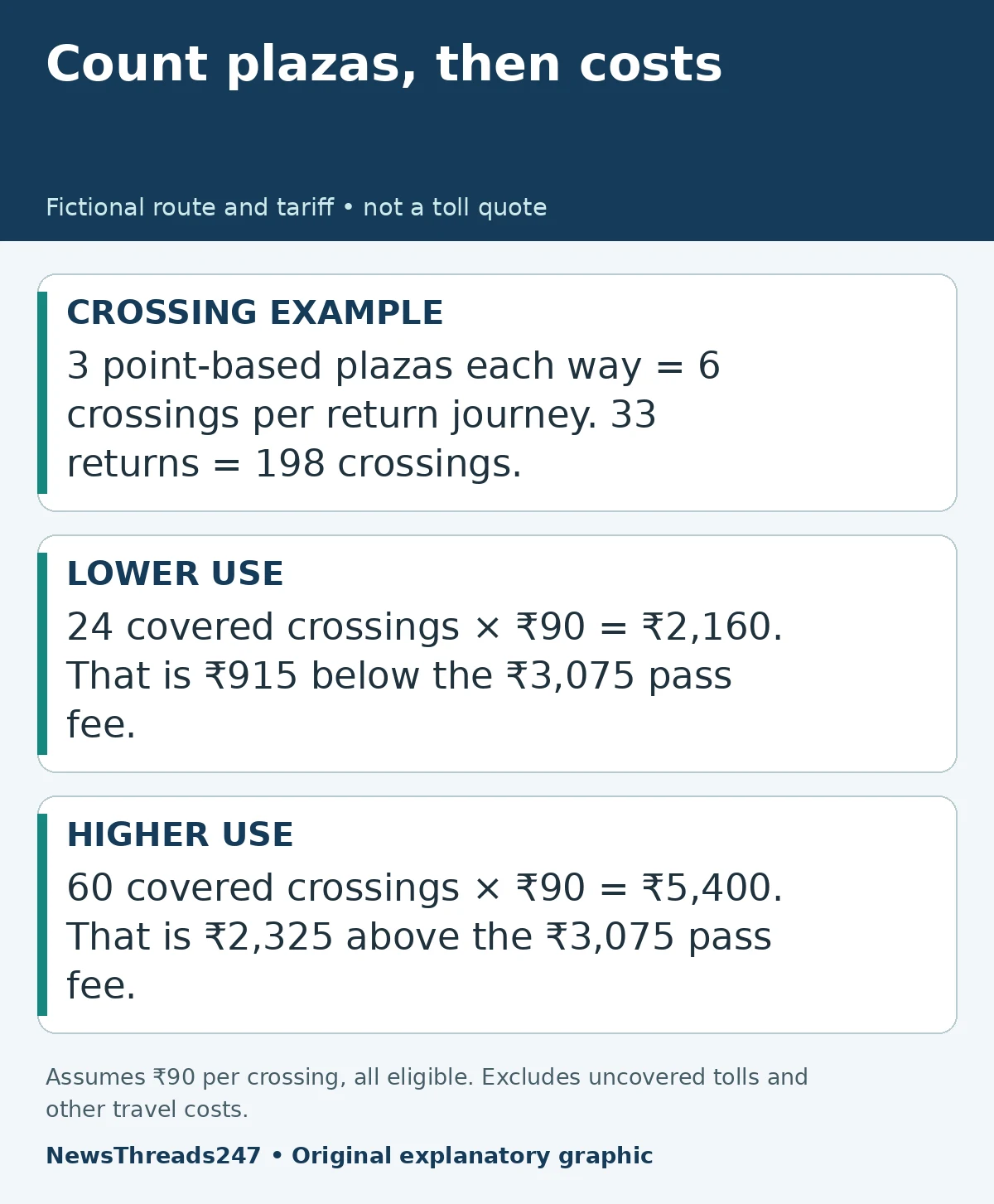
This is a counting example, not a named route or a toll quote. Its purpose is to expose a common planning error: writing “one trip” in a diary when the pass records several plaza crossings. If you mix point-based and closed systems, keep separate rows and add the applicable units.
Calculate value from the tolls you would really replace
For a first estimate, add only the eligible charges expected before the pass reaches either limit. Compare that total with ₹3,075. Use current plaza-specific tariffs and your actual travel pattern, including any existing concession that affects what you would otherwise pay.
Here are two fictional examples using an ordinary eligible charge of ₹90 per crossing. At 24 crossings, the replaced spending would be 24 × ₹90 = ₹2,160: ₹915 less than the pass price. At 60 crossings, it would be ₹5,400: ₹2,325 more than the pass price. These figures illustrate the method; ₹90 is not a claim about any real plaza.
With that same fixed ₹90 assumption, ₹3,075 ÷ ₹90 = 34.17. You would need 35 crossings for the replaced total to exceed the fee. Real routes can contain different tariffs, so adding the charges is more reliable than applying this one-number shortcut.
Do not divide the fee by 200 and call that your actual cost per use unless you expect to use all 200 covered crossings. The result, ₹15.375, describes full use of the allowance. At 60 uses, the pass fee alone works out to ₹51.25 per use. Neither figure includes uncovered tolls, fuel or other journey costs.
Keep the pass and wallet separate
The FAQ says the pass reverts to regular FASTag operation after one year or 200 trips, whichever comes first. Benefits continuing for a year therefore do not mean that 200 crossings renew each month. Check the remaining count as well as the activation anniversary.
Keep a usable regular wallet for charges outside the pass and for travel after expiry. A pass payment is not evidence that the ordinary wallet has been topped up. Before leaving, check both the pass status and the issuer’s balance/status information rather than relying on a payment receipt alone.
If a covered crossing appears to deduct money unexpectedly, retain the plaza, date, time, transaction reference, pass status and remaining-count record. Check whether activation had completed, whether coverage applies and whether a limit had expired. Use the official support route shown in the app and your FASTag issuer’s dispute channel; avoid paying an unofficial “reactivation” agent.
Buy only after the comparison is complete
The official purchase routes are Rajmargyatra and NHAI’s website. The FAQ describes activation as normally taking up to two hours after successful verification and payment. Confirm that it shows active before treating your next crossing as covered. This guide does not promise activation at an exact minute or resolution of a dispute within a fixed period.
A final check needs just four answers: is the vehicle eligible, are the relevant plazas covered, how quickly will crossings be consumed, and do the charges replaced justify the current fee? If any answer is missing, finish that check before buying. Popularity cannot substitute for your route calculation.
For an electric-car journey, keep charging stops separate from toll coverage. Our EV charging-power guide explains why a charger’s headline rating alone does not establish the time needed at a stop.
Sources and visual credits
Checked for this article on 27 October 2026: the linked MoRTH/PIB fee announcement, September uptake release, IHMCL FAQ and official Rajmargyatra route. The FAQ retains its base-year ₹3,000 amount; the dated 2026 announcement supplies the current fee. All worked routes and ₹90 tariffs are fictional. Featured artwork is an AI-generated concept, not a photograph of an actual plaza; both diagrams are original editorial graphics.