
CAT 2026 candidates have a useful preparation window before their admit cards are due: organise the records needed to check the card, make sure account access is available, and postpone precise test-centre arrangements until the individual document is issued. That work is more useful than repeatedly following an unofficial “download now” link.
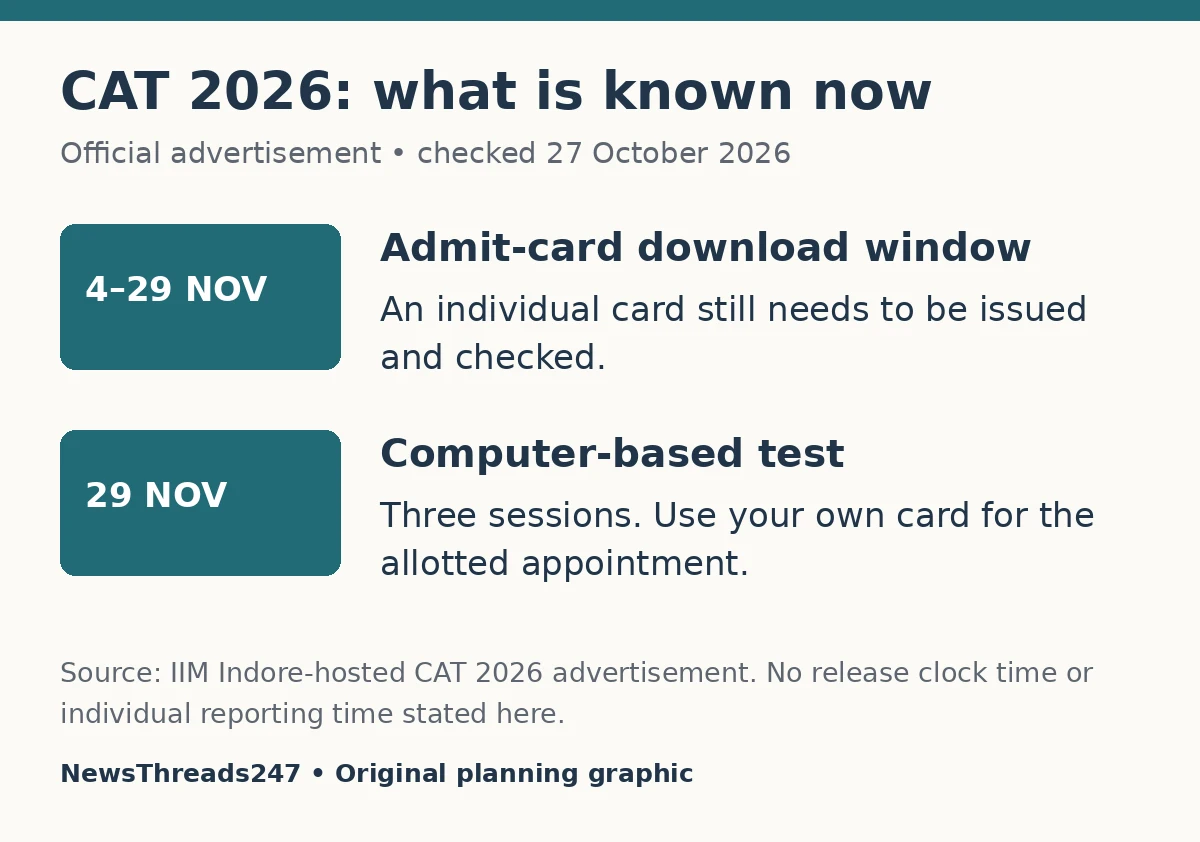
The official CAT 2026 advertisement hosted by IIM Indore lists the admit-card download period as November 4–29, 2026, and the computer-based examination as November 29 in three sessions. At this guide’s October 27 verification, November 4 was still ahead. The advertisement does not establish an individual candidate’s allotted session, centre address or reporting time.
Use the official CAT website for the current announcement and candidate access. The advertisement itself says information on that site is final. This is guidance for already-registered candidates in India, not a new registration invitation or a claim that the admit card is available today.
Build a small record pack before download day
Put your registration confirmation and the information you used in the application in one private folder. Record where to find your candidate account details, rather than leaving the task to a search through old messages on the morning of release. Keep passwords private; an exam reminder shared with a friend does not need to contain your login credentials.
The purpose is comparison. When a card becomes available, you want the submitted record beside it so you can identify an actual mismatch. A familiar spelling in a group chat or a coaching institute’s spreadsheet is not the application record. If something differs, write down exactly which field differs and which source you are comparing it with.
For example, a fictional candidate might have used one spelling in a practice-test account and another in the CAT application. The practice account alone cannot establish an error on the CAT document. Checking the application record first makes a later request for clarification more specific. It also avoids sending a vague “my details are wrong” message without the detail needed to investigate.
Treat the issued card as the source for your own appointment
An exam date and an individual appointment are different levels of information. The advertisement supplies the test date and says there are three sessions; it does not assign you to one. Do not build a non-refundable journey around an assumed morning or afternoon allocation.
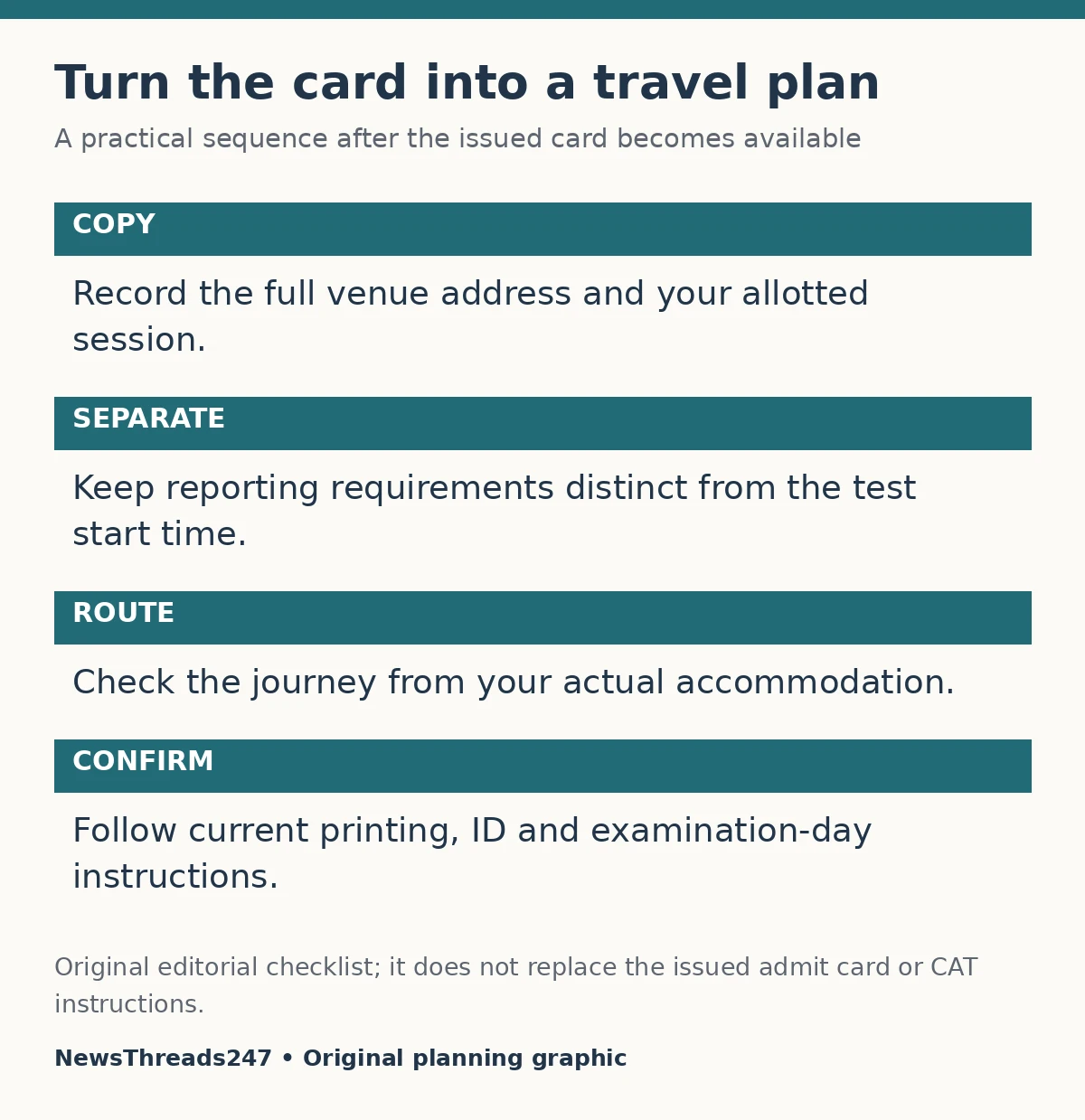
Once you can access your card, read it from top to bottom before starting travel bookings. Identify the candidate details, the date, the allotted session, the exact venue and the reporting instructions that actually appear on it. Keep the examination’s start time separate from any earlier reporting or entry requirement. Use the issued instructions for the final arrival plan.
A centre’s name may be similar to another institution’s name. Copy the complete address into your travel note, including any building or locality detail stated on the document. Then check the route against that address. A search result for the institution’s main campus is not enough if the card identifies another site.
Use a two-stage travel plan
Before the card arrives, make a flexible plan: identify whether you may need intercity travel, who could help with transport and what arrangements can still be changed. This is contingency planning, not a reason to assume that a preferred city or centre has been allotted.
After the card arrives, replace assumptions with the actual venue and reporting instructions. Estimate the journey from where you will really be staying, rather than from a city centre by default. Leave room for transfers, locating the entrance and an unfamiliar route. This guide does not prescribe a universal arrival buffer; the card’s instructions and your journey determine what is sensible.
Consider a hypothetical candidate who will stay with a relative across the city. A railway booking may get them to the right city, yet their final local trip could remain the difficult part. Listing the station-to-accommodation and accommodation-to-centre journeys separately reveals that problem before test morning.
What to do if a download or detail needs attention
Read the official portal’s current notice before deciding that a missing download is an account problem. The advertisement gives a date range rather than a release clock time. Check the current notice for activation details.
If you cannot access the account or document, record the exact issue and the time you encountered it. Use the assistance route currently provided by the official CAT site. Explain whether you cannot sign in, cannot find the card after signing in or have a concern about a field on a downloaded document. Those are different problems and deserve different descriptions.
For a suspected mismatch, preserve the downloaded file and your submitted record while seeking clarification. Do not edit a document yourself to make it appear correct, and do not treat an enquiry as proof that a change has been accepted. Follow the authority’s response and any current instructions about what to carry.
Finish with a document-and-instructions check
Save the issued file somewhere you can find it again. Check that it opens and that the important details are readable. Follow the card’s own printing, identification, photograph and examination-day requirements; old-year lists and a friend’s recollection should not replace the current instructions.
Our guide to exam-city slips and admit cards explains the general distinction between location planning and an admission document. It does not establish that CAT uses a separate city-slip stage. For CAT, use the documents and notices that CAT actually issues.
The useful result of this week’s preparation is simple: one reliable application record, working access to the official route and a clear plan for checking the issued card. That leaves the final days available for revision and travel arrangements grounded in your actual appointment, rather than a last-minute attempt to reconstruct it.
Sources and visual credits
The IIM Indore-hosted CAT 2026 advertisement was visually checked on October 27, 2026. Its download window and test date are the confirmed timetable used here; the CAT website remains the final source for changes and candidate instructions. Individual allocations and release clock time are not established by that advertisement. Examples and explanatory graphics are original editorial planning aids. Featured artwork is an AI-generated conceptual study-desk illustration, not an admit card or an examination-centre photograph.