
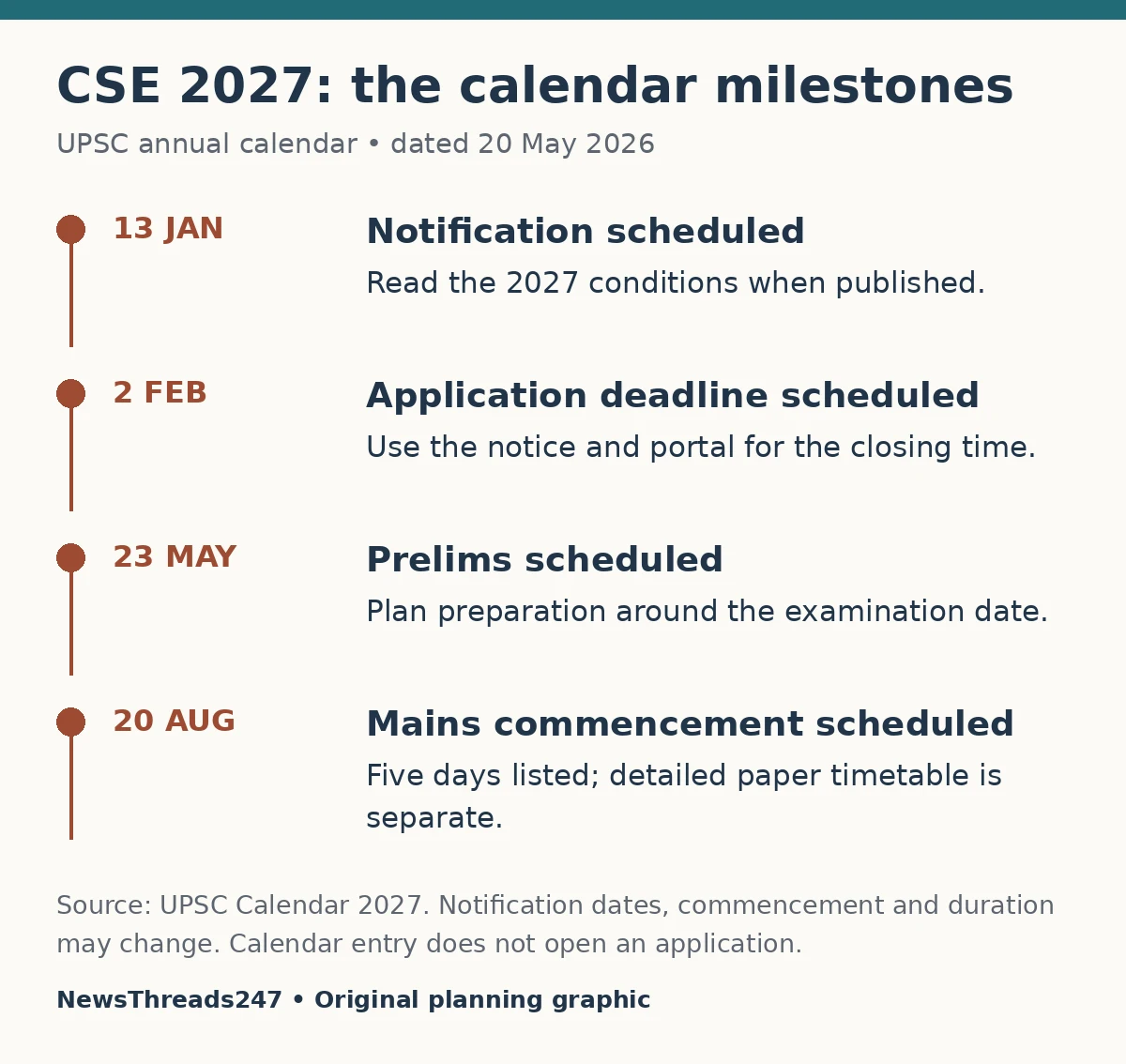
UPSC’s 2027 examination calendar gives Civil Services Examination aspirants a planning framework: the notification is scheduled for January 13, applications close on February 2 and Preliminary Examination is scheduled for May 23. The useful next step is to organise preparation and application checks around those dates, while waiting for the 2027 notification to establish the cycle’s detailed conditions.
These dates come from UPSC’s annual calendar dated May 20, 2026. They are not a new October announcement. The Commission explicitly says notification dates, examination commencement and duration can change if circumstances require. Check the official exam-calendar page again when making an important decision.
For candidates in India, the distinction matters now: a calendar can support a study plan without opening an application. It does not confirm the 2027 vacancy count, fees, category conditions or every document requirement. Do not pay an intermediary simply because a social post describes the cycle as “announced.”
Put the application window beside the exam date
It is easy to remember May 23 and overlook the earlier administrative work. Put January 13 and February 2 in the same planning system as the test date. The calendar lists the deadline as a date, without the application portal’s precise closing time; use the eventual notification and portal instructions for that time.
The calendar also schedules Civil Services Mains from August 20, 2027, for five days. That entry does not mean five consecutive calendar days or establish the detailed paper timetable. Use it as a broad planning marker until UPSC publishes the relevant programme.
A practical planning sheet needs three separate columns: a scheduled event, what it allows you to do, and what still needs confirmation. For the notification date, the next action is to read the cycle’s official notice. For the application deadline, it is to complete and verify the submission under that notice. For the exam date, it is to plan preparation and, later, the issued appointment and instructions.
Prepare questions for January rather than guessing the answers
Make a short list of the conditions you must check when the notice arrives: the age reference date and applicable relaxations, educational requirements, attempt rules, fees or exemptions, application procedure and required evidence. This is a list of questions, not a statement that the rules will match an earlier year.
Put supporting records in an orderly private folder where appropriate, and note any inconsistency you may need to resolve through the proper issuing authority. Do not upload documents to an unofficial “eligibility checker” merely because it promises an early answer. A third-party summary cannot establish that UPSC will accept a particular record.
For a fictional candidate whose qualification result is expected later, the right planning question is what the 2027 notice says about their stage of study and the evidence required at each stage. It would be premature to assume either eligibility or exclusion from the annual calendar alone. The date entry does not answer that question.
Work backwards in phases, with a review point in each
From now until the notification, separate study tasks from administrative tasks. Study tasks can include revisiting foundational material, practising recall and reviewing earlier mistakes. Administrative tasks include organising records and preparing the questions above. Giving each a place prevents paperwork concerns from repeatedly interrupting revision.
When the notification is published, reserve a focused session to read it and record the conditions relevant to you. Check whether the calendar dates have changed. If applying, plan completion before the closing day and retain the portal’s actual confirmation. A payment debit, an incomplete form and a submitted application should not be treated as interchangeable states.
Between application and Prelims, schedule review points based on what practice reveals. Instead of assigning an equal number of hours to every topic by habit, identify which mistakes recur and why. A mistake log can distinguish a knowledge gap, a misread question and poor time allocation. Each calls for a different response.
Make the plan measurable without promising a result
An illustrative weekly review could ask three questions: which planned tasks were completed, which errors repeated, and what should change next week? The objective is to improve the plan’s fit with your available time. It is not a formula for a rank or selection, and it should not make an unavailable full-time schedule feel compulsory.
For example, a candidate working rotating shifts might protect two shorter review sessions and one longer practice session, then adjust the next week after seeing which commitments were realistic. Another candidate may have more time but need to reduce passive reading. The calendar supplies shared milestones; it does not make their daily constraints identical.
Keep a small amount of unallocated time in each phase for work that takes longer than expected. A plan that fills every available hour can become unusable after a single disruption. If you fall behind, reassess scope and priority rather than silently moving every unfinished task to the final week.
Keep Prelims, Mains and other examinations distinct
The 2027 calendar contains many examinations. Its NDA and CDS entries, for example, are different application cycles with their own notices. A screenshot containing several dates is not evidence that one set of rules applies to all of them. Identify the exact examination name before recording a deadline.
Similarly, the CSE Mains entry is not an invitation for every calendar reader to sit Mains. Progression and eligibility are governed by the applicable examination process. Use the schedule to understand the year’s shape, while leaving individual participation to the rules and subsequent official outcomes.
Our application-confirmation explainer for JEE Main illustrates why payment and completed submission need separate checks. Its JEE-specific instructions do not transfer to UPSC; for CSE, follow UPSC’s own 2027 process when published.
How to keep your calendar useful when dates change
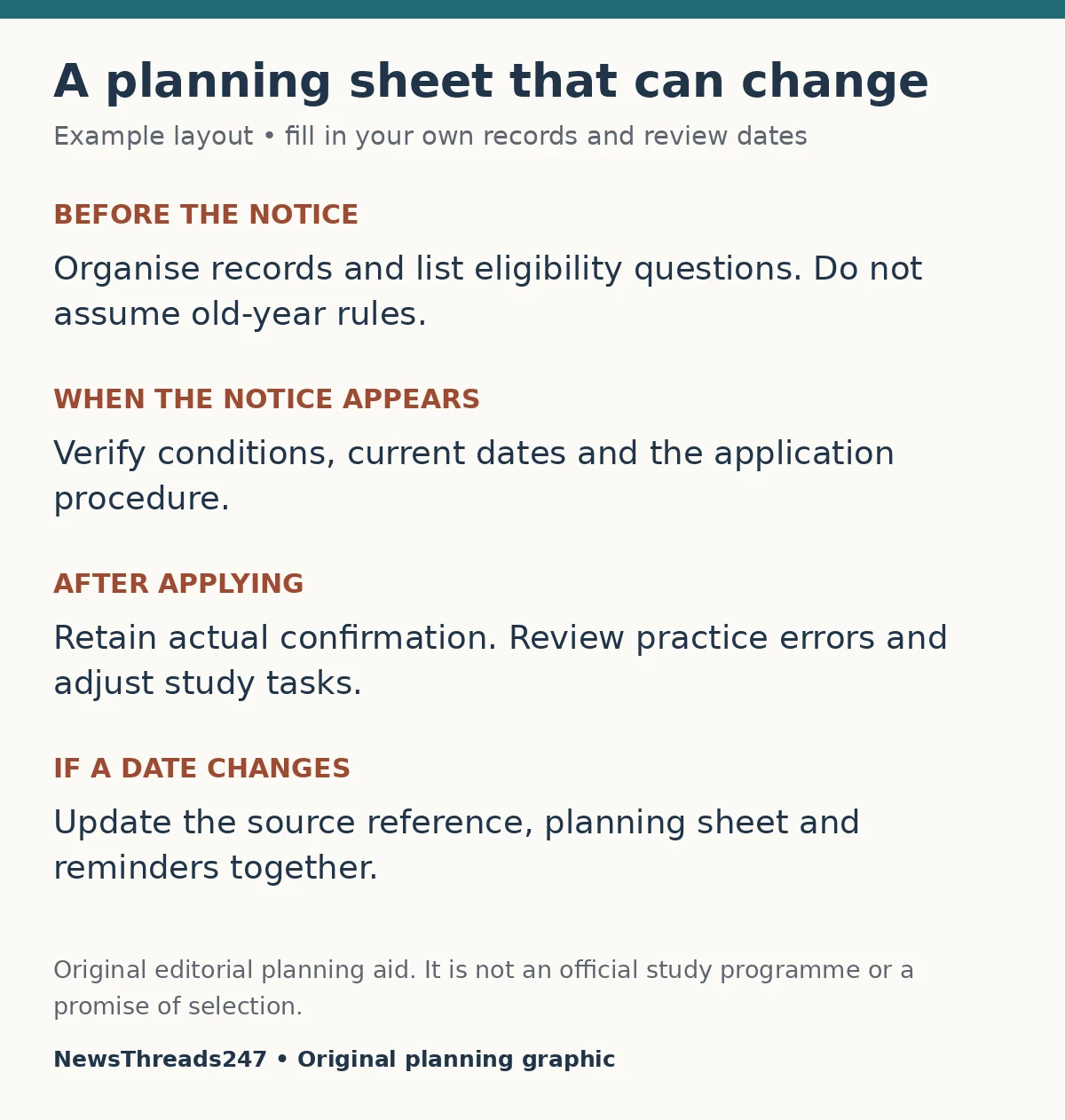
Save the source URL and the date you checked it beside each milestone. If a later official notice changes a date, update the planning sheet and any reminders together. Preserve enough context to distinguish a revision from a recycled old-year post.
Use a simple status such as “scheduled in annual calendar” until the cycle notice provides firmer instructions. Later, replace it with the relevant notice reference and your actual application state. That small discipline makes the sheet a working record rather than a collection of promising dates.
The immediate value of the 2027 calendar is therefore practical: it brings the application window into view early enough to prepare, while keeping unannounced conditions open. A useful plan can be specific about your next action without pretending that every rule or outcome is already known.
Sources and visual credits
UPSC’s May 20, 2026 annual calendar and official calendar listing were checked October 27, 2026. Dates remain subject to the Commission’s stated revision provision. This guide does not claim that CSE 2027 applications are open or that eligibility, fees and vacancies have been confirmed here. The planning examples and diagrams are original editorial suggestions, not an official preparation programme. Featured artwork is an AI-generated conceptual illustration, not a UPSC office or examination document.