
An SBI overdraft against a fixed deposit can provide temporary cash while the deposit remains in place. Whether it costs less than closing the FD depends on how much you actually borrow, how long the balance remains outstanding and what early closure would pay. The advertised difference between the borrowing and deposit rates is only one input.
Checked on October 27, 2026, SBI’s YONO product page describes an overdraft secured by a lien on the underlying deposit, with interest at one percentage point above that deposit’s rate on a daily reducing balance. It lists zero processing charge and no prepayment penalty. Those are product terms, not a new October launch or a personalised sanction.
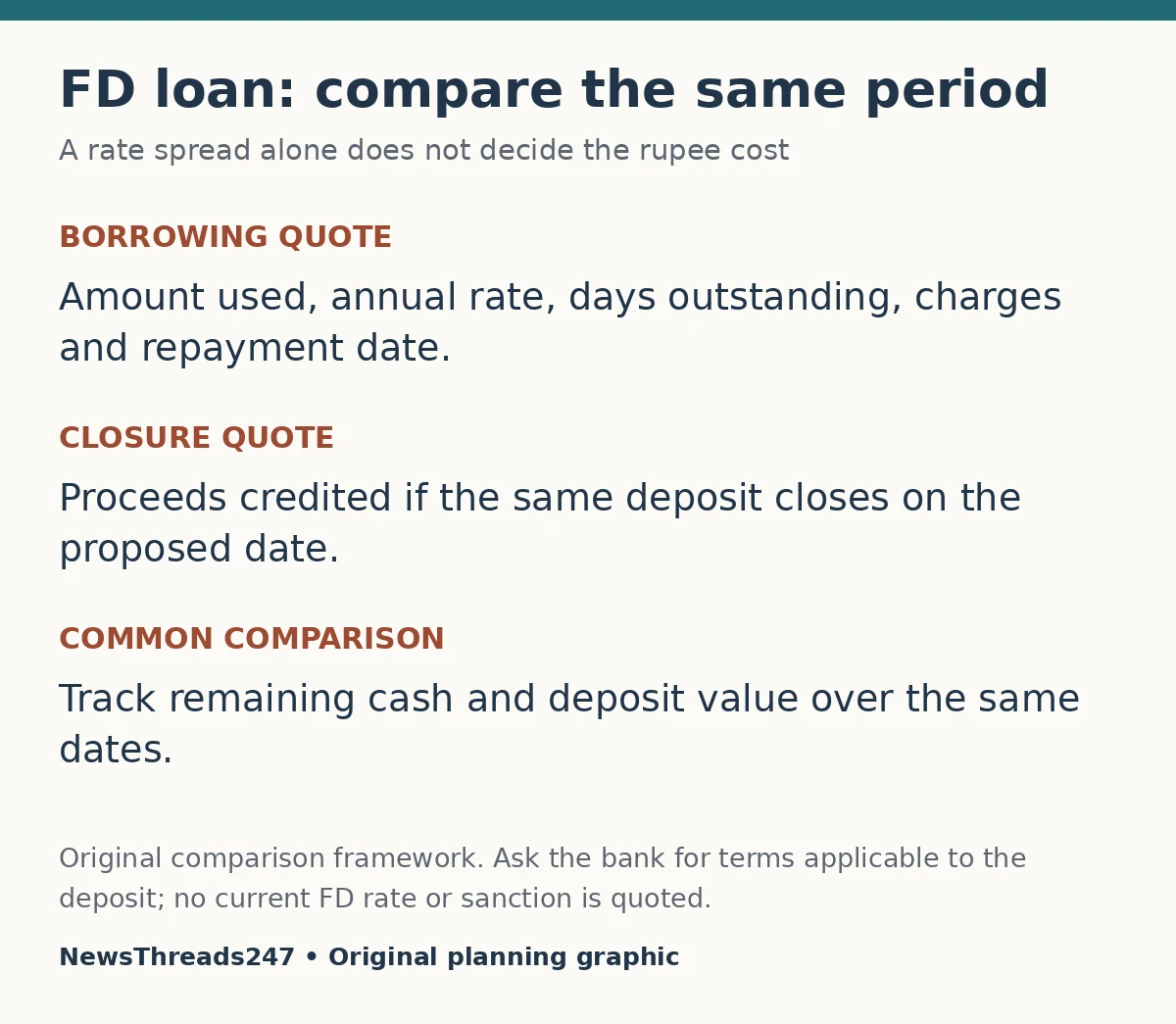
For Indian depositors considering this route, start with two written figures from the bank: the borrowing terms applicable to your deposit and the proceeds of closing that same deposit on the proposed date. This guide gives an illustrative comparison method; it does not quote a current FD yield or recommend a loan for a particular person.
Understand the spread before calculating
One percentage point above a 7% deposit rate would be 8% a year. It would not be 7.07%. The 7% and 8% figures here are hypothetical teaching assumptions, not SBI’s rate offer on October 27. Use the rate actually attached to your deposit and the bank’s offered borrowing rate.
The deposit interest does not make the borrowing interest disappear. You have an asset earning interest and a separate debt costing interest. To compare keeping the FD with closing it, account for both alternatives over the same period and include the money left over after meeting the cash need. Subtracting two headline percentages can conceal differences in amounts and timing.
Suppose the deposit is larger than the cash requirement. If you close the entire deposit, some proceeds may remain after paying the bill. If you borrow only the required amount, the deposit remains but you must repay the debt. A fair comparison states what happens to that unused cash, rather than pretending it vanishes from one option.
A daily-balance example shows why repayment timing matters
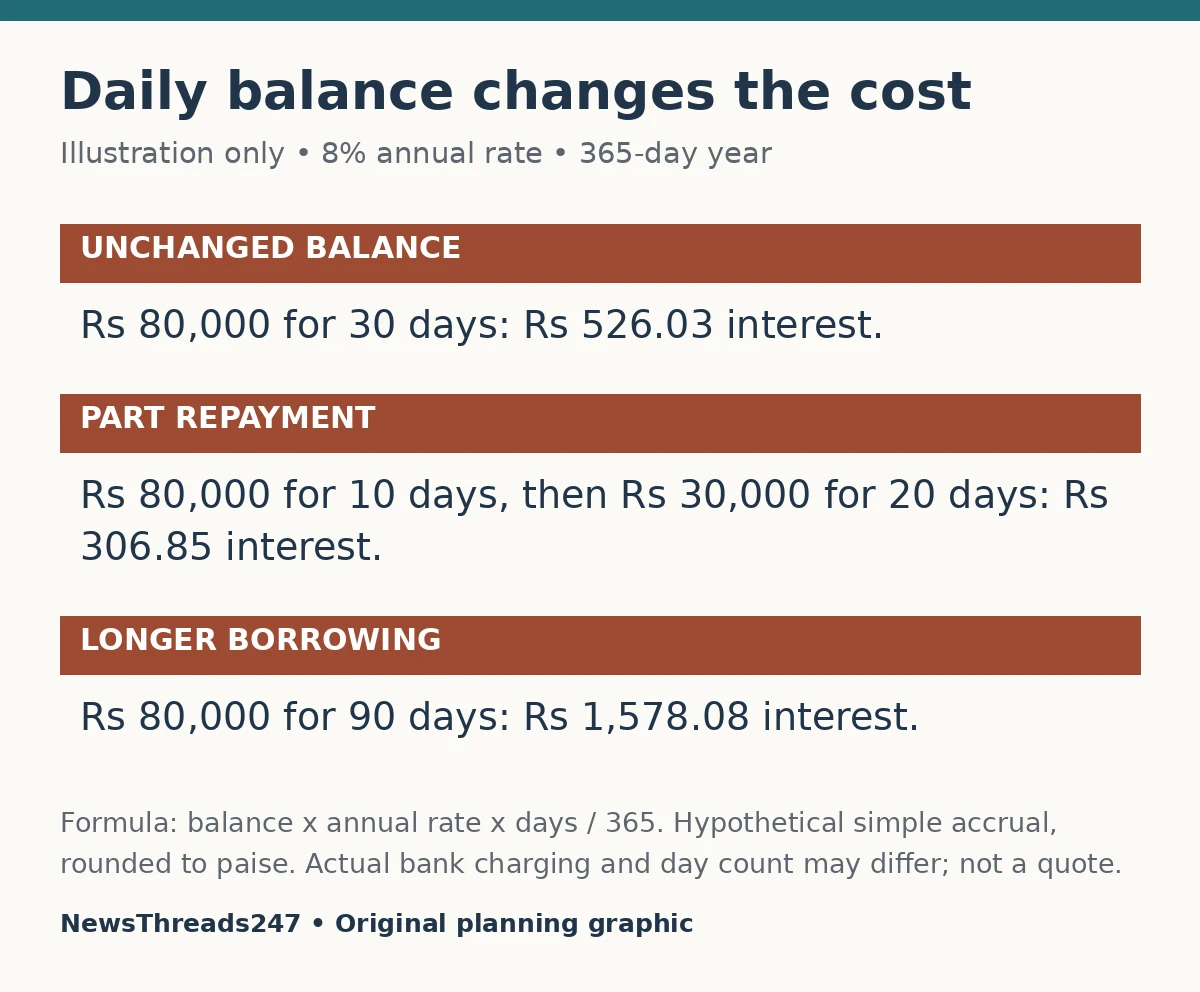
Assume an illustrative ₹80,000 overdraft balance at 8% annually for 30 days, using a 365-day year and simple daily accrual. The arithmetic is ₹80,000 × 0.08 × 30 ÷ 365 = ₹526.03, rounded to the nearest paise. This is a worked explanation, not the bank’s settlement figure; actual charging, day count and debits must be checked in the offered terms.
Now suppose the balance is ₹80,000 for 10 days and falls to ₹30,000 for the next 20 days after a ₹50,000 repayment. Under the same assumptions, interest is ₹175.34 plus ₹131.51, or ₹306.85. The difference comes from the lower outstanding balance, not a lower annual rate.
The result also shows why a repayment source matters. “I will clear it soon” is not a date or an amount. Before borrowing, write down where the repayment will come from and what happens if it arrives late. Extend the example to 90 days at an unchanged ₹80,000 balance and the illustration rises to ₹1,578.08. A brief bridge can become a longer cost.
Get a closure figure, not just a penalty percentage
Ask the bank for the amount that would actually be credited if you closed the FD on your intended date, and the basis of that calculation. A penalty percentage alone may not explain how the completed holding period affects interest. Keep the proposed closure date the same in both the borrowing and withdrawal comparison.
SBI’s published Policy on Depositors’ Rights says the bank declares its premature-withdrawal penal-interest policy and addresses the applicable rate for premature closure for renewal. That is a reason to request the specific calculation for your deposit; it is not a universal rupee charge this article can fill in without its terms.
Do not compare the original maturity amount directly with a loan’s first month of interest. One is a future asset value; the other is a cost over a shorter period. Align the dates first. If you need help interpreting the offer’s overall borrowing cost, our loan APR and KFS guide explains why a rate and an all-in cost can differ.
Check the channel and deposit type
SBI’s full time-deposit loan page distinguishes branch facilities from online overdrafts. It lists online access for eligible single-name TDR/STDR deposits and directs joint holders to branches. A deposit appearing in your account is not, by itself, proof that the online borrowing route is available.
There is also a published-page inconsistency worth checking before relying on a minimum. The full page’s features section says ₹5,000 for online overdrafts, while its FAQ says ₹25,000. The YONO page separately displays ₹5,000. This guide does not resolve that conflict by guessing. Confirm the applicable minimum, margin and limit in the actual channel and sanction before making a commitment.
Likewise, “up to 90%” on the YONO page is a ceiling description, not a promise of that amount for every deposit or applicant. Ask which deposit qualifies, the amount available, whether the offered rate can change, when repayment is due and how the lien is released. Do not use a general online percentage as evidence of an approved limit.
The decision needs a repayment plan as well as a cost
Borrowing against your own deposit still creates a repayment obligation and ties the deposit to the facility. A lien is important: the FD is security, not freely available cash you can simultaneously treat as uncommitted savings. Ask the bank what happens at maturity and if the borrowing is not cleared.
SBI’s repayment section caps overdrafts at five years or the deposit’s remaining maturity, whichever is earlier, and says online overdrafts are liquidated at deposit maturity if not repaid. Its FAQ separately gives a shorter three-year cap for TDR/e-TDR. Confirm the deposit-specific repayment date in the sanction rather than assuming five years is always available.
If the cash requirement is short and the repayment source is identifiable, calculate the bridge period and test a delay. If the need is ongoing or repayment is uncertain, extend the cost comparison to that longer period. Neither situation produces a universal answer; it tells you which assumptions deserve attention.
Bring a concise request to the bank: eligible deposit and channel, amount to use, annual borrowing rate, charges, repayment and maturity treatment, and the dated closure-proceeds calculation. Comparing those items is more useful than choosing from a slogan about “keeping the FD intact.”
Sources and visual credits
SBI’s YONO and full time-deposit loan pages and its published depositor policy were checked October 27, 2026. The loan pages display update dates in 2025; they are presented as available product information, not a fresh rate announcement. Conflicting minimum figures are disclosed rather than silently reconciled. All arithmetic uses explicitly hypothetical inputs, excludes tax effects and is not a bank quote. Original explanatory graphics accompany an AI-generated conceptual featured illustration.