
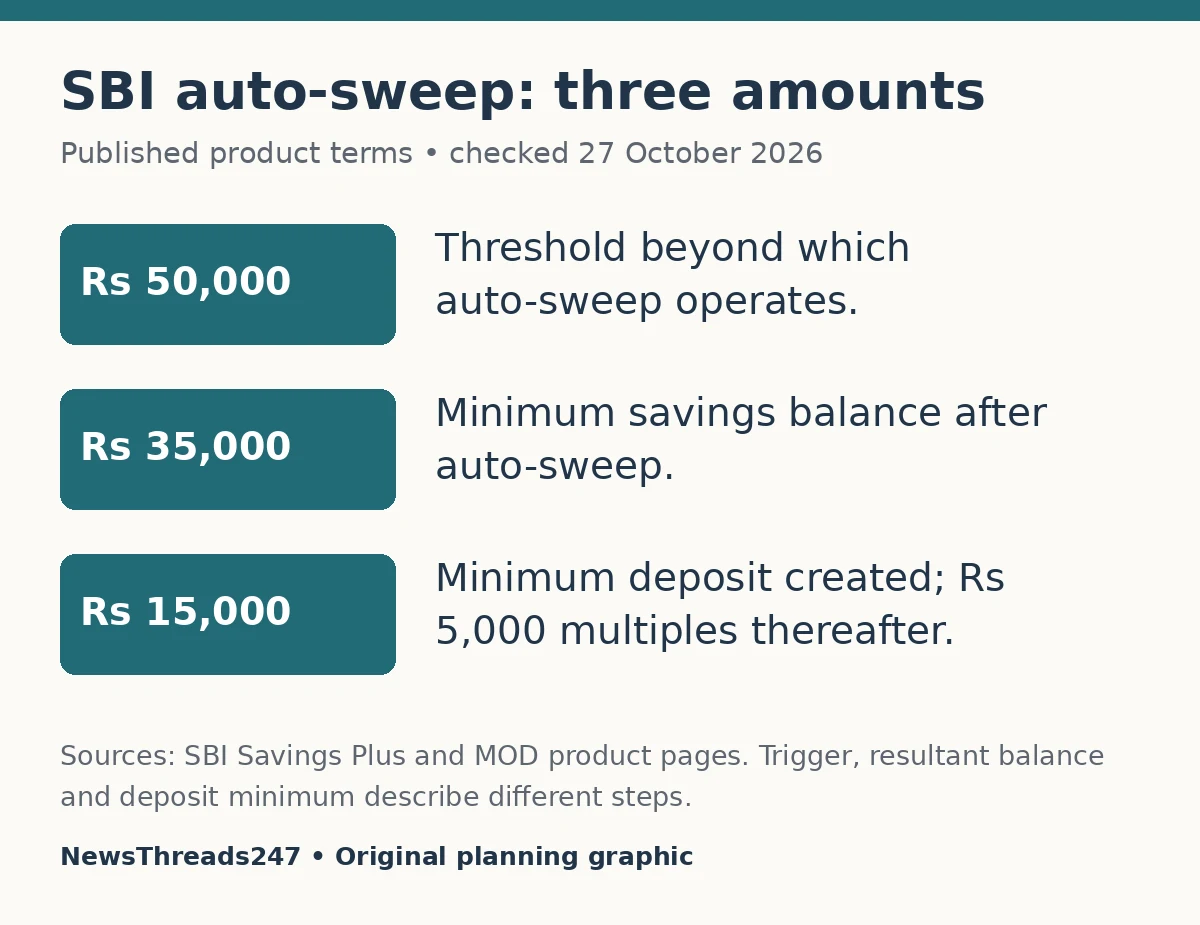
SBI’s Savings Plus auto-sweep has three amounts to understand: a ₹50,000 threshold beyond which the sweep operates, a minimum ₹35,000 balance left in savings after the sweep, and a minimum ₹15,000 term deposit created. They describe different parts of the process. Treating all three as a single “minimum balance” makes account statements harder to interpret.
Those figures appear on both SBI’s Savings Plus page and its Multi Option Deposit Scheme summary, checked October 27, 2026. The Savings Plus page displays a December 1, 2025 update date. This is a guide to the published arrangement, not a claim that SBI announced a new threshold today.
For Indian account holders, the useful question is what should move between savings and a linked deposit under the facility actually enabled on their account. A generic article about auto-sweep at another bank—or an old SBI guide with different figures—cannot answer that account-specific question.
The trigger and the retained balance do different jobs
The threshold describes when the automatic transfer is triggered. The resultant balance describes what remains in savings after it. Neither should be confused with the minimum size of the new deposit. SBI also specifies creation in ₹5,000 multiples after the ₹15,000 minimum.
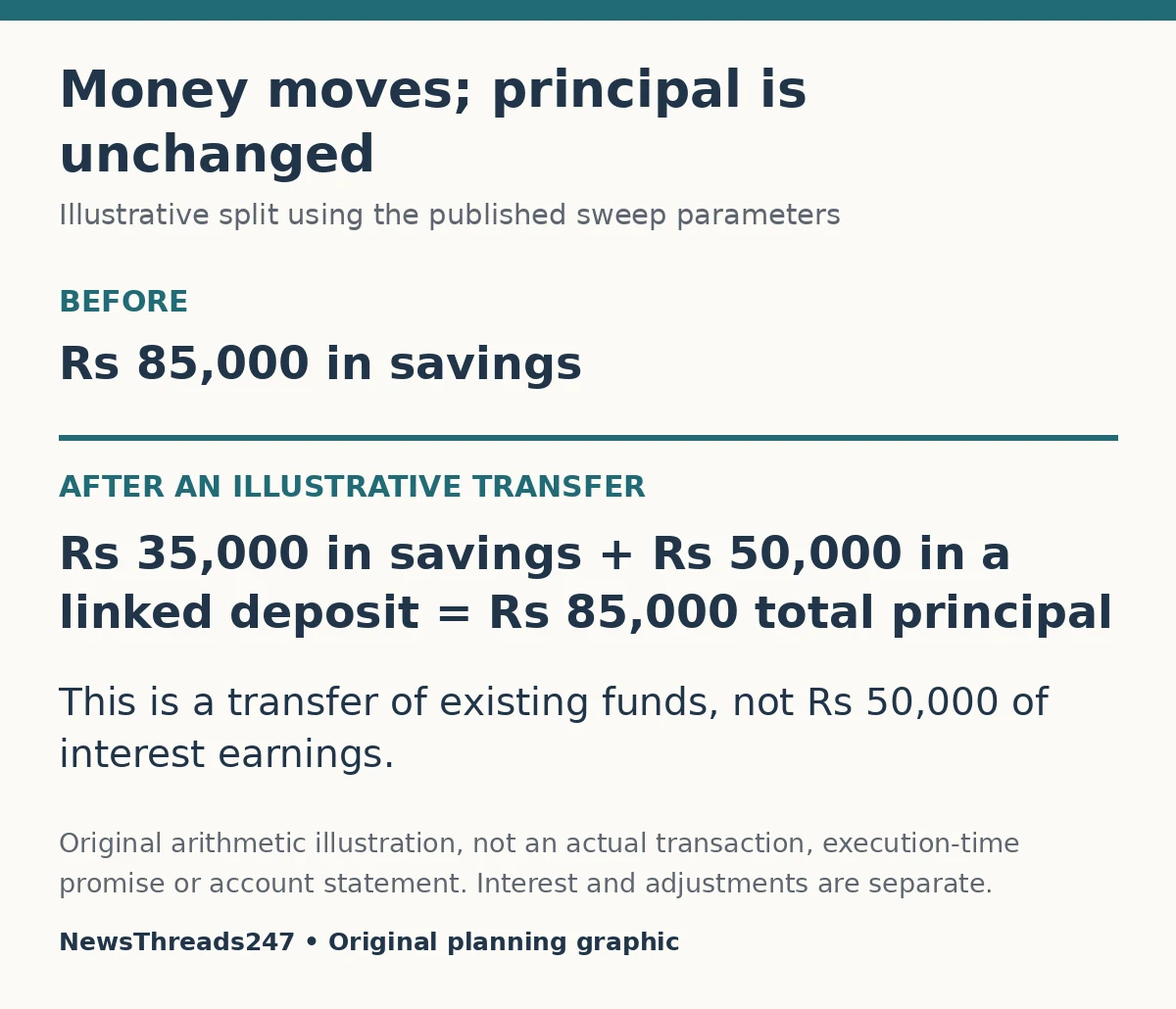
Consider a deliberately simple illustration with ₹85,000 in savings before a sweep. Moving ₹50,000 to a linked deposit would leave ₹35,000. The transfer is above the ₹15,000 minimum and fits the ₹5,000 unit. Total principal is still ₹85,000: ₹35,000 in savings plus ₹50,000 in the deposit. This demonstrates the published parameters, not a promise about an account’s execution time or every balance combination.
The transfer is not an extra ₹50,000 of earnings. Your own money has changed location. Interest, when applicable, is separate from the principal moved. Read a savings debit alongside the corresponding deposit creation before concluding that money has disappeared or that a bank charge has been taken.
Read savings and deposit records together
A useful review starts with the date and amount of the savings-account entry. Find the corresponding linked-deposit record and identify its principal, term and interest information. Then check whether any later reversal or payment explains a further movement. A single balance screenshot can hide the sequence.
Keep principal, earned interest and any adjustment in separate columns. That prevents an ordinary transfer from being counted as a return. If the entries do not reconcile, ask the bank to identify the linked deposit and explain the movement using the statement dates and amounts. You do not need to share passwords or OTPs to describe the issue.
For example, a fictional customer sees a lower savings balance after receiving a payment. Before treating it as a failed credit, they check whether a deposit was created under an enabled sweep arrangement. If no matching record is found, the missing explanation remains a question for the bank, rather than a reason to invent one.
Reverse sweep can return more than the immediate shortfall
SBI says reverse-sweep withdrawals occur in ₹5,000 units and multiples. Its published conditions also say that when the outstanding TDR/STDR balance reaches ₹15,000, the full amount reverses to savings irrespective of the requirement. This is why the savings credit need not exactly equal the small amount you expected to need.
To see the effect without predicting an actual transaction, imagine a linked deposit balance of ₹20,000. A ₹5,000 unit withdrawal would take it to ₹15,000; the stated full-reversal condition then matters. Do not assume the last ₹15,000 must stay in the deposit just because your immediate shortfall was small. Check the actual statement for the completed reversal.
The published Savings Plus conditions let the customer specify first-in-first-out or last-in-first-out for breaking deposits, with LIFO used if there is no mandate. In plain language, that determines whether older or newer linked deposits are used first. If several deposits have different dates, record the instruction applicable to your account before interpreting which one changed.
Automatic sweep and a stand-alone MOD are separate routes
SBI’s MOD summary distinguishes automatic transfers from a stand-alone MOD created by the customer. It says the latter can be created irrespective of the auto-sweep threshold and resultant-balance conditions. Therefore, finding a MOD deposit does not, by itself, establish that an automatic sweep happened.
Ask which facility is enabled, which account is linked and what instruction governs it. A savings account, a manually created deposit and an enabled automatic transfer arrangement should not be treated as the same thing. Use the current controls in SBI’s own channel, or ask the branch to identify the facility and instructions attached to your account.
The published MOD summary lists a one-to-five-year deposit term. That term is not a promise that an early reversal preserves the originally expected maturity return. Before enabling or depending on frequent withdrawals, ask the bank how interest and any premature-withdrawal adjustment apply to the deposit and the portion withdrawn.
Convenient access is not the same as an unchanged return
A sweep arrangement is meant to organise liquidity, but a return comparison still needs the actual deposit terms and holding period. Do not assume that all money moved into a term deposit earns the full contracted return if it is brought back early. Equally, do not assume every reversal destroys interest on every other linked deposit.
SBI’s published depositor policy addresses premature withdrawal and the bank’s penal-interest policy. Obtain the terms applicable to your actual product and ask for a worked statement example if that treatment is unclear. This article does not supply a universal penalty or an after-tax return.
For essential payments, confirm the account’s available funds and applicable facility rather than relying on an assumed sweep at an assumed minute. If a payment is already due, an explanation of product design is not proof that a particular transfer has completed.
A short account review before relying on auto-sweep
Write down the account variant, whether automatic sweep is active, the linked-deposit term and the breaking-order instruction. Compare those with the current product terms. Then check a real deposit creation and a real reversal, if any, to understand how the entries appear on your statements.
Keep the source date with your notes. If you find an older guide describing different thresholds, verify the applicable terms rather than averaging the figures or assuming the most attractive one applies. Our deposit-insurance explainer covers a separate issue: why additional accounts at one bank should not automatically be counted as additional insurance cover.
The most useful outcome is a clear picture of where your money sits and which instruction moves it. Once the trigger, retained balance and deposit units are separated, the statement becomes easier to check—and a bank query can focus on the actual unexplained transaction.
Sources and visual credits
SBI Savings Plus, MOD scheme information and the published depositor policy were checked October 27, 2026. Product terms can change; execution and eligibility must be confirmed for the account. Examples illustrate the displayed parameters and do not reproduce actual customer transactions or promise interest earnings. Both explanatory graphics are original. Featured artwork is an AI-generated conceptual illustration, not an SBI interface or a photograph of a real account record.