
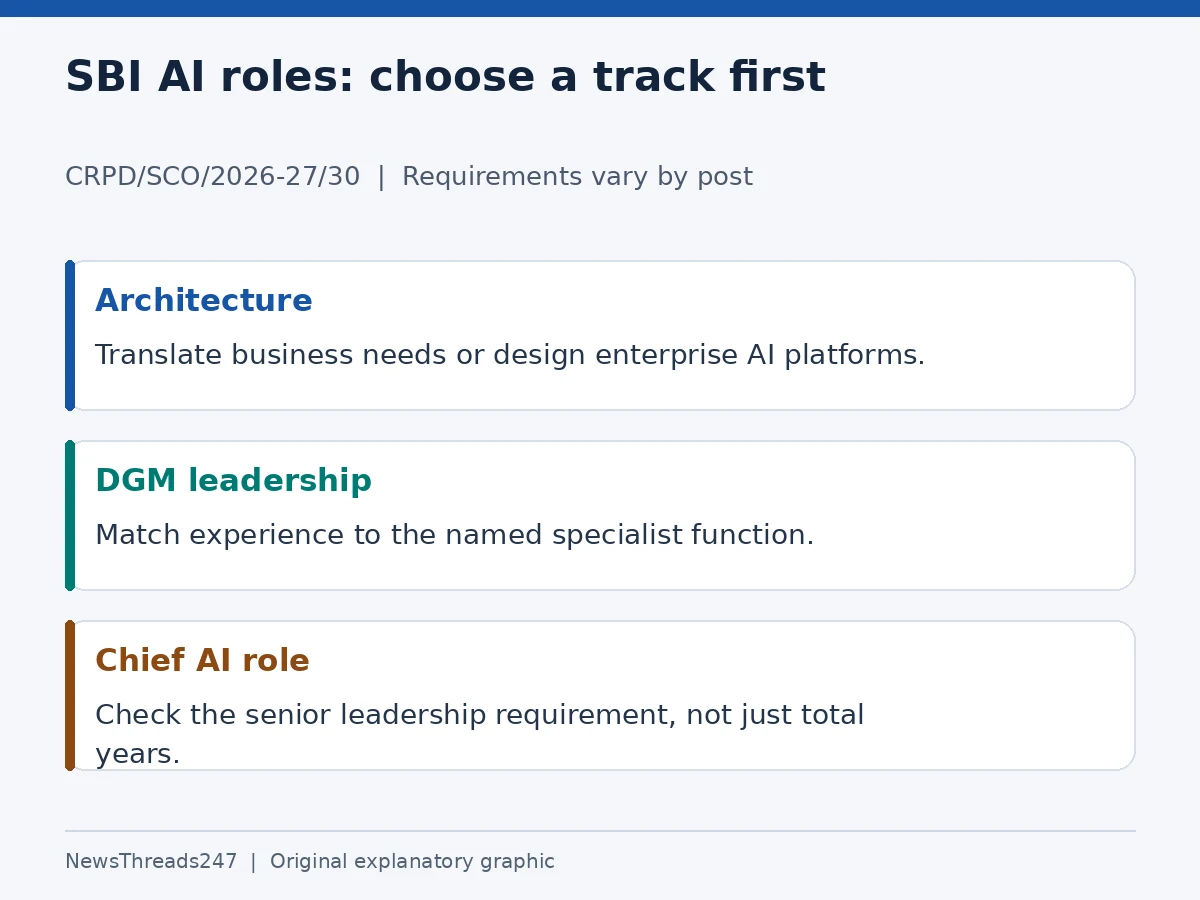
SBI’s current AI specialist recruitment is for experienced professionals, and the first decision is which post your work actually supports. Six openings under advertisement CRPD/SCO/2026-27/30 span architecture and leadership. A general interest in AI, a recent course or a senior-sounding job title does not by itself establish eligibility.
The official application portal lists 9 November 2026 as the registration and payment deadline for all six posts. SBI’s current openings page confirms the application window began on 19 October. These dates were checked on 27 October; follow the same advertisement for any correction or extension rather than borrowing a deadline from another SBI recruitment.
Start with the exact post, then check its requirements
The roles are GM & Chief AI Officer; DGM in Risk and Operational Analytics; DGM in AI Governance and Compliance; DGM in Data Engineering, Model Application Development and AI Ops; AI Solution Architect; and Enterprise AI Architect. There is one vacancy for each. The official portal preserves the full names, which matter when selecting the application.
| Track | Age band at 30 September 2026 | Experience headline |
|---|---|---|
| Chief AI Officer | 40–55 | 15+ years overall; 3+ in specified senior leadership |
| Three DGM posts | 35–50 | 10+ years overall; 2+ in the relevant senior leadership function |
| AI Solution Architect | 30–45 | 8 years overall; 3 in the specified solutioning work |
| Enterprise AI Architect | 30–45 | 8 years in technology; 3 in the specified architecture work |
This is an orientation table, not a complete eligibility assessment. The detailed notice, particularly pages 2–10, distinguishes mandatory degrees, relevant experience and preferred certifications. The architecture posts have different degree lists: management-related study appears for Solution Architect, while Enterprise Architect specifies technology and related fields. Read the exact list for your chosen post; do not assume an “equivalent” qualification is automatically accepted. For the architecture posts, the notice measures post-qualification experience at 30 September 2026 and excludes training and teaching.
A useful first pass is to place each condition into one of three columns: clearly supported, needs clarification, or not met. Keep preferred credentials separate from mandatory requirements. This prevents a strong certificate from distracting attention from a missing degree field, qualifying period or relevant responsibility.
Build an evidence matrix before polishing the résumé
Create one row for each mandatory requirement. In the next column, write the dated evidence you could supply. A degree row might point to the certificate and marksheets. An experience row should identify the employer, start and end dates, role and work that relates to the requirement. Add a final column for anything that remains unclear.
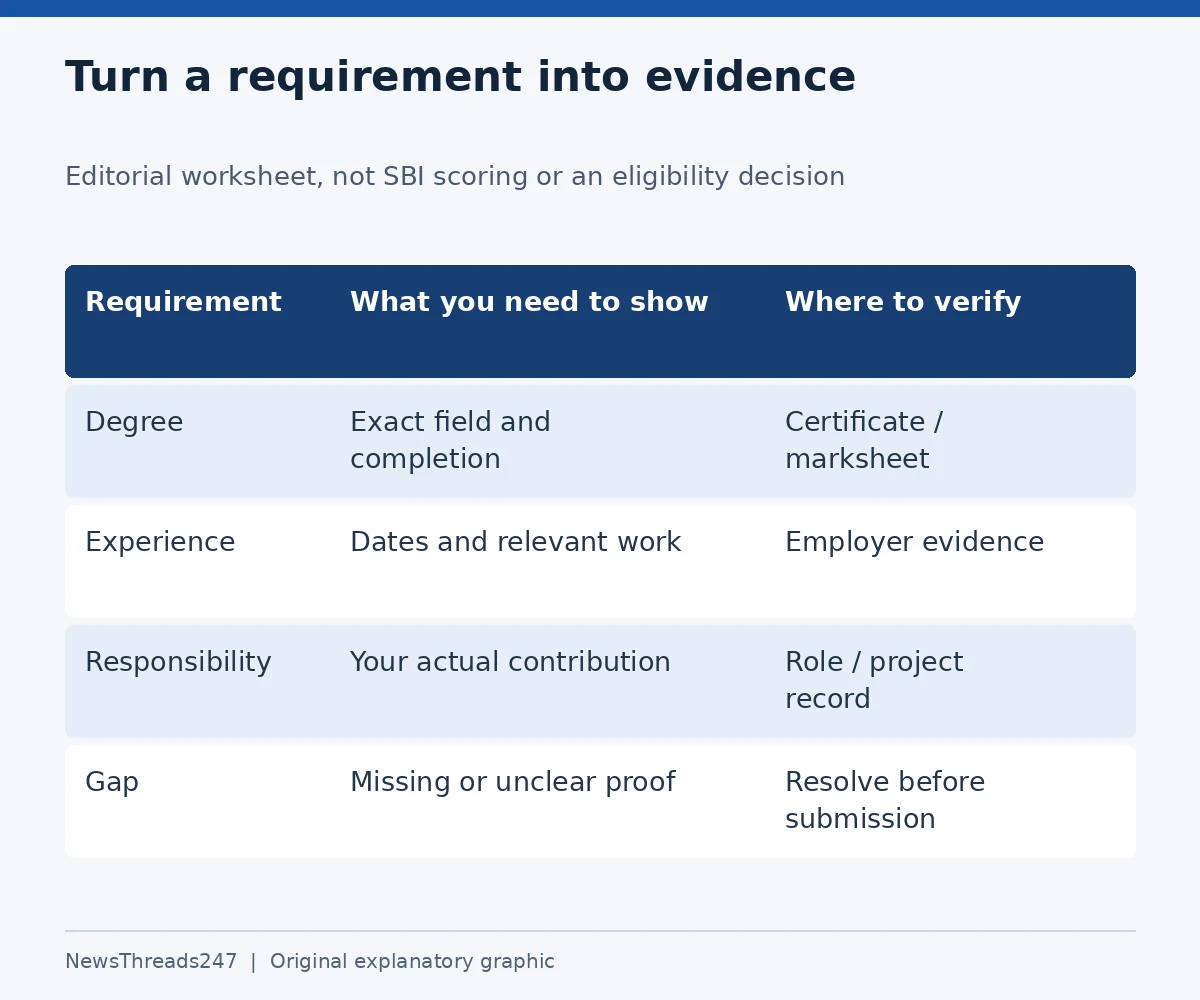
For example, “worked on an AI project” leaves several questions open. Did you design the solution, build a component, manage delivery or provide operational support? Was it a personal demonstration or an enterprise deployment? State your actual contribution and its period. A precise account is more useful than a page of technical terms that a reader cannot connect to your work.
Keep your chronology consistent across the application, résumé and supporting records. If two documents use different titles for the same role, explain the relationship accurately. If you moved from a developer role into architecture, separate the periods instead of treating the whole employment spell as architecture experience. Do not count overlapping dates twice in your own worksheet.
The worksheet is an editorial preparation tool, not SBI’s scoring system. Its purpose is to reveal a missing document early enough to request it. It cannot decide whether the bank will accept a particular qualification or experience record.
A fictional applicant shows why total years are not enough
Consider a fictional applicant, Maya, who has nine years in technology. Her résumé says she “supported AI initiatives” for three of them, but her employment letter gives only a generic software role. She should not automatically translate those three years into evidence that every architecture condition is met.
Maya’s next step is to reconstruct the relevant period from records she is entitled to use: the work she performed, when she performed it, her responsibility and what her employer can confirm. She then compares that record with the chosen post’s wording. If the work was mainly implementation rather than solution design, the distinction belongs in the application rather than being hidden by a broader title.
Now imagine another fictional applicant with many years of individual technical contribution but little leadership responsibility. That person may have a substantial career, yet the leadership track asks a different question. More years cannot simply be substituted for a specific kind of responsibility. This is why comparing posts is worth doing before spending time rewriting a résumé.
Read the engagement terms separately from the role
The notice describes an initial three-year fixed-term engagement, with a possible discretionary two-year extension. Selection involves shortlisting, interview and CTC negotiation; minimum eligibility does not guarantee an interview. The listed application fee is ₹750 for General/EWS/OBC applicants and nil for SC/ST/PwBD applicants. Check the detailed notice for applicable conditions and documentary requirements.
Treat the contract and the job description as separate decisions. Write down what you would need clarified about responsibilities, location, compensation structure and the end of the engagement. An extension should not be treated as income that has already been secured. Likewise, an advertised compensation ceiling is not a promise of monthly take-home pay.
If an offer eventually arrives, compare fixed cash, variable components and deductions on their own terms. Our guide to CTC, fixed cash and monthly pay in India explains that later-stage comparison. At application stage, keep the focus on accurate eligibility evidence and the actual engagement being offered.
Finish the application with a record you can check
Begin through SBI’s current openings page and select advertisement /30. Read its full notice, linked forms and upload instructions before entering details. A folder named with the advertisement number can keep this application separate from another recruitment with a different deadline or document list.
Before submitting, compare names and dates against the underlying records, open every uploaded file and check that it is readable. Save the application reference and the payment outcome where a fee applies. A useful final check is to explain, using your own saved records, which post you applied for and what evidence supports each mandatory condition.
Do not assume a midnight cutoff when a listing gives only a date. Complete the process early enough to resolve an unreadable upload or payment issue, and revisit the official notice for changes. Neither a third-party summary nor this preparation method can promise shortlisting or selection.
Sources and visual credits
Reporting is based on SBI’s current careers listing, advertisement CRPD/SCO/2026-27/30 and its linked application portal, checked 27 October 2026. The examples are fictional editorial illustrations. The featured image is AI-generated conceptual artwork; the two explanatory graphics are original NewsThreads247 work, not SBI documents or interfaces.