
The 2027 Oscars’ AI rules do not amount to a simple ban on every movie made with an AI tool. They protect eligibility for human acting and screenwriting while requiring a closer look at creative authorship. For filmgoers following awards coverage, the crucial question is which achievement is being considered, not whether the word “AI” appears anywhere in a production story.
The Academy announced the changes on May 1, 2026, for the 99th Oscars. The current awards-season rulebook was checked on October 27; the May announcement remains the starting point for understanding these requirements. The rules govern Academy Awards consideration, including international submissions where applicable; they are not a worldwide law governing how films may be produced.
The general rule and the category rules work together
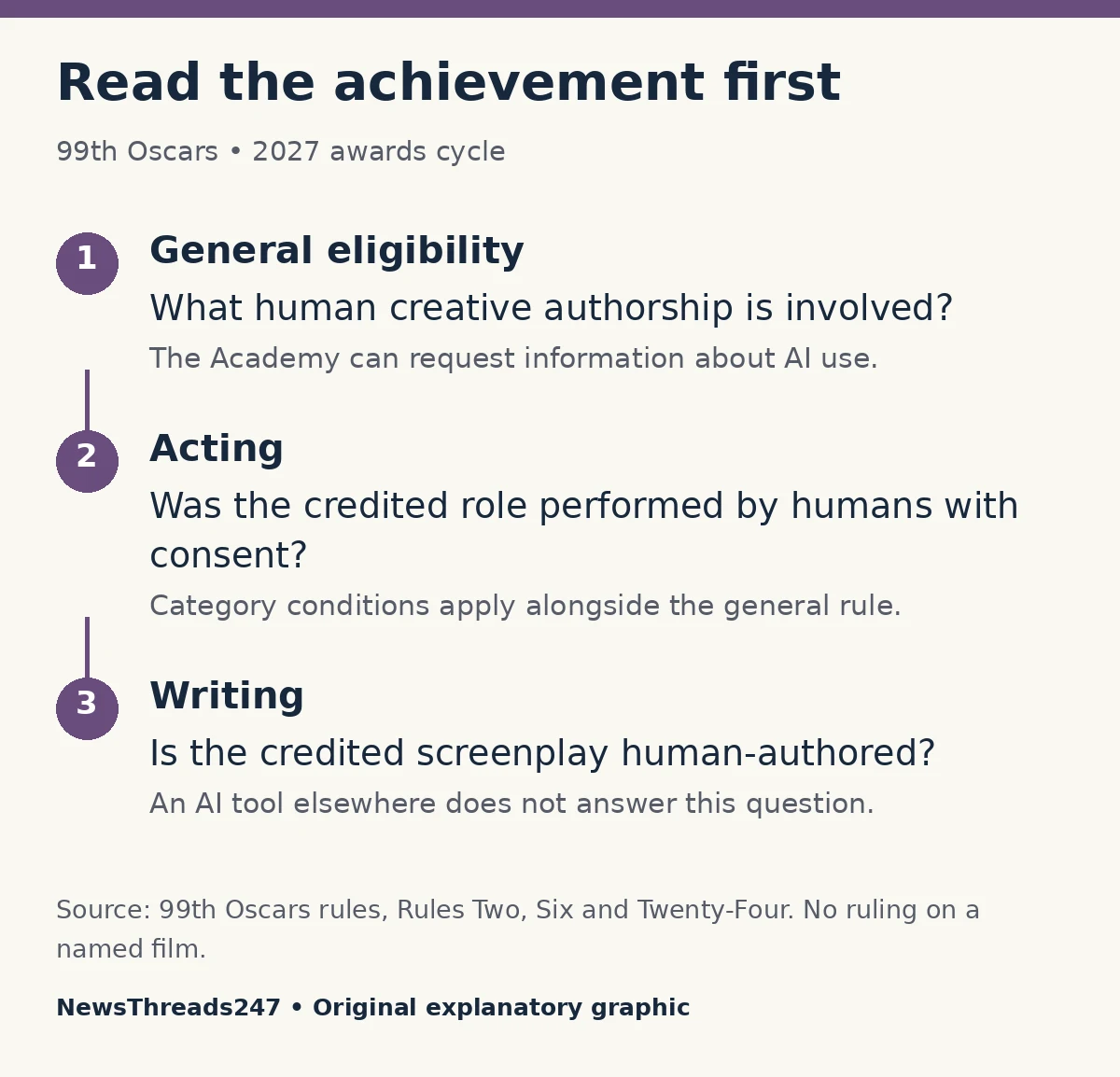
Rule Two of the 99th Oscars rulebook says digital and generative-AI tools do not themselves improve or harm nomination chances. The Academy and its branches consider the human role in creative authorship and may request more information about AI use. Category-specific requirements still apply.
Read those ideas together. The general language does not grant automatic eligibility to a synthetic performer. The acting rule does not, by itself, disqualify every other achievement in a digitally assisted film. A headline compressing both into “AI banned at the Oscars” leaves out the part readers need to interpret a real case.
A useful way to read any awards claim is to identify its unit: the film, a performance, a screenplay or another craft achievement. Then find the rule governing that unit. Otherwise, a statement about one contribution can quietly turn into a statement about the entire production.
Acting eligibility requires a human performance and consent
Rule Six requires an eligible role to be credited in the film’s legal billing and demonstrably performed by humans with their consent. Uncredited performances are excluded. Rule Twenty-Four separately requires explicit screenwriting credit and human authorship for either Writing category; the final shooting script must be submitted.
Those requirements make a credit important without making it sufficient. A name appearing in billing is evidence to examine, not a shortcut around the human-performance condition. Likewise, calling a generated character an “actor” in promotional material does not settle whether an eligible human acting achievement exists.
For viewers, this is a reason to be precise when discussing a screen image. Ask who performed the role and what the production has actually disclosed. Do not infer that a face looking natural proves human performance, or that an obviously fantastical appearance proves the absence of a human contribution. Appearance and authorship are different kinds of information.
Human authorship is not a numerical AI allowance
The announcement’s writing requirement is about who authored the screenplay. It does not give readers a universal percentage they can calculate from a behind-the-scenes video. Neither the relevant general rule nor the cited writing requirement supplies a simple “under this much AI is safe” formula.
Suppose a fictional production describes using an AI tool somewhere in its workflow. That description alone does not tell you whether the screenplay was human-authored, which parts of the finished work were generated or whether the requested category’s conditions are met. The unanswered questions should remain visible instead of being filled with an invented cutoff.
For a filmmaker preparing documentation, a practical response is to keep a clear account of the people responsible and the tools’ roles, alongside the required submission materials. That is an editorial planning suggestion drawn from the information the Academy can request, not an extra official form or a guarantee of acceptance.
Two hypothetical cases show the distinction
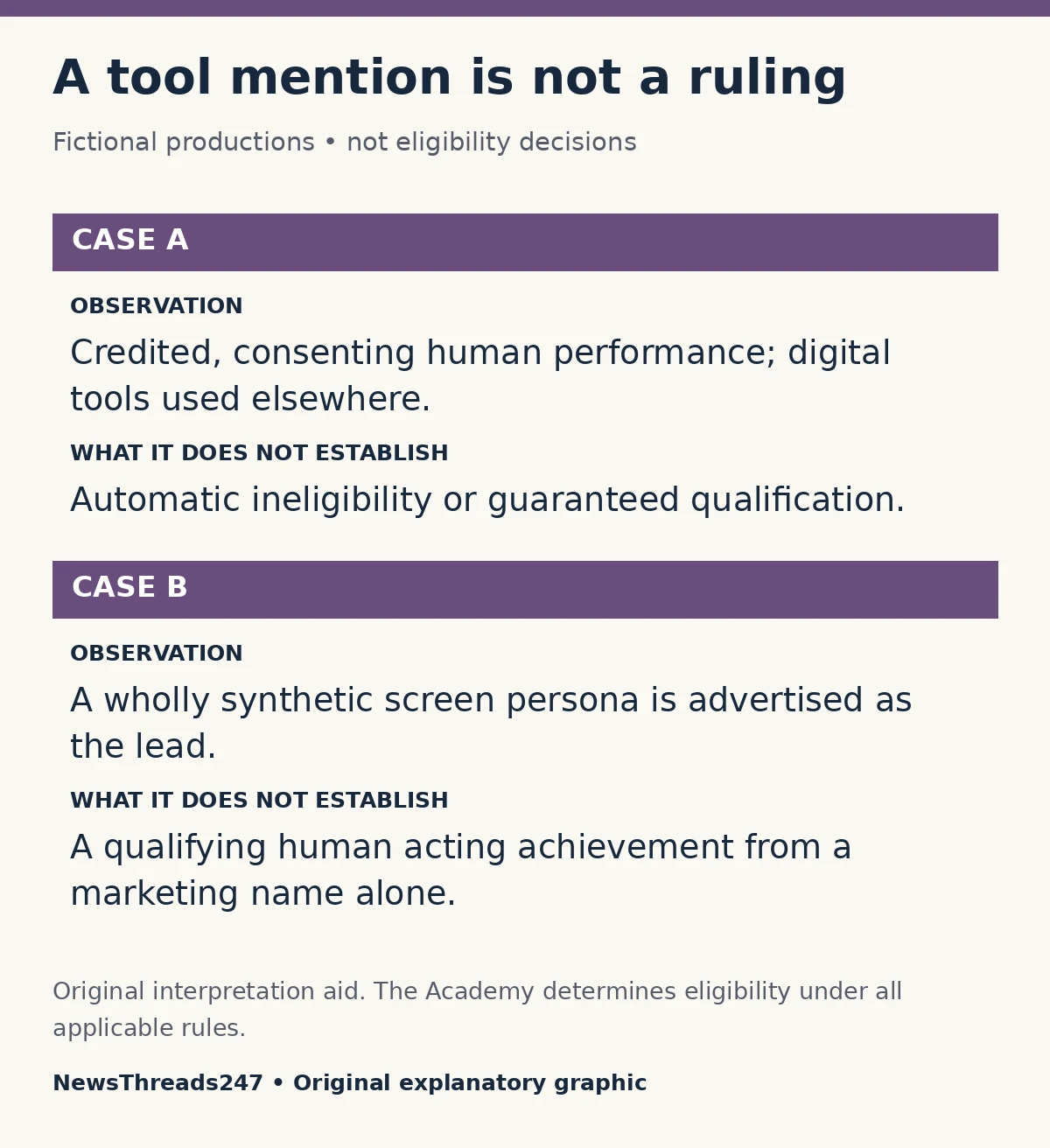
In the first case, a fictional film has a credited human performer who consented to the performance, while its production description mentions digital tools elsewhere. The tool reference is not enough to declare that performer ineligible. It is also not enough to certify eligibility: the actual facts and all applicable rules still have to be considered.
In the second, a fictional project advertises a wholly synthetic screen persona as its lead. It would be misleading to treat the persona’s marketing name as proof of a qualifying human acting performance. A screenplay credit in the same project would need its own human-authorship assessment. Neither case is a ruling about an existing movie.
The same discipline helps when a discussion moves between categories. A concern about how one shot was created should not automatically become a claim about who wrote the screenplay. Evidence may be relevant to more than one question, but the link needs to be explained rather than assumed.
An eligibility rule is not a nomination
Eligibility is only the first stage of an awards discussion. A film being submitted, an achievement being eligible, a shortlist and a nomination are different statuses. None should be substituted for another in a headline or caption. A campaign poster is not an official nomination announcement.
Read dates with the same care. The Academy’s May announcement lists different submission deadlines across categories, including a final November 12 general-entry deadline for the 99th cycle. That date should not be applied to every category: the announcement lists earlier deadlines too. Anyone submitting work should consult the current category instructions and key dates directly.
This guide is not a submission service, and it does not determine that any film qualifies. The Academy resolves eligibility under its rules. If the record is incomplete, the useful statement is that the relevant facts or determination are not yet established.
How to check the next AI-and-Oscars headline
First identify the edition: rules for the 99th ceremony are not interchangeable with an older rulebook. Next identify the category and the claimed change. Follow the story’s link to the official announcement and then to the current full rules. A summary can explain a policy well while still omitting exceptions or later revisions.
Then separate documented production information from opinion. “The filmmaker says a tool was used for this task” is an attributed account. “The Academy has ruled the film ineligible” requires evidence of that decision. A commentator’s prediction should not be presented as a completed ruling, even when the underlying debate is important.
Finally, decide what remains unknown. You may have a clear category rule but insufficient production detail to apply it. Leaving that gap open is more informative than naming a supposed offender from a trailer, a rumour or a generated-looking publicity image. The rulebook gives a framework; it does not make every online accusation reliable.
For a different kind of film label, our Indian cinema age-rating guide explains what a certification label tells families. Age suitability and awards eligibility answer entirely different questions; neither is a substitute for the other.
Sources and visual credits
The Academy’s May 1 announcement and linked 99th Oscars full rules were checked October 27, 2026. Rules and dates may be revised; use the official rules hub for submissions. Interpretive examples and diagrams are original and do not describe named films. Featured artwork is an AI-generated conceptual soundstage illustration, not an awards photograph or an image of a real production. No interviews, production inspections or eligibility determinations are claimed.