
A sample paper helps most when you use it like a rehearsal—not when you simply download it, admire the questions and move on. For CBSE Class 10 and Class 12 students preparing for the 2026–27 examination session, the board’s academic website now provides subject-wise Sample Question Papers (SQPs) and Marking Schemes (MS). The two files belong together.
Go directly to the official subject lists: Class 10 sample papers and marking schemes or Class 12 sample papers and marking schemes. Choose your subject, download both files and check that the heading refers to exam session 2026–27. These are official practice resources; they are not leaked examination papers or a promise that the actual board questions will be repeated.

Where the official CBSE 2026–27 sample papers are available
CBSE’s Academic Unit lists sample question papers and matching marking schemes separately for Class X and Class XII. Its September 2026 academic circulars also include a notice about the resources for the current academic session. That distinction matters because an older PDF often circulates in school groups long after a new session’s subject list has appeared.
| Class | Official download page | What to select |
|---|---|---|
| Class 10 / X | CBSE Class X 2026–27 | Your exact subject, then its SQP and MS links |
| Class 12 / XII | CBSE Class XII 2026–27 | Your stream’s exact subject, then its SQP and MS links |
| Official announcements | CBSE Academic circulars | Relevant updates or corrections after the release |
For Class 10, the page includes Mathematics (Basic) and Mathematics (Standard) as separate entries, alongside Science, Social Science, English and other subjects. Choose the mathematics level you actually study. For Class 12, subjects listed include Physics, Chemistry, Biology, Accountancy, Business Studies, Economics, Mathematics, Computer Science and many language and elective papers. A student should not assume that a marking scheme for a different subject or level applies to their own answer.
How to download both documents without getting the wrong year
- Open the relevant official Class X or XII page in a browser.
- Find the exact subject title and, where shown, the correct level or paper.
- Download the SQP file for the question-paper pattern.
- Download the matching MS file from the same subject row.
- Check the document header, subject name, session and any board notes. Store the two files together so you do not accidentally compare different sessions.
Students sometimes search for “CBSE 2027 sample paper PDF” and reach a coaching-site mirror. Such a page may contain useful commentary, but it is not the authoritative source for the newest board-issued document. When a PDF does not open properly, retry from the CBSE Academic subject list or use a different browser rather than paying a site that claims official access.
What a marking scheme tells you that the sample paper cannot
The question paper lets you practise the task: read a prompt, decide what is being asked and compose your answer under a time constraint. The marking scheme helps you review how credit may be awarded. In some subjects, this may involve key concepts, a correct method, reasoning steps, specified elements or structured responses. The format varies by subject and question.
For example, in mathematics, a student might reach a wrong final value after several correct steps. A marking scheme can help show whether the method contained credit-worthy work and where the error arose. In a theory subject, an answer may be long yet still omit the particular concept the question tests. A marking guide helps shift the focus from writing more words to answering more precisely.
Do not treat a scheme as a script to be memorised word for word in every case. Read the board’s own instructions about accepted alternatives and marking principles for your subject, where provided. A useful response demonstrates understanding, not just a string of copied phrases.
A four-step practice cycle that actually improves answers
Using only the latest sample paper once is too little practice for most students. On the other hand, repeatedly looking at the solutions before trying the questions can produce false confidence. A more useful approach is to separate solving, marking and revision.
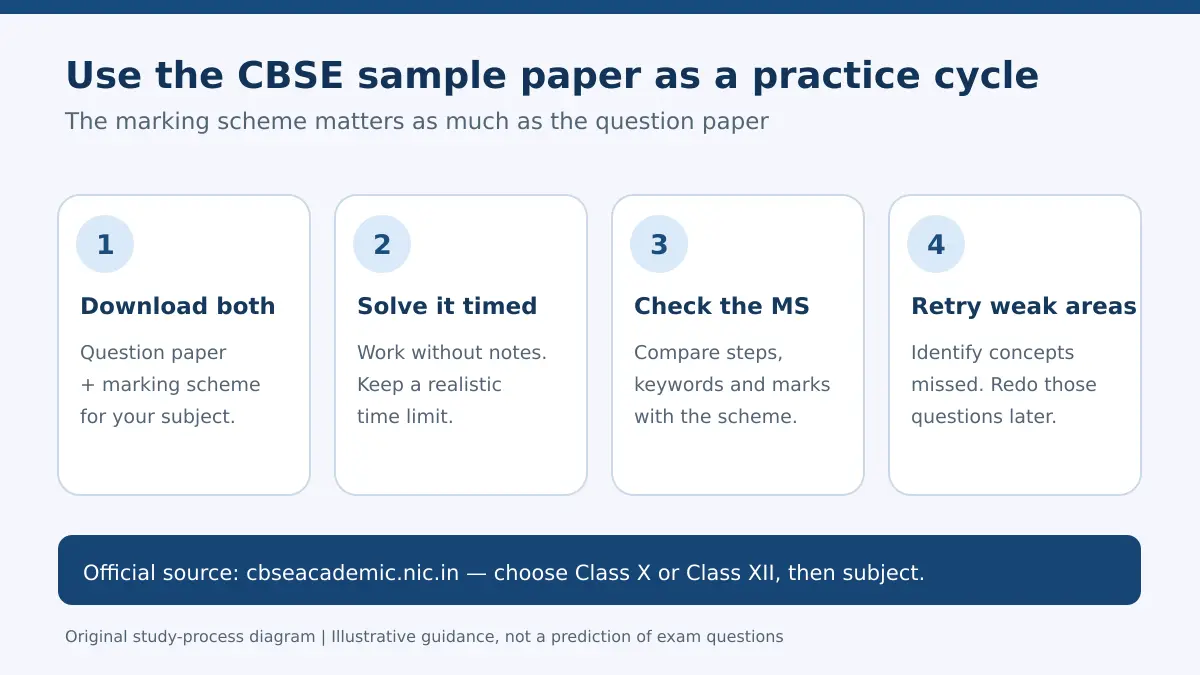
Step 1: Read the instructions before starting
Look at the overall question structure, permitted choices, marks and expected duration shown on the paper. Read any subject-specific instructions. Notice whether the paper asks you to show working, respond in a word limit, interpret a source or write a longer explanation. These details affect how you should practise.
Step 2: Attempt it under a realistic time limit
Use paper and pen if that matches your exam practice. Keep your notes closed. Set a timer appropriate to the paper instead of stopping after every question to search for an answer. If you get stuck, mark the question, move on according to your plan and return later. The aim is to discover how you perform when the clock is running.
Step 3: Evaluate with the marking scheme
Only after finishing should you compare each response with the corresponding official marking scheme. Check not just whether the final answer matches, but whether your reasoning, structure and coverage fit what the question asks. Where the scheme allows multiple correct approaches or responses, respect that flexibility.
Step 4: Record the reason for each lost mark
Create a small error log with four labels: concept not understood, question misread, method incomplete and time pressure. The labels tell you how to revise. Re-reading a chapter is useful for a concept gap; practising shorter timed answers is more useful when you know the material but regularly run out of time.
What Class 10 students should check first
Begin with the correct mathematics entry—Basic or Standard—if that subject applies to you. For Science and Social Science, inspect how questions combine recall with explanation, application or interpretation in the official SQP. In language subjects, notice the distribution of reading, writing and literature tasks and practise the expected form of each response.
Do not decide that a topic can be skipped just because it is absent from one sample paper. A sample paper demonstrates a pattern and a range of question types; it is not an exhaustive list of every examinable concept. Work from the official current curriculum and school teaching plan alongside the sample resource.
What Class 12 students should check first
Choose your exact subject and confirm that the PDF belongs to the 2026–27 session. In numerical subjects such as Physics, Mathematics or Accountancy, use the marking scheme to study the value of a complete method and correct working. In subjects such as Business Studies, History, Political Science or Economics, examine how the question asks you to interpret, justify, compare or explain rather than simply recite a definition.
Practical and project components, where applicable, require separate attention. A sample written examination paper is not a substitute for completing current school or board instructions for practical assessment. If your concern is eligibility, school lists or a private-candidate registration route, our separate CBSE 2027 registration explainer addresses that administrative distinction rather than question-paper practice.
Common mistakes that waste a sample paper
- Downloading only the SQP: you miss the matching scoring guidance.
- Using an older session by mistake: verify the 2026–27 header and official subject page.
- Reading the answers first: this measures recognition, not independent exam performance.
- Copying a model answer without understanding it: a changed question can expose a shallow memory-based response.
- Ignoring timing: a correct untimed answer may not be enough if you cannot finish the paper.
- Assuming prediction: no legitimate SQP guarantees the exact questions in the final exam.
How to use the next seven days
If your schedule is crowded, keep the plan modest. On day one, download the appropriate files and skim their structure. On days two and three, attempt one paper in a realistic session, then mark it carefully. Day four is for correcting two or three repeated misunderstandings, not revising every chapter. On days five and six, practise those question types again with questions from your textbooks or other legitimate practice material. On day seven, take a shorter timed check and review whether your error log has improved.
This is only a suggested practice routine, not an official CBSE timetable. Adjust it to your teacher’s plan, actual exam date, health and other study commitments. The larger principle is steady feedback: practise, examine the mistake, correct it and test again.
Frequently asked questions
Are the 2026–27 CBSE sample papers officially available?
Yes. CBSE Academic lists Class X and Class XII subject-wise Sample Question Papers and Marking Schemes for exam session 2026–27 on its official website.
Does the sample paper contain the final 2027 board questions?
No. It is a practice and pattern resource, not a leaked final paper or a guarantee of repeat questions.
Should I download a marking scheme for every subject?
Download the matching marking scheme for each subject you practise when CBSE provides one. It can clarify expected elements, working and evaluation patterns.
What if the subject appears under more than one name or level?
Check the subject code, title and level applicable to your school registration. Ask your teacher if uncertain; do not use the wrong mathematics level or a different language paper for practice.
Is one sample paper enough for full exam preparation?
No. It is one valuable resource. Combine it with the current syllabus, textbooks, teacher feedback, previous practice and genuine revision of weaker concepts.