
An old car may be worth more as a running vehicle than as scrap. Yet repair bills, fitness requirements and resale uncertainty can make the next decision surprisingly difficult. If you decide to send it for authorised scrapping, one document deserves particular attention: the Certificate of Deposit (CoD).
In brief: A registered vehicle scrapping facility (RVSF) can issue a CoD as evidence of the vehicle’s transfer for scrapping. Under India’s vehicle scrappage framework, a qualifying CoD can help its holder seek certain new-vehicle registration and motor vehicle tax concessions. That does not mean every owner receives a fixed cash bonus or an automatic 25% discount. The value and eligibility depend on the transaction, vehicle category and applicable rules.

What is a Certificate of Deposit in vehicle scrapping?
The 2021 rules governing registered vehicle scrapping facilities describe the CoD as proof that the vehicle’s ownership has been transferred to a registered scrapper. The facility is required to deal with the registration certificate and records as specified in the rules, and the certificate can be used for declared incentives linked to a replacement vehicle. The rules also contemplate a tradeable CoD, which is different from a cash payment for the scrap metal.
It helps to separate three things that often get mixed up: the agreed scrap value paid for the old vehicle, the CoD issued in connection with transfer to the scrapper, and the subsequent Certificate of Vehicle Scrapping after the vehicle has actually been scrapped. The documents are not interchangeable. Keep records of each step.
What benefits can a CoD provide?
Two national notifications are particularly important. The Ministry of Road Transport and Highways has stated that registration of a vehicle against submission of a CoD can qualify for a waiver of the new registration certificate fee under GSR 714(E). A separate notification, GSR 720(E), provides for a concession in motor vehicle tax of up to 25% for non-transport vehicles and up to 15% for transport vehicles registered against a CoD, subject to the applicable conditions and state implementation.
| Potential benefit | What the central policy says | What to verify |
|---|---|---|
| Registration certificate fee | Fee not levied for registration against a qualifying CoD under the stated notification | Applicable procedure when registering the replacement vehicle |
| Motor vehicle tax, non-transport | Concession up to 25% | Actual concession offered by the relevant State/UT and vehicle category |
| Motor vehicle tax, transport | Concession up to 15% | Actual State/UT concession and eligibility conditions |
| Scrap sale price | No nationally fixed private-vehicle scrap value in the cited PIB reply | Written offer from the facility and payment terms |
The policy reply also refers to periods of up to 15 years for non-transport vehicles and up to eight years for transport vehicles for the stated tax-concession arrangement. Those figures should not be misread as a universal instruction to scrap every private car as soon as it turns 15. Vehicle-age restrictions, registration renewals, fitness rules and local enforcement can be different questions. Delhi-NCR rules, for example, require particular local scrutiny.
Before comparing a new-car quotation, ask the dealer or registering authority to show how any CoD-related concession is calculated in your location. A dealer’s separate promotional discount is not necessarily a government concession, and it should not be represented as one.
How to find an authorised registered scrapping facility
Use the official V-Scrap/Parivahan vehicle-scrapping service or a transport authority’s verified channels to check available registered scrappers and the current owner application route. The Government of India’s National Government Services listing describes an online owner process that can connect owners with registered facilities. Do not assume a local metal-recycling dealer is an RVSF merely because it buys old vehicles.
Ask the operator for its registered facility identification and verify it independently. Clarify whether it accepts vehicles registered in your State, whether pickup is offered, what identity and registration documents are required, whether there is an outstanding loan or hypothecation entry to clear, and how final payment and certificates will be delivered. The official rules contemplate pan-India acceptance across registering jurisdictions, but the practical handover and record checks still matter.
The handover checklist: documents, valuation, payment, certificates
Do not treat this as a simple sale of a damaged car to a roadside scrap merchant. When a vehicle’s registration and identity are involved, an incomplete handover can create unpleasant problems later. The following order gives you a sensible conversation to have with the facility.
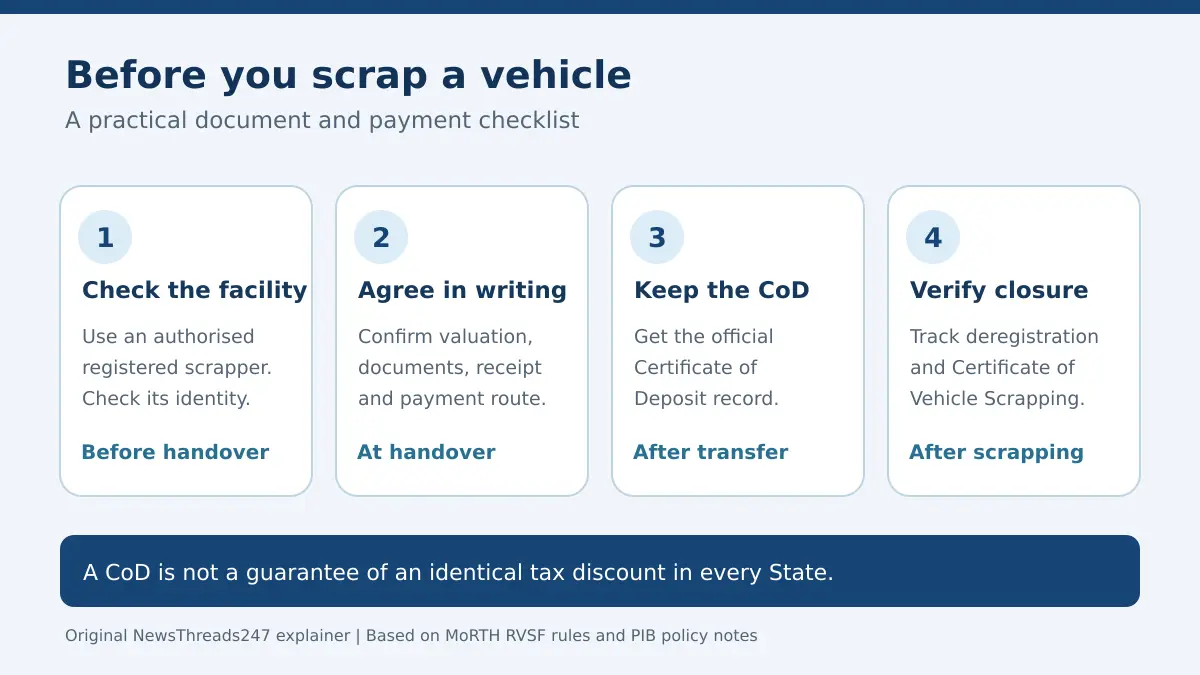
1. Verify vehicle identity and your authority to hand it over
Have the registration details and legitimate ownership documents ready. If the vehicle has a financier recorded against it, resolve the necessary lender-related steps before the final transfer. When acting for another owner, ask the facility what valid authorization it requires. Never hand over an RC or identity documents to an unverified middleman simply because they promise faster paperwork.
2. Agree on a written scrap valuation
The government’s November 2024 reply says there is no central intervention setting a fair market price for privately owned vehicles being scrapped at registered facilities. Condition, recoverable material and a facility’s offer influence the price. Ask whether towing, handling or other legitimate charges are deducted and whether the amount quoted is the net amount you will receive.
3. Obtain the CoD and a payment record
The RVSF rules specify evidence of transfer and an agreed consideration paid through the allowed documented methods. Keep the certificate reference and payment receipt. If someone tells you that a handwritten note is exactly the same as the government-linked CoD, verify that assertion with the official facility or transport authority before agreeing.
4. Follow up on deregistration and the final scrapping record
The rules require the registered scrapper to facilitate deregistration processes and provide the relevant vehicle-scrapping certificate after the work. Ask how the status will be reflected in the transport records and what confirmation you will receive. Save a copy of the handover agreement and communication until these steps are complete.
Can you sell or transfer the CoD?
The central RVSF rules describe the CoD as tradeable. They also say a certificate used to claim benefits is collected by the agency or dealer providing the benefit and marked as cancelled in the VAHAN database. In practice, do not agree to transfer or sell a CoD based only on an informal promise. Ask how the current official transfer, authentication and redemption procedures work in your case and whether the intended recipient can actually use it.
More importantly, the scrap value of your old car and the economic value of a CoD are not the same number. Someone may quote a scrap price, a proposed CoD transfer value and a potential new-car tax saving in one breath. Request each figure separately. Only then can you compare a scrapping offer against a conventional used-car sale.
Should you scrap an old vehicle or sell it as used?
Start with four questions. Is the vehicle legally permitted to continue operating in your location? What would it cost to make it reliable and compliant? What is the genuine market offer from a buyer after inspection? And what is the net scrapping offer after fees, including only confirmed incentives you can actually use?
A running older vehicle may still have resale value above its material value, while a seriously damaged or uneconomical-to-repair vehicle can make a registered facility more attractive. There is no honest one-size-fits-all answer. If you choose a normal used-vehicle sale, the used-car handover and RC checklist covers different transfer concerns; a CoD is not a substitute for that transaction.
Example: why “25% savings” can be misleading
Imagine a non-transport vehicle owner considering a new car. The dealer says a CoD may qualify for a tax concession “up to 25%.” That percentage refers to the relevant motor vehicle tax, not 25% of the ex-showroom vehicle price. If the tax before a concession were hypothetically ₹80,000, a full 25% tax concession would amount to ₹20,000—not 25% of the car’s selling price. The actual applicable concession may be lower or unavailable under the local conditions, so this example is only arithmetic, not a quotation of a benefit.
Also keep the separate registration-fee rule and any manufacturer promotions on distinct lines of the written quotation. That makes it possible to see where each amount comes from and which part is guaranteed before payment.
Questions owners commonly ask
Is scrapping every vehicle older than 15 years compulsory across India?
No such blanket statement follows from the CoD tax-concession rules. Check the registration, fitness and local restrictions applicable to the specific vehicle and location, especially where end-of-life vehicle enforcement rules apply.
Does the government set the scrap price?
The cited MoRTH/PIB reply says the price for privately owned vehicles scrapped at RVSFs is decided by market forces and the vehicle’s condition. Negotiate the offer and keep a written record.
Is the Certificate of Deposit the same as the final scrapping certificate?
No. The CoD relates to the transfer to the registered scrapper and declared incentives. The Certificate of Vehicle Scrapping records the later scrapping process under the facility rules.
Can I claim a full 25% discount on the new car?
No. The central provision describes a motor vehicle tax concession of up to 25% for qualifying non-transport vehicles, not a flat percentage off the full car price. Actual eligibility and implementation must be checked locally.