
A used car that drives well on a ten-minute test drive can still carry paperwork delays, deferred mechanical repairs or unpaid liabilities. A useful delivery checklist therefore has two independent tracks: confirm the car is what the seller says it is, and verify that title, finance, insurance and transfer obligations are handled. Neither a vehicle-number lookup nor a glossy “certified” sticker replaces an inspection by someone who works for the buyer.
The safest order is to check the vehicle identification number (VIN/chassis number) and records first; inspect the car in daylight and on a lift when possible; complete a controlled test drive; reconcile ownership and payment terms; and only then release the balance. This guide is for private used-car purchases in India as of 1 November 2026. Registration and document requirements may differ by state, transaction type and registration authority.
The seven checks before you pay for a used car
| Stage | What to verify | Pause the deal if… |
|---|---|---|
| 1. Identity | VIN/chassis and engine numbers against RC and service documents | Stamping is obscured, altered or inconsistent |
| 2. Title and finance | RC particulars, seller identity and any hypothecation entry | Seller cannot explain a lender charge or transfer path |
| 3. Public dues | Pending challans/blacklist, tax and any RTO matter | Dues are unresolved without a written settlement plan |
| 4. History | Invoices, service chronology, recall or major-repair disclosure | Odometer, dates or repair explanations conflict |
| 5. Physical condition | Structural, engine, tyres, braking, electronics and underbody | Inspection is refused or unsafe faults remain |
| 6. Insurance | Current policy, cover and how transfer/endorsement will be handled | Cover or transfer arrangements are unclear |
| 7. Handover | Payment evidence, signed delivery note, keys and transfer reference | The parties cannot document what was exchanged |
Use this table as a stop/go sequence, not a promise that every source can certify the vehicle. A clean public challan search, for example, does not certify accident history, nor does a full service booklet prove a car has never been repainted.
1. Match the registration number, VIN and physical car
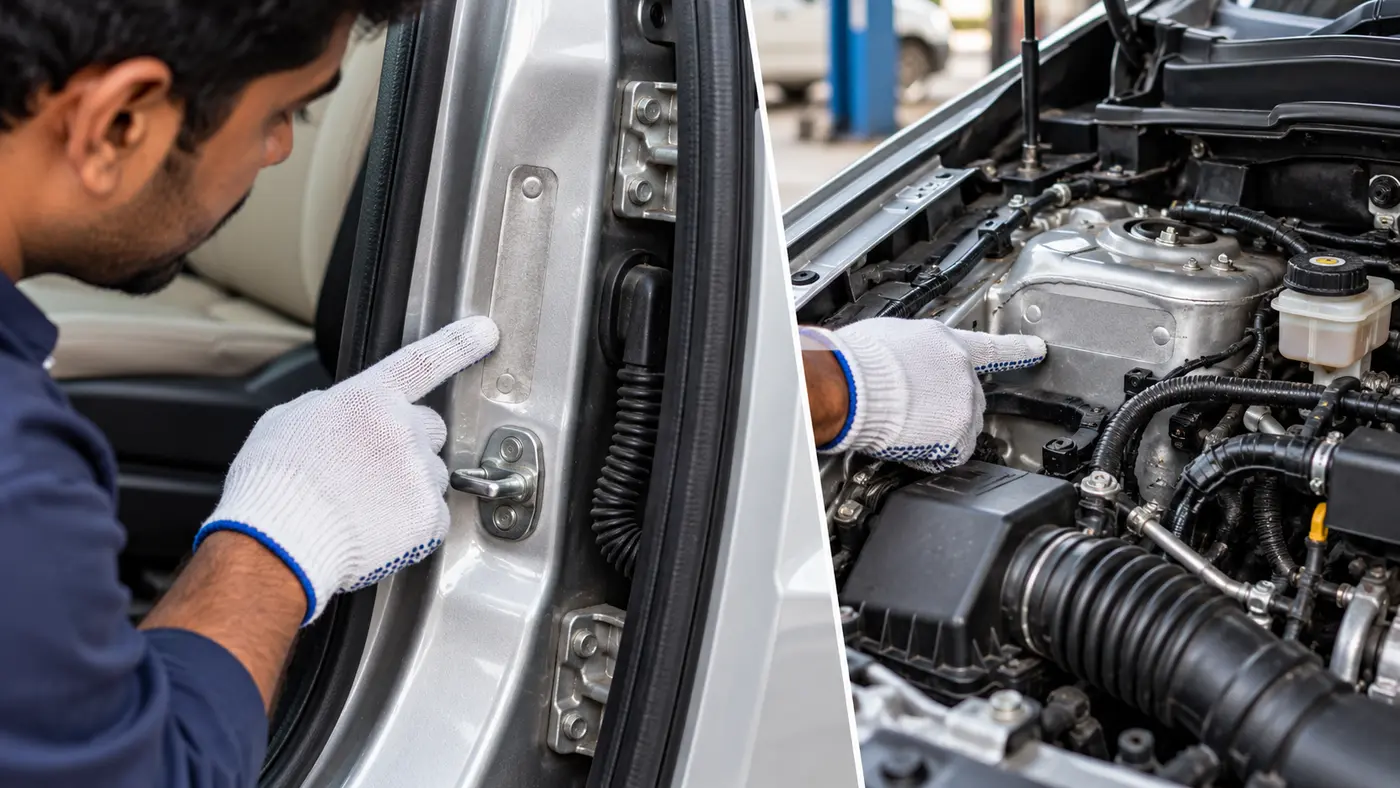
Begin with the original registration certificate (RC) or verifiable digital RC and the seller’s authority to sell. Check the registration number, manufacturer, model, fuel type, registration date and chassis/engine identifiers wherever those fields are legitimately accessible. The chassis/VIN is typically found at manufacturer-specified points such as a dashboard viewing area, door aperture or stamped panel; locate it from the model’s owner manual rather than guessing. Match the actual stamping to the RC and insurance details, allowing for any lawful masking of public digital data.
Ask to see an invoice or service document carrying enough identifier digits to cross-check. A mismatch can be a typing error, but it also needs an official explanation before money changes hands. Photograph documents only with the owner’s permission and store them securely; never post a seller’s RC or identity numbers publicly. Government data services can limit access, require OTP or charge a fee—do not use unauthorised “full owner history” websites.
2. Check challans, blacklisting and the finance entry separately
The transport ministry’s eChallan portal and VAHAN citizen services provide relevant official checks, subject to access, state integration and live record availability. A registration-number lookup can help surface pending enforcement or administrative issues; check the appropriate state or RTO portal where the national view is incomplete. The ministry’s vehicle-status lookup also describes checks for insurance, PUCC and challans. Take a dated result or receipt, but remember that a clear screen means “nothing displayed here at this moment”, not “nothing exists anywhere”.
If the RC indicates a bank/NBFC hypothecation charge, ask for the original financier’s closure/no-dues certificate and confirmation that the termination has been processed or will be completed before transfer. The ministry’s hypothecation guidance describes Form 35, financier involvement and relevant supporting documents. A verbal “loan is closed” statement does not prove the RC record has been cleared. If a loan is still active and the transaction contemplates simultaneous payoff, obtain written lender directions, account details and a release sequence; do not send the payoff to an unrelated personal account.
3. Build a service timeline rather than counting stamps
Request dated service invoices with kilometres, job descriptions, parts and workshop identities. Plot successive odometer readings and compare them with the instrument cluster, tyre manufacture dates, interior wear and the seller’s claimed use. A gap in invoices is not proof of fraud; it is a reason to price additional inspection into the deal. Conversely, a neat service booklet cannot establish that no repairs were done elsewhere.
Look for recurring coolant loss, transmission work, repeated fault codes, battery failures and major insurance repairs. Ask whether any structural work, airbag deployment or flood exposure occurred, and request written supporting evidence when the answer matters to your price or safety. Our separate airbag-repair records explainer explains why restraint-system invoices deserve their own check. For cars under recall, use the manufacturer’s authorised VIN-specific recall process, not a model-wide assumption.
4. Pay for a genuinely independent mechanical inspection
A seller’s multi-point certificate may be useful as one document, but the buyer should engage an independent trained technician or an authorised workshop of the model’s brand if possible. Agree the cost and scope in writing: cold start, diagnostic scan, underbody and lift inspection, steering/suspension, braking, tyres, leaks, cooling, charging, electrical systems, air-conditioning and road-test behaviour. Check that the specialist has permission and safe facilities to lift the car; do not crawl beneath an unsupported vehicle.
Test from a cold engine where feasible, inspect panel gaps and fresh paint under natural light, look for uneven tyre wear and listen for unusual noises over different road surfaces. A short car-park loop will not reveal every issue, so include city-speed driving, safe braking and a roadworthy check. For electric vehicles, request a battery-health assessment where the manufacturer offers one and check warranty transfer rules; see our EV battery warranty guide. Treat unexplained dashboard warning lights as a hold, not a negotiation flourish.
An inspection is a risk-reduction service, not a guarantee against hidden defects. Ask the technician to rank findings as safety-critical, urgent cost, routine maintenance or cosmetic, and estimate repair ranges only with vehicle-specific evidence. Record defects before agreeing a final price. If the seller refuses an inspection without a sensible reason, be prepared to walk away.
5. Understand ownership transfer before the payment
For an ordinary sale, the government’s ownership-transfer guidance identifies Form 29 as the seller’s notice of transfer and Form 30 as the buyer’s transfer application. It also describes different filing periods for within-state and out-of-state transactions and possible extra documentation. Do not treat the entire process as complete merely because papers have been signed or an online form has been started. The registered owner name must ultimately be updated in the transport records.
Ask who will initiate the VAHAN transfer, pay the prescribed charges, submit any original RC/NOC or tax documents, and respond to RTO queries. The portal’s transfer-of-ownership walkthrough shows that the registered-owner-linked login and OTP steps can matter. If the seller is acting for somebody else, verify written legal authority. Cross-state purchases, lender charges, inherited vehicles and cars with pending legal proceedings need additional work; seek the relevant RTO’s current requirements before paying.
6. Insurance and pollution certificate: verify, then transfer
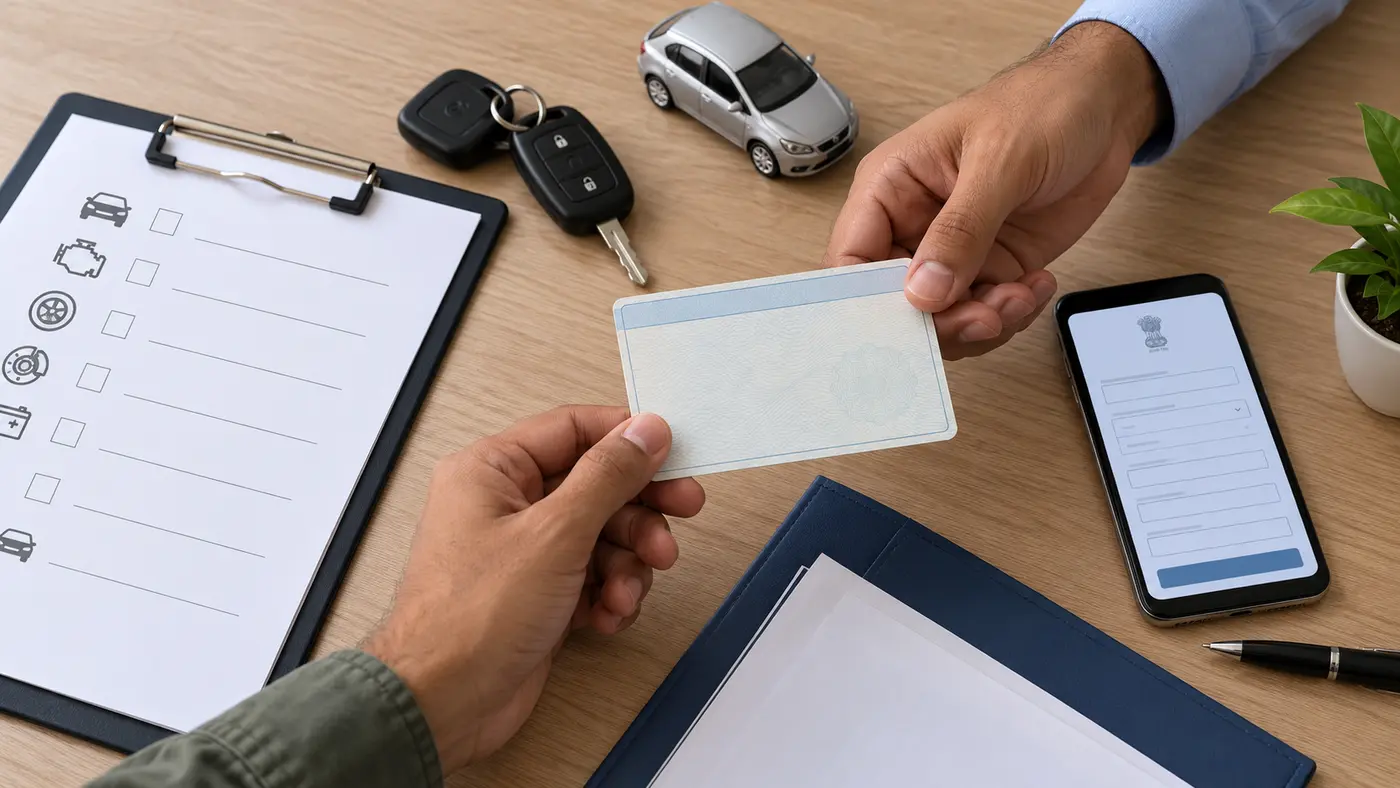
Check policy validity, vehicle identification, declared cover and any pending claims disclosed by the seller. A policy remaining in the seller’s name is not the same as establishing the buyer’s cover for every risk and driver. Speak directly to the insurer about the change of ownership, endorsement, applicable deadlines and any fresh inspection required; retain written confirmation. A seller’s no-claim discount is not automatically the buyer’s discount. Also inspect the pollution-under-control certificate and whether a fresh test is due; coverage and testing rules vary by vehicle type and local law.
Separate “can the car legally be driven home today?” from “has permanent registration transfer finished?” Agree who bears a loss, violation or damage during the transition and arrange valid cover before driving. Do not rely on a payment receipt as an insurance document.
7. Make the final payment and handover auditable
Prepare a signed sale agreement or delivery memo identifying the seller and buyer, registration number, VIN (recorded privately), actual odometer reading, sale price, date and time, payment trail, disclosed defects, included equipment and the RTO/insurance obligations each party accepts. Transfer money only to the verified contractual party through an auditable channel; do not accept a demand to split the sale into an undocumented “cash balance”. For a dealer transaction, note the dealer entity and invoice/GST details where applicable.
- Before balance payment: RC and VIN match; seller’s authority verified; inspection findings acknowledged; challan/loan resolution documented; insurer contacted; transfer process agreed.
- At handover: two keys if supplied; owner manual; service invoices; tyre/wheel tools; charger or accessories where applicable; receipt; delivery time and odometer signed by both sides.
- Immediately after: submit the transfer in the correct channel; track the application reference; obtain policy endorsement; preserve all official acknowledgements and check the final RC update.
- Stop signs: overwritten VIN, unexplained financier charge, seller refusing identity checks, unsafe structural/brake issues, forged invoices or pressure to pay before inspection.
Example: a good-looking car with a bank entry still on the RC
Consider a six-year-old hatchback whose seller offers a reasonable price, clean-looking service invoices and no challan visible in the first lookup. The RC still shows a lender. Even if the seller produces a mobile screenshot saying the loan was paid off, the buyer should request lender-issued closure evidence and the Form 35/termination path. Put a written condition in the agreement that the transfer cannot be completed until the charge is resolved and decide who bears the delay or cancellation cost. Do not presume the absence of challans somehow removes a finance encumbrance.
By contrast, a dealer that supplies the full inspection sheet, original lender closure confirmation, accessible vehicle records, written transfer commitment and an agreed insurance plan reduces several distinct risks. The dealer badge alone does not do that work. Preserve each source as a separate check.
Frequently asked questions
Is checking the registration number enough to know the accident history?
No. An official public vehicle-details or challan lookup is not a comprehensive accident, flood, theft, insurance-claim or repair-history report. Ask for service and claim documents, inspect the vehicle and obtain records lawfully available to you.
Can I take delivery before the RC changes into my name?
Transfer processing can take time, but taking possession is not a reason to skip the required applications. Have signed documents, an auditable handover time, an agreed application plan and valid insurance arrangements. Follow the current RTO and insurer rules for your situation.
Who should pay pending traffic challans?
Settle responsibility explicitly in the sale agreement and confirm outstanding liabilities through the relevant official portal. Do not assume a private agreement erases an authority’s record; ensure it is resolved to the RTO’s satisfaction before transfer.
Do I need the original RC and two car keys?
The required RC document or accepted electronic equivalent depends on the transport process; the RTO can specify whether originals must be submitted. Two keys are desirable but not universal. Price a missing spare and check immobiliser/key programming before purchase.
Official sources and methodology
Reviewed on 1 November 2026: MoRTH transfer guidance, loan termination guidance, VAHAN citizen services, eChallan, transport vehicle-status report and manufacturer-operated used-car inspection/documentation discussion. The editorial photographs are original conceptual illustrations, not pictures of a car in the story. This guide does not endorse a specific dealer or third-party vehicle-history service.
This is general buyer information, not legal, engineering or insurance advice. Laws, RTO workflows, insurer procedures and vehicle-specific requirements can change. Confirm your exact case with the relevant official agency and qualified independent inspector before making a purchase.