

A teacher’s name in Common App does not tell you whether every college on your list will receive that teacher’s recommendation. Before submitting a US first-year application, check the college’s requirements, the teacher’s assignment to that college and the recommendation’s submission separately. Then check the college’s own applicant checklist when it becomes available.
Common App allows you to submit your application before your counselor or teachers submit their forms. That flexibility can prevent an unnecessary delay to your part of the application, but it does not create a universal extension for school documents. The institution’s stated requirements still matter.
Begin with the college, rather than the invitation list
Open the relevant college in My Colleges and read its recommendation requirements before arranging extra letters. Common App’s first-year application guide explains that institutions choose their own requirements. A teacher, school counselor, coach and application advisor perform different roles; having more names attached to your account is not a substitute for the required type of recommendation.
For example, imagine one college requires a teacher recommendation and another permits an optional letter from a different kind of recommender. A coach’s letter may be useful where accepted, but do not assume it fills a teacher requirement elsewhere. This is an illustrative planning problem, not the policy of a named college. Read what each institution actually requests.
Make a short record for each college: entry term, application plan, required recommender roles, number of letters accepted, application deadline and any separately stated school-document deadline. Keep the source link beside each deadline. An early-action date for one college should not migrate into the row for another.
Adding and assigning are separate checks
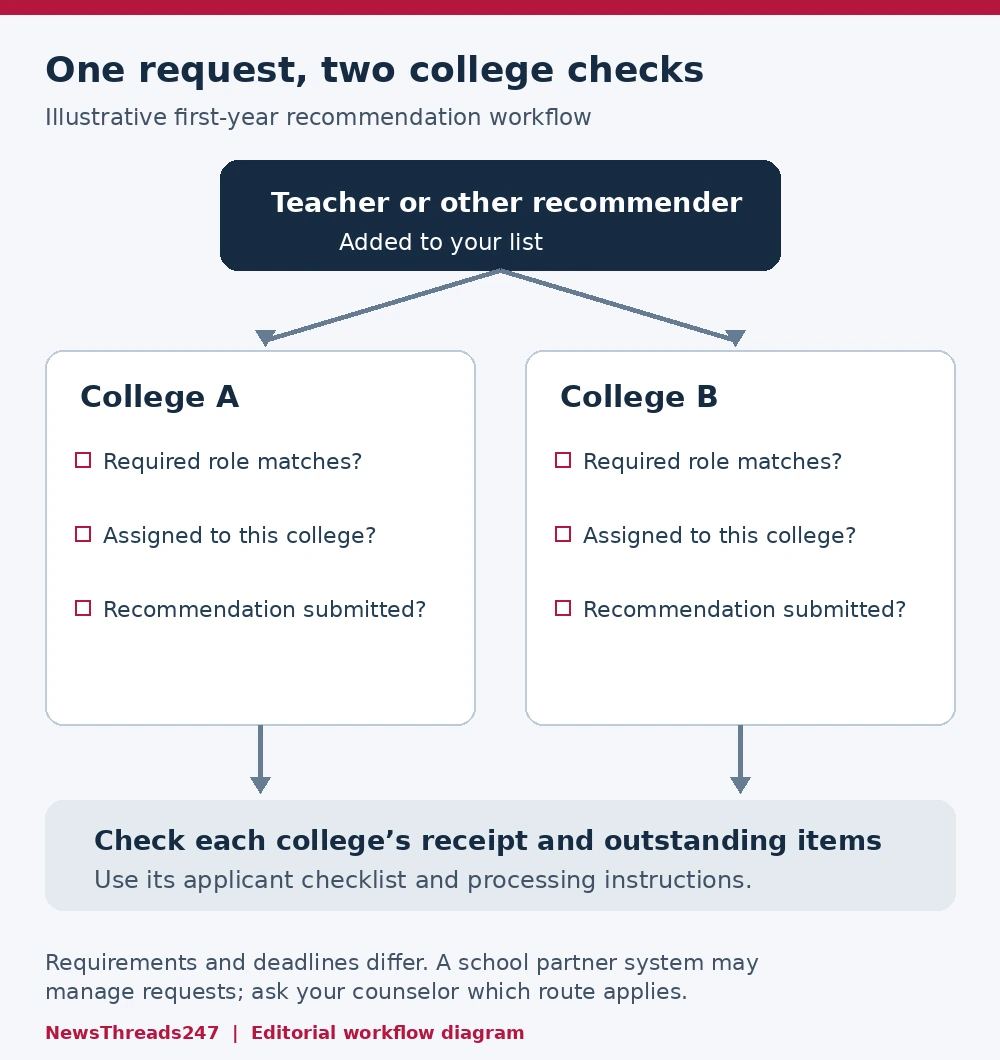
Common App’s assignment instructions say that a teacher or other recommender added to the management list must also be assigned to a college for that recommendation to be sent there. The assignment needs to be repeated for the relevant schools and recommenders. Assignment to at least one college also triggers the invitation email for those recommender types.
The documented route is through a college’s Recommenders and FERPA section in My Colleges. Find the teacher or other-recommender area, select the intended person and use Assign. Optional recommendations may require Add Another. Check the selected college again after the action instead of assuming an invitation has covered the entire list.
Suppose you ask the same teacher to support applications to College A and College B. A completed assignment for A does not establish an assignment for B. Your useful check is not simply “Did I ask the teacher?” It is whether that teacher is attached to each college that should receive the letter and meets that college’s stated role requirement.
Use your school’s route when it has a partner system
The ordinary assignment instructions are not the whole workflow for every high school. Common App’s counselor and recommender guidance says counselors who use an integration partner submit forms through that partner. If your school uses a partner system, ask your counselor how its teacher requests and assignments should be handled before creating competing requests.
The practical handover is a clear list of colleges, plans and deadlines, together with the exact issue you see. If your school manages teacher requests elsewhere, a missing control in Common App may reflect that arrangement. It is more useful to identify the school’s process than to repeatedly add the same teacher through different routes.
Decide what you can submit while a letter is pending
The official submission-before-recommendations answer confirms that the applicant’s application can be submitted before school forms, whether the counselor or teacher uses online or paper submission. It also tells applicants to follow up so recommendations can be completed by the school’s stated application deadline. Do not turn the platform’s ability to accept later material into a promise that a college will treat it as timely.
If your own application is ready but a letter is not, separate the two decisions. Review and submit your part by its applicable deadline. Contact the recommender about the outstanding form, and read the college’s published document policy. Where the policy is unclear or the deadline has passed, ask the admissions office about your specific situation rather than relying on another applicant’s experience.
A useful follow-up gives the recommender the college name, the role requested, the relevant deadline and the status you can actually see. Ask whether the invitation arrived and whether anything remains to be submitted. Avoid asking to see or edit a confidential recommendation, or assuming a saved form has been sent.
Keep submission evidence and receipt evidence together
After completing your application, save its submission confirmation. Separately record the recommendation status displayed for each assigned college. When the college supplies access to its applicant portal, use its checklist and processing instructions to check whether required materials have reached the institution. If the two systems appear different, note the exact item and the time you checked.
Do not send a second copy or create a new recommender account merely because a college’s checklist has not updated immediately. Follow that college’s stated processing interval first. If the interval has passed, ask the office which item is missing and what submission route it wants. This preserves a useful record and avoids multiplying versions of the same document.
Application help and recommendation submission also differ. Common App’s guide says advisors do not submit forms; counselors submit school records and recommendations describe students from the writer’s perspective. Choose support based on the task that remains, rather than assuming an advisor invitation supplies a missing school form.
Finish with a college-by-college handover
Before leaving the application, check one complete college record at a time: the requirement is identified, the correct person is assigned through the school’s actual system, the applicant’s part is submitted, and outstanding documents have an owner and a deadline. Repeat for the next college. A single “recommendations done” note is too vague when the underlying requirements differ.
Keep the financial side of submission separate too. Our Common App fee-waiver explainer covers the request and confirmation process. A fee waiver, a submitted application and a received recommendation are different checks on the route to a complete file.
Official guidance checked on 30 October 2026. This article concerns Common App first-year applications to US colleges. It does not establish a common deadline, guarantee acceptance of late materials or report access to a student’s private application.
Visual credits: NewsThreads247. Featured and contextual images are AI-generated conceptual illustrations; the in-article diagram is an editorial guide, not an application interface or actual applicant record.