

A CSS Profile noncustodial-parent waiver is a request for a college to excuse a particular parent-information requirement. It is not an automatic approval, a waiver of every financial-aid document or the same thing as a CSS Profile application-fee waiver. Start by checking whether the college requires that parent’s information for your entry term and aid year.
That first check has a concrete 2026 application-season example. Baylor’s current waiver page says CSS Profile is no longer required for students entering from Fall 2027. Students seeking need-based aid for Spring or Summer 2027 still fall under Baylor’s 2026–2027 CSS Profile instructions. An old checklist without the entry term can therefore send a family toward a request it may not need.
Check whether the requirement applies before requesting an exception
For US college applications, create a separate financial-aid record for each institution. Write down the entry term, aid year, applicant category, required forms and official financial-aid contact. If you are applying internationally, read that institution’s instructions for international applicants; do not assume a form used by a US citizen is available or sufficient for you.
Baylor’s admissions aid page corroborates the Fall 2027 change and distinguishes FAFSA routes from its Baylor International Financial Aid Application. This is an institution-specific change, not evidence that CSS Profile has ended across US colleges. The useful lesson is to check the current entry-term instructions before carrying forward last year’s form list.
If a college still requires information from a noncustodial parent, find its own waiver instructions. Read which form it accepts, what supporting material it requests, how to submit it and whether it states a deadline. An admissions application date and a financial-aid document date can serve different purposes; record each one as the college describes it.
One form can lead to several independent decisions
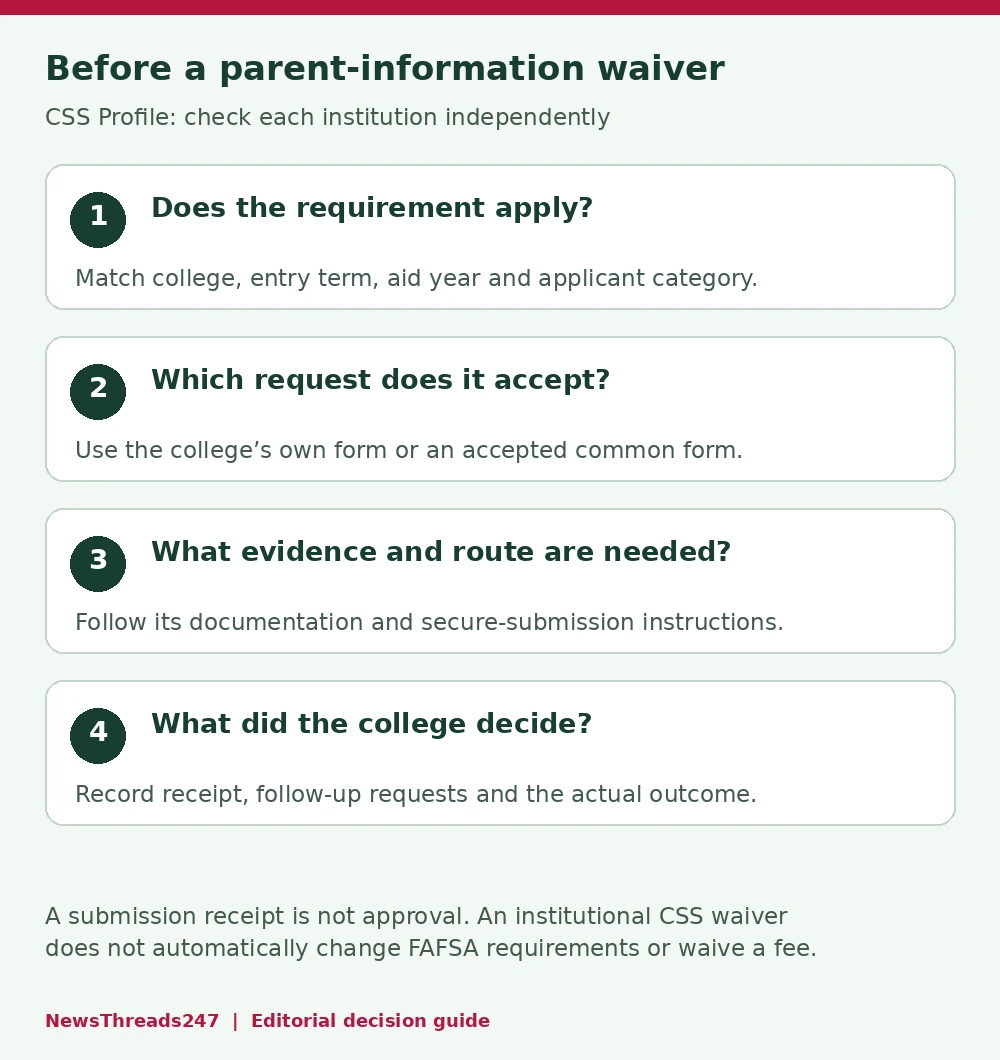
College Board’s current help answer says a waiver request can be submitted to colleges, some of which use their own form. Each college decides whether it will excuse the noncustodial parent’s CSS Profile application. The central form is a way to request a decision, not a decision issued on behalf of every institution.
The College Board request form tells applicants to confirm that an institution requires the parent information and accepts that version of the waiver. It also says approval is not guaranteed and additional information may be requested. Keep a copy of the version you submit and a separate record of where you sent it.
Consider a student applying to two colleges. College A accepts the College Board form, while College B directs applicants to its own process. Sending A’s packet does not complete B’s requirement. Even if both accept the same form, record each college’s receipt, requests for more evidence and eventual decision separately. This is an organizational example, not an account of an individual student’s outcome.
Explain the circumstances accurately and use the requested evidence
Follow the form’s questions and describe what you know. Do not invent dates, contact history or another person’s financial details to make an incomplete answer look complete. Where information is unknown, use the form’s permitted way of reporting that and ask the aid office when clarification is needed.
The College Board form identifies lack of contact, contact-limiting legal orders and abuse-related situations as examples that institutions may consider. It also points to possible third-party evidence. These examples do not establish that everyone with one of those circumstances will receive approval; the receiving institution determines its requirements and decision.
Cornell’s instructions, for example, require third-party supporting documentation and say a parent’s refusal to provide information or support does not itself constitute a waiver. Treat that as Cornell’s stated rule. A family disagreement about paying tuition should not be described as no contact if contact exists. Ask the college which process addresses the actual circumstances.
If obtaining records or contacting a parent could create a safety concern, explain that concern privately to the financial-aid office and ask what alternatives it can consider. Use the institution’s approved secure submission route for personal records. There is no reason to post sensitive family documents in public forums to obtain advice about a form.
Keep the CSS request separate from federal-aid questions
Tufts’ parent-information policy makes an important distinction: its waiver approval applies to Tufts institutional aid, while federal-aid eligibility is determined separately under FAFSA requirements. It requests a written explanation and supporting evidence for its own review. Do not assume an institution’s CSS decision changes your FAFSA obligations.
Likewise, requesting an exception to parent information does not by itself remove an application fee. If cost is the issue, use the relevant fee-waiver guidance. If unusual family circumstances prevent completion of another form, contact the office responsible for that form. Naming the exact problem helps the institution direct you to the right process.
Track the request until the college gives an answer
After submission, keep the confirmation, the list of documents supplied and any reference number. Follow the college’s stated processing instructions, check its aid checklist and respond through its approved channel if more information is requested. A receipt confirms delivery of a request; it does not tell you that the requirement has been waived.
If no response has arrived near a relevant deadline, ask the office what remains outstanding, whether it has your packet and which steps you should complete while the request is reviewed. Do not choose a later date from another college’s website or assume a request pauses all aid deadlines. Where the college gives case-specific instructions, retain them with your record.
If a request is denied, ask what information or process remains available under that institution’s rules. This article cannot predict an appeal outcome or whether aid will be offered. Keep an affordability decision tied to the actual financial-aid offer, rather than a hoped-for waiver or an estimated award.
For another part of that record, our FAFSA submission-summary guide explains how processing a form differs from receiving an aid offer. Complete-file checks are useful because application platforms, institutional decisions and financial offers each answer a different question.
Sources checked on 30 October 2026. This is a US college-aid process explainer. College, entry-term, applicant-category and aid-year rules control; no waiver approval or financial-aid award is guaranteed. No private family records were accessed for this article.
Visual credits: NewsThreads247. Featured and contextual images are AI-generated conceptual illustrations; the in-article diagram is an editorial guide, not an application interface or actual applicant record.