
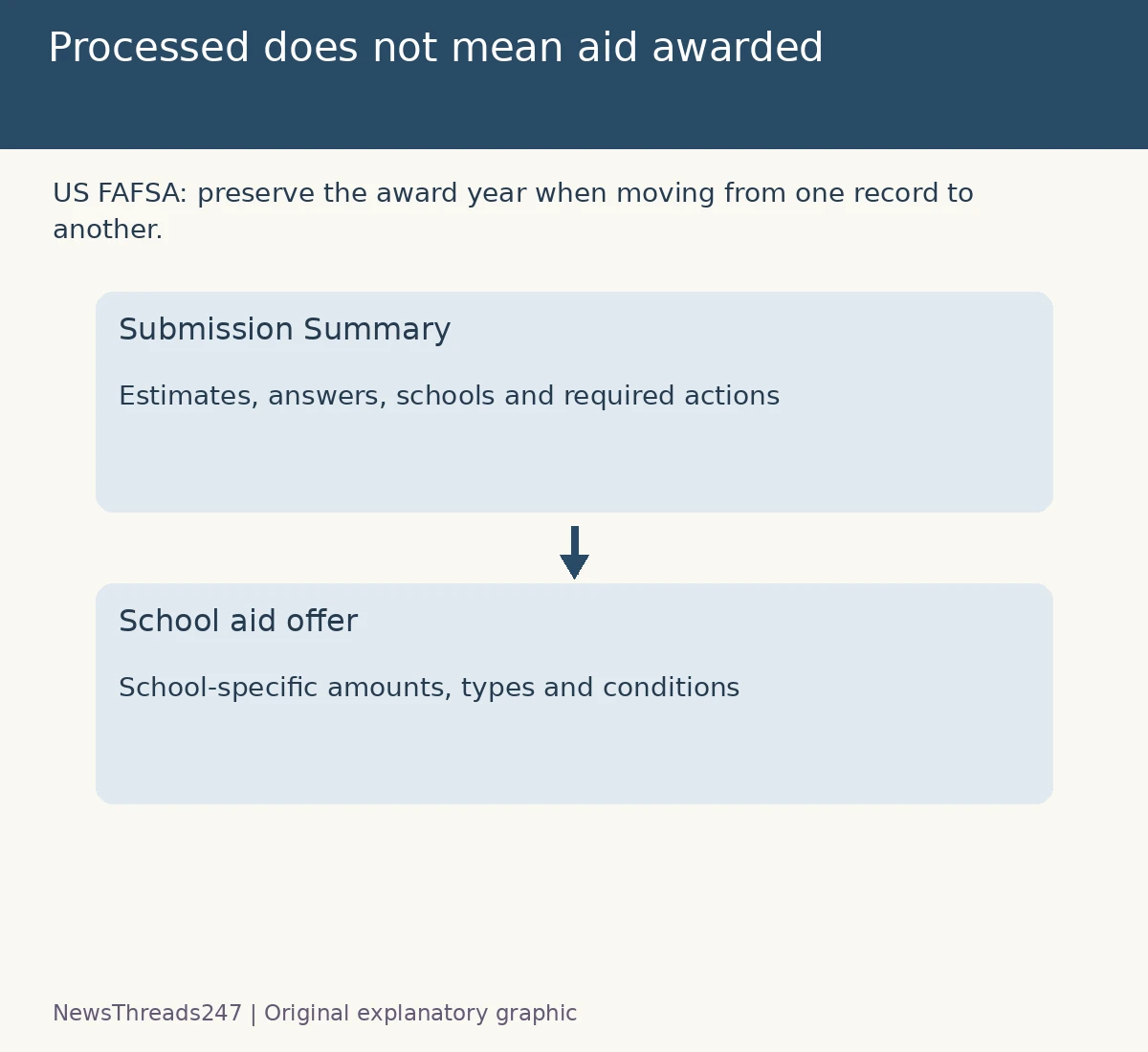
A processed FAFSA form is not a promise that a college has awarded the amounts on the screen. For US students, the FAFSA Submission Summary is a checkpoint for estimated eligibility, reported answers and required actions. The school’s financial aid offer is a separate document. Read both for the correct award year before deciding what money is available.
Federal Student Aid’s 2027–28 availability announcement confirms that the form is available for study between July 1, 2027 and June 30, 2028. Students who successfully submitted during early testing do not need to resubmit. The next useful action after processing is review, rather than opening another form because an aid offer has not arrived.
Start with the year and the actual status
Sign in through StudentAid.gov and identify the relevant FAFSA submission in the account dashboard. Keep the award year and processed date with your notes. A student applying for a future year can also have records for another year; a familiar name on a document does not establish that it is the record the school needs now.
FSA’s after-submission guide distinguishes a draft, a form in review, action required and a processed form. If the record needs action, read the actual message. Do not treat a screenshot from a relative’s account or an earlier submission as confirmation that your current form is complete.
The official summary explainer says only the student can access the full Submission Summary, rather than a parent or spouse contributor through their own account. Review it together where helpful, while keeping individual account credentials private. Our FAFSA contributor guide covers that earlier role; contributing information is a separate issue from receiving an award.
Read actions before treating an estimate as usable money
The summary has Eligibility Overview, FAFSA Form Answers, School Information and Next Steps. Use the first for an overview, then examine the answers and selected schools and read every relevant Next Steps comment. Some comments provide information; others require a correction or documents. Merely seeing an eligibility number does not mean the remaining work can be skipped.
FSA explains that the Student Aid Index, or SAI, helps determine eligibility; it is not the family’s bill or a dollar award. Write it down as an index, with its label. Do not subtract it from a college price and present the difference as the grant that college must pay. Likewise, an estimated federal aid figure is not a school-specific commitment.
Choose the right route for the issue
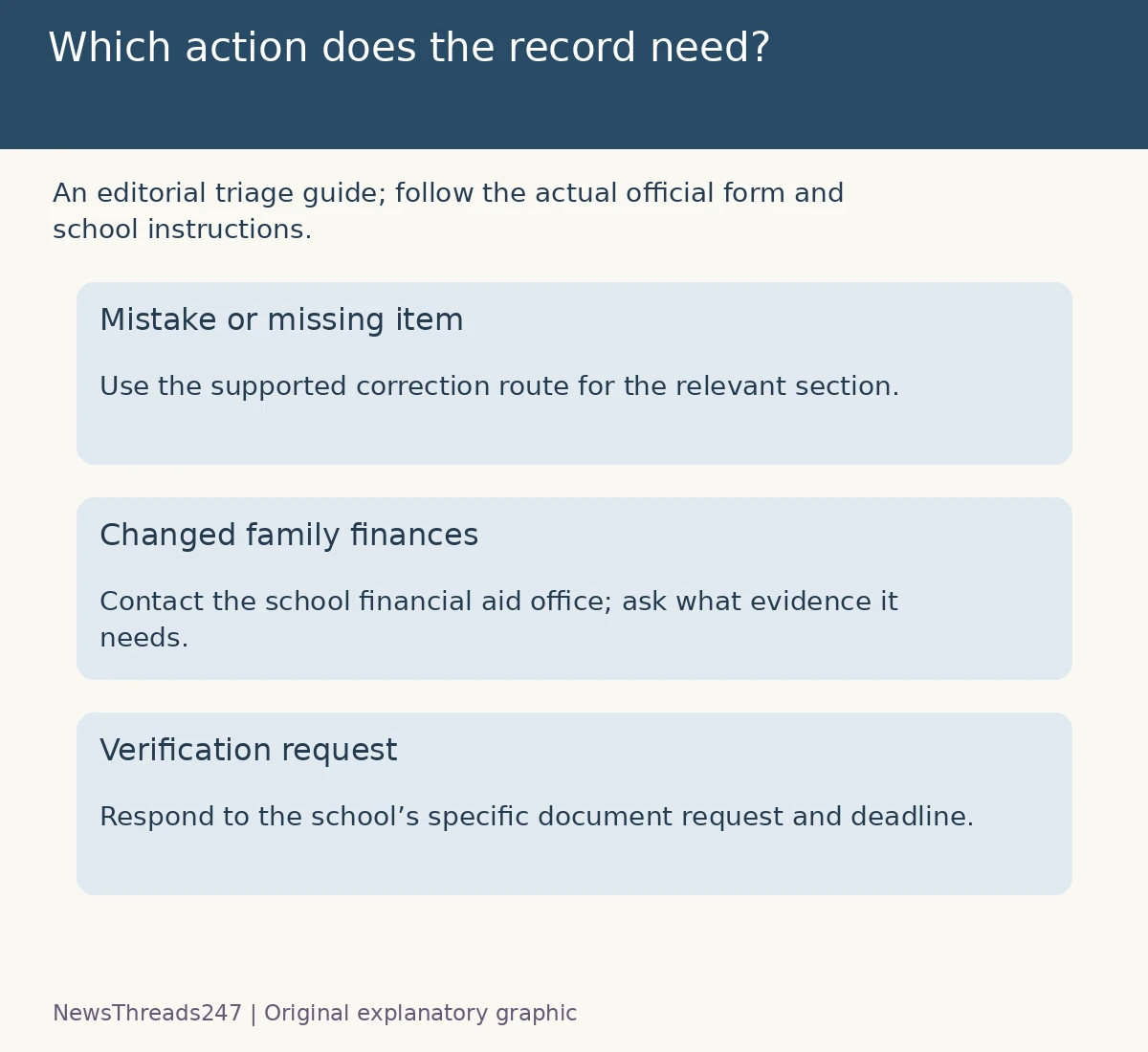
A typo and a later loss of household income are different problems. FSA’s after-submission guidance describes online corrections after processing, including correcting mistakes, adding a missing signature or consent, and changing selected schools. Follow the actual correction flow for the record concerned. Contributors need their own accounts to correct their own information.
FSA’s aid-adjustment guidance directs students with substantially changed financial circumstances to the school’s financial aid office after submitting. For example, if a parent lost a job after the tax year represented on the form, the task is to explain that change and ask what documentation the school needs. It is not to replace a required historical answer with a guessed current amount.
A useful enquiry states the award year, what has changed, when it changed and which part of the record or offer is affected. Ask for the school’s supported process and deadline. Send sensitive documents only through its verified channel. This article cannot decide whether an adjustment will be granted or how much aid a family should expect.
Verification is a request to answer, not an accusation
The official FAFSA process guide says that students selected for verification will receive school instructions about the evidence required and its deadline. Selection does not itself mean wrongdoing. Read the request rather than collecting a generic folder of documents and hoping it is enough. If one required item is unavailable, ask the office how to handle that specific gap.
Keep an action log with four fields: request, office or channel, due date and completion evidence. “Uploaded” and “accepted as complete” are different stages. If the portal still marks an item missing, retain the upload confirmation and ask about the mismatch. Avoid repeatedly changing unrelated FAFSA answers to make a school’s document request disappear.
Use a school offer to answer the school-cost question
The school’s aid offer identifies the types and amounts it is offering after its review. The summary does not replace it. FSA’s process guidance also notes that some offers sent before verification are estimates. Read any conditions and unresolved requests on the actual offer rather than assuming the heading “award” settles everything.
Imagine a fictional student whose summary contains an estimated federal grant and whose college later sends an offer with grants and a loan option. The student should not add the earlier estimate to the later grant line without checking whether they describe the same aid. That would risk counting one source twice. A loan option also should not be relabelled as money that never has to be repaid.
For comparing the remaining cost, use the school’s complete cost information and the actual offer. Our college net-price guide addresses that separate comparison. The current article’s job is to get the application record and required actions into a reliable state before those figures are used.
Check deadlines at the right level
The official 2027–28 process page gives June 30, 2028 as the federal submission deadline, while warning that states and schools can have earlier deadlines. That date is not permission to postpone a document request from your college. Record the deadline for the actual action and source, rather than keeping one undifferentiated “FAFSA deadline” on a calendar.
Finish by keeping the latest processed record, any correction confirmation, school requests and the eventual offer together by award year. Review unresolved actions again when the school contacts you. The result you want is a clear account of what is estimated, what needs action and what the school has actually offered—not simply a reassuring number on the first screen.
Sources and visual credits
US official sources checked October 28, 2026: Federal Student Aid’s 2027–28 announcement, Submission Summary explainer, after-submission guide and FAFSA process guidance. No personal aid eligibility or account was assessed. The example is fictional. Featured art is AI-generated conceptual artwork; the two original graphics are explanatory aids, not a government form or account interface.