
If an Indian college has delayed a fee refund, organise the withdrawal and payment timeline before sending another general reminder. UGC’s letter dated October 7, 2026, published on its website on October 16, seeks Governors’ intervention over persistent non-compliance. It does not, by itself, announce a new refund percentage or a fresh deadline for every student.
The useful next step is to identify the applicable admission-cycle directions, show when and how you withdrew, obtain the institution’s calculation and use the correct grievance process. A complaint should make the unresolved point easy to assess. This guide explains that record-building process; it cannot determine an individual student’s entitlement.
What changed in October—and what did not
The October 7 letter says that complaints remained unresolved despite earlier circulars, forwarding grievances and follow-up with institutions. It asks for intervention to secure compliance with the fee-refund guidelines. The letter’s date and its October 16 website publication date are different; neither should be substituted for your college’s admission or withdrawal date.
Its attached earlier material also needs its original year preserved. A deadline printed in an older circular does not become a 2026 deadline because the document is attached to a 2026 letter. Before claiming a particular deduction or full refund, identify the current policy that covers your institution, programme, admission cycle and withdrawal timing. Ask the institution to identify the provision it is applying.
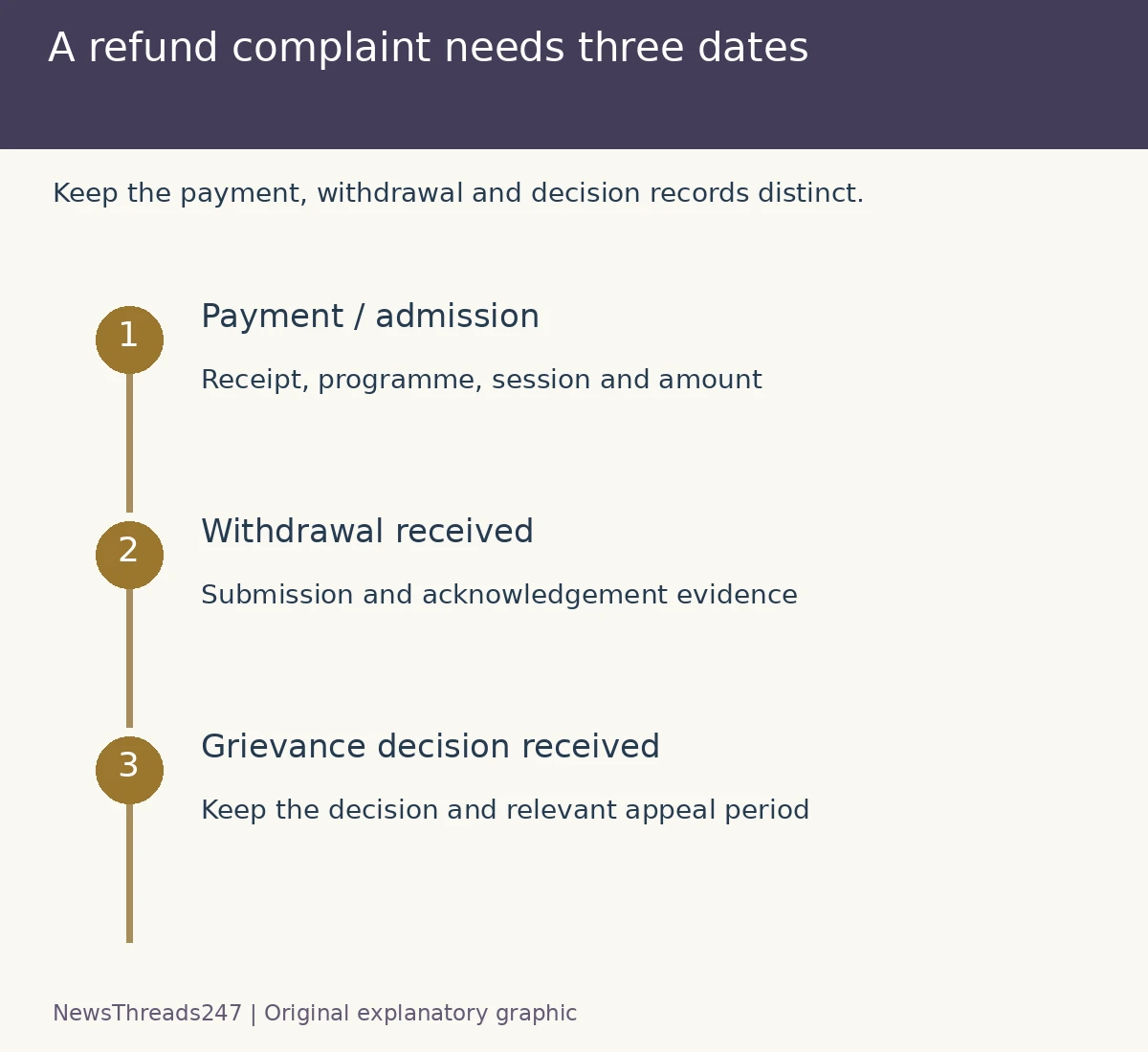
Put three events on one page
First record the admission and payment: programme, academic session, admission reference, amount, receipt and payment date. Next record withdrawal: the prescribed channel you used, submission date and time, acknowledgement or ticket number, and any documents the institution requested. Finally record the response: calculation, reason for a deduction, proposed payment date or refusal.
Do not merge these into one “application date”. A refund enquiry sent later is not necessarily the original withdrawal request. If you used an online withdrawal form, keep its acknowledgement alongside the email follow-up. If the portal did not generate one, retain the contemporaneous evidence you do have and describe the missing acknowledgement honestly.
Keep a copy of the prospectus and the policy version relevant to admission. Save the source URL and date accessed. A current webpage may have changed since you paid; a saved copy can help explain which terms you saw. It does not override applicable UGC directions or settle a legal dispute on its own.
Ask for a calculation that can be checked
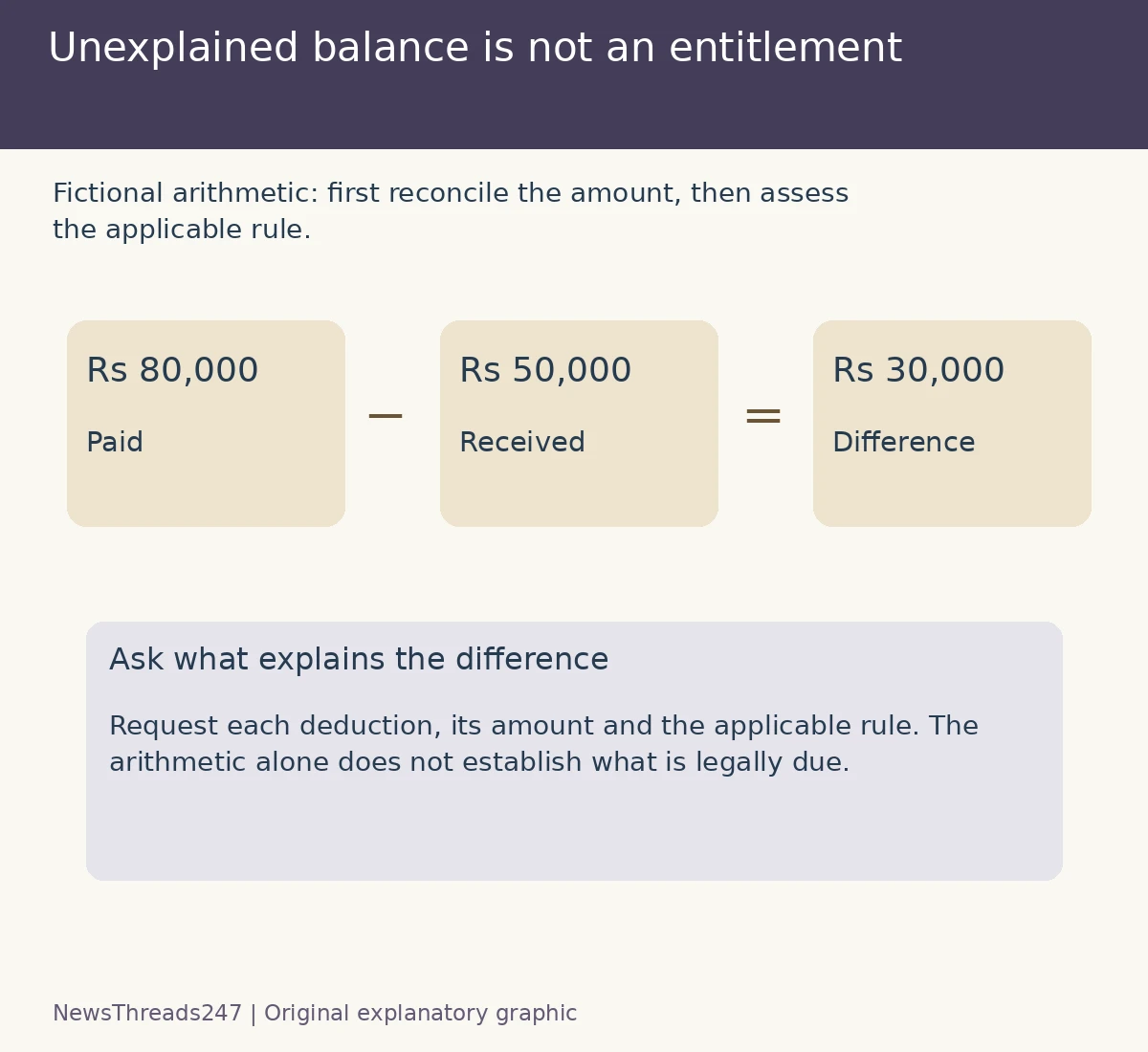
A useful request names the amount paid, the withdrawal acknowledgement and the amount received so far, then asks for an itemised calculation and the authority for each deduction. Separate tuition, deposits, hostel and other charges rather than assuming one rule resolves every component. Do not invent a refund rate to fill a blank in the institution’s reply.
For a fictional example, a student paid ₹80,000 and has received ₹50,000. The arithmetic difference is ₹30,000. That is the unexplained balance to reconcile, not proof that ₹30,000 is legally due. The institution may claim a deduction; the student needs its amount, basis and applicable rule. A clear dispute about one line is easier to review than a message that only says “refund everything”.
Use the institution’s grievance route
The UGC Redressal of Grievances of Students Regulations, 2023 include delayed or denied refunds due to eligible withdrawing students within their grievance definition, subject to Commission guidelines. They direct an institutional complaint to the Chairperson of the Students’ Grievance Redressal Committee, or SGRC. Find the institution’s published committee and Ombudsperson details rather than assuming the admissions agent is the final authority.
Under regulation 5, the SGRC should send its report and recommendations, with a copy to the student, preferably within 15 working days of receiving the complaint. A student aggrieved by its decision may appeal to the Ombudsperson within fifteen days of receiving that decision. These are distinct procedural periods. The first is not a promise that money will reach a bank account in fifteen days.
Record when the SGRC received the complaint and when you received its decision. Read the full decision and the relevant regulations promptly if considering an appeal. Do not calculate a personal deadline from the date this article was published, or assume that “working days” applies wherever the text says “days”. Seek institution-specific clarification or qualified help if the deadline is disputed.
Make the escalation file self-contained
Use a short chronology followed by numbered attachments. State the remedy requested: an explanation, a corrected calculation, processing of an identified balance or a reasoned decision. Include the institution’s response even when you disagree with it. Explain why it does not answer the specific issue instead of deleting the part that is inconvenient to your case.
UGC’s Student Corner lists e-Samadhaan as its grievance-redressal portal. Use the current official route and retain any acknowledgement and status reference. A portal submission is evidence that a complaint was lodged, not proof that its claim has been accepted. It also does not justify ignoring an applicable institutional appeal period.
Submit only the personal and payment information the official process requires. Keep account numbers and identity documents out of public social posts. If a contact or portal address is unclear, return to UGC’s official site; do not pay an intermediary who promises a guaranteed refund.
Keep the decision and the payment separate
If the institution says the refund is approved, ask for the approved calculation and payment reference. When money arrives, reconcile it with that calculation. If it differs, identify the precise difference and continue with the existing reference where the process allows. Avoid opening multiple contradictory complaints with different amounts or withdrawal dates.
Recognition is a separate check from a refund dispute. Our guide to UGC recognition for online degrees explains how to check a programme’s status before paying. Neither recognition nor a successful admission establishes a universal refund entitlement. What matters here is the applicable rule and a verifiable record of your own transaction.
Sources and visual credits
Checked October 28, 2026: UGC’s October 7 intervention letter, its October 16 notice listing, the 2023 student-grievance regulations and Student Corner. Older circulars retain their own dates. The rupee example is fictional arithmetic, not an entitlement calculation or legal advice. Featured art is AI-generated conceptual artwork; the two original graphics are record-building aids, not an official UGC form.