
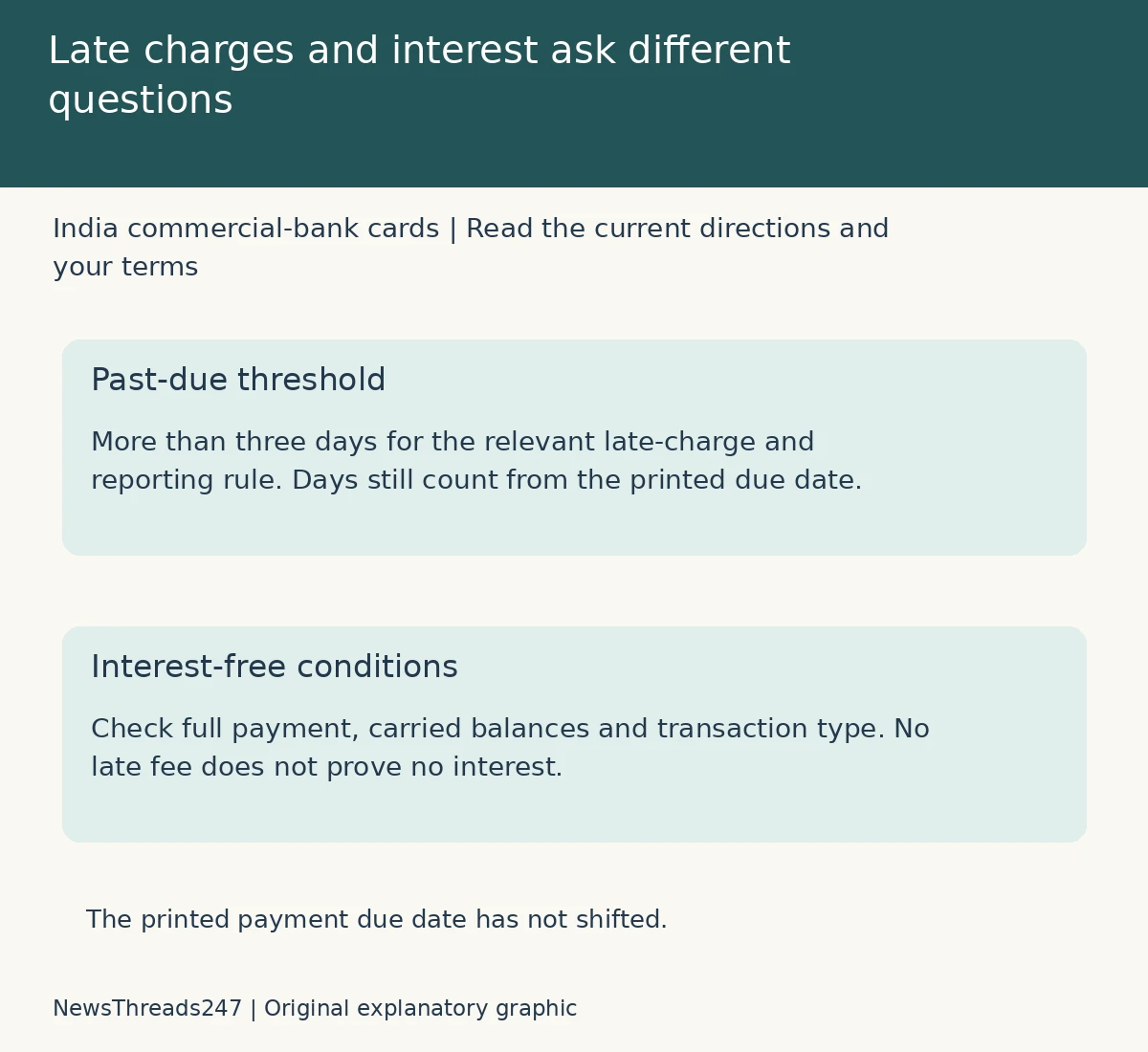
A credit card’s three-day rule is not permission to treat the payment due date as three days later. For cards issued by commercial banks in India, RBI places a threshold on past-due reporting and late-payment-related charges. The conditions for retaining an interest-free period are a separate part of the bill and the card’s terms.
If you are checking a charge, keep the statement, payment receipt and date the card account was credited together. Then identify whether the disputed line is interest, a late-payment fee or something else. “I paid within three days” does not answer all three questions in the same way.
Read the current rule with its scope
RBI’s Commercial Banks—Credit Cards and Debit Cards Directions, 2025, updated October 1, 2026 are the regulatory source used here. These directions have a defined commercial-bank scope; do not automatically apply every provision to an issuer governed by a different set of directions. Check the actual issuer named on the account.
Paragraph 23 distinguishes the conditions for late-payment-related charges and past-due reporting from interest. The relevant threshold is an account remaining past due for more than three days. When applicable, days past due are still measured from the statement’s payment due date. This guide is explaining an existing boundary in the current directions, not announcing a new three-day benefit today.
Keep the statement date, due date and credit date separate
The statement date closes the billing period. The due date identifies when payment is required. The date you instructed a transfer and the date it was credited to the card can differ. Check the issuer’s authorised payment modes and processing instructions before assuming a transfer receipt establishes timely receipt by the card account.
HDFC Bank’s published MITC, version 2.3 dated January 2025, describes three grace days for processing and says clear funds are due by the statement’s due date. Its version date matters: read your own card’s current terms rather than treating this example as a verified tariff for every HDFC product today.
A practical payment record names the card, statement period, amount, due date, payment method, transaction reference and credited date. Use the account’s official payment history when available. If the dates disagree, ask the issuer to identify the receipt date it used and the evidence supporting it.
Interest-free conditions need their own check
ICICI Bank’s current credit-card FAQ explains that paying the minimum amount can leave interest applying to the remaining balance. It also distinguishes cash advances, which do not have the same interest-free treatment as eligible purchases. These distinctions matter more than a general label such as “grace period”.
Check the previous statement as well as the latest one. A balance carried forward can affect the interest-free benefit even when a later payment avoids a late-payment charge. Read the applicable MITC and the bill’s finance-charge explanation. Do not assume that a zero late fee proves zero interest, or that a fee reversal also reverses every finance charge.
Ask for an itemised explanation if interest is unexpected: the balance used, transaction dates, payment adjustments, applicable rate and calculation period. This article quotes no universal APR or fee. Those amounts depend on the actual issuer, product, transaction and terms; a worked arithmetic example is not a bank quote.
Reconcile the remaining amount before disputing the base
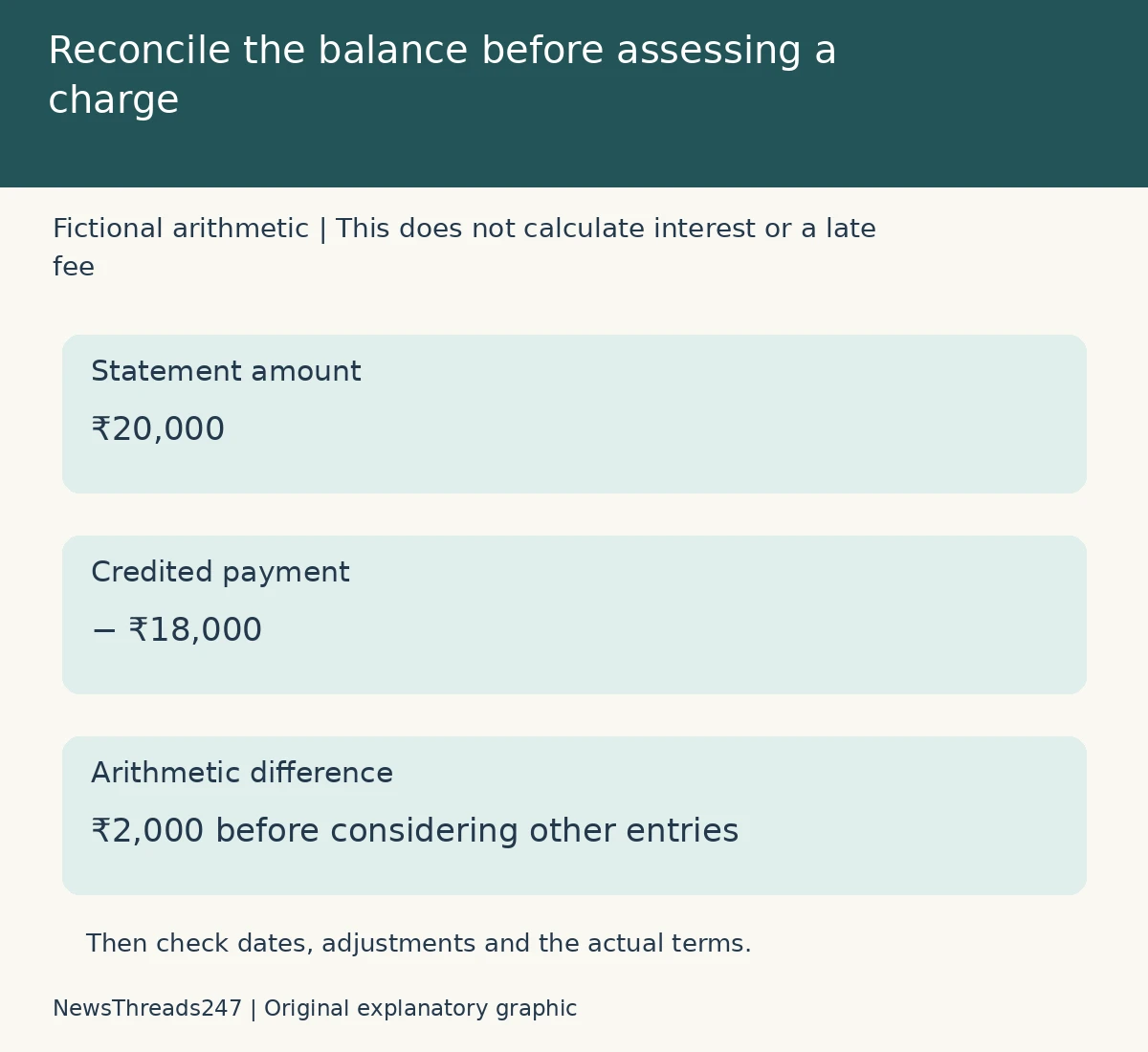
Consider a fictional statement of ₹20,000 followed by a credited payment of ₹18,000. The arithmetic difference is ₹2,000 before considering other entries. That calculation identifies a balance to reconcile. It does not calculate interest, decide payment allocation or establish a particular late fee.
RBI’s directions require interest to reflect payments, refunds and reversals, and late-payment-related charges to apply to the relevant outstanding amount after the due date rather than the whole original bill. To examine your own statement, line up every relevant credit and debit in date order. Avoid testing a charge against a balance that includes an amount already paid or reversed.
For a second fictional case, a customer pays the full amount after the printed due date and sees no late fee. The customer still needs to check whether the interest-free conditions were met. The absence of one type of charge does not settle the other. These examples show questions to ask, not findings about an actual account.
Raise a precise billing query
State which line is disputed and why. A useful enquiry might identify the statement period, payment reference and credited date, then request the rule and calculation used for that particular fee or interest entry. Keep the issuer’s response and supporting documents. An unexplained screenshot of the final balance usually asks the reviewer to reconstruct too much.
If the disagreement concerns credit reporting, ask what status was reported and for which period. Our credit-report correction guide covers that separate evidence trail. A corrected bill and a corrected credit record need their own confirmation; a refund does not by itself prove every downstream record changed.
Review recurring payment arrangements against the actual bill and receipt record. A reminder is useful, while an instruction that failed or paid an unexpected amount still needs attention. Choose the supported payment route and allow for its processing conditions rather than planning around the last possible day of an assumed extension.
Sources and scope
India commercial-bank card guidance checked October 29, 2026 using RBI’s current directions, ICICI Bank’s FAQ and the specifically dated HDFC MITC. No card account was tested or personalised repayment advice provided. Rupee examples are fictional arithmetic, not interest calculations or issuer quotations. Verify the actual card’s current terms before assessing a charge.
Visual credits: NewsThreads247. Featured image: AI-generated conceptual illustration, not a record of an event, customer or account. Body graphics: original explanatory artwork; examples are labelled fictional.