
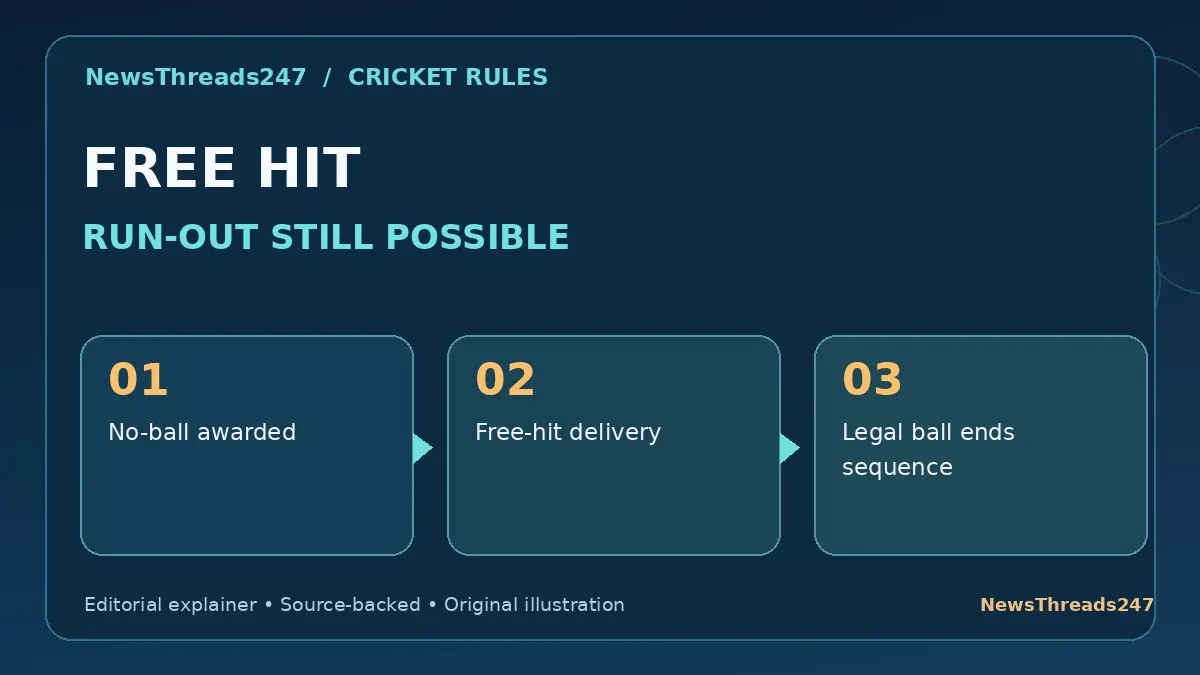
A free hit makes a cricket broadcast look simple: the umpire circles an arm and the batter knows an ordinary catch or bowled dismissal will not work. The difficult part is understanding what happens next if a wide is delivered, a fielder runs out a batter or the ball hits the stumps.
This guide uses ICC limited-overs playing conditions and worked scoring examples to separate the free hit from the no-ball that created it. It does not confuse the special dismissal protection with a guarantee that the batting side cannot lose a wicket.
Table of Contents — Expand or Collapse
Why a No-Ball Creates a Free Hit
In a limited-overs cricket match, the umpire calls No-ball and the scoreboard immediately gains an extra. The next delivery carries another consequence: it is a free hit. That second ball is unusually valuable to the batting side, but it is not a ball on which every rule disappears. Readers often misunderstand the combination of dismissal protections, field restrictions and extras.
The International Cricket Council’s limited-overs playing conditions make the free hit the next delivery after a no-ball, whether the original no-ball arose from a front-foot fault or another recognized no-ball infringement. The striker on the free hit benefits from the same protection from most dismissals as on a no-ball.
This article discusses ICC ODI and T20I arrangements and the MCC’s helpful explanation. Local, school and recreational competitions may use different playing conditions, so the official match regulations remain the final authority.
Which Dismissals Are Still Possible?
On a free hit, a batter cannot ordinarily be dismissed bowled, caught, leg before wicket, stumped or hit wicket. A bowler can strike the stumps with the ball, yet that does not automatically remove the striker. The ball remains in play unless another rule makes it dead.
Three exceptional dismissal categories remain relevant under the ICC rule: run out, obstructing the field and hitting the ball twice. The latter two involve specific legal definitions, not merely touching the ball twice by accident or standing near a fielder. Either batter can be run out while attempting a run.
A simple mental test is to ask whether a dismissal would have been possible on the no-ball itself. If the answer is no, the free hit normally protects the striker from that mode as well. The rules do not give unlimited immunity to unsafe or obstructive play.
A Worked Example: Ball Hits the Stumps
Imagine the bowler delivers the free hit, the striker misses and the ball strikes the stumps. On an ordinary legal delivery, the striker could be out bowled. Here, the dismissal protection applies: the striker is not out bowled.
Suppose the ball rebounds away from the stumps and the batters try to run. They may take runs while the ball remains in play. ICC clarified the treatment of runs from a ball that hits the stumps on a free hit in its 2023 playing-condition update; such runs count toward the team’s total under the relevant scoring rules.
The lesson for scorecard readers is that a broken wicket is not always a wicket taken. Examine the delivery signal first, then check whether another form of dismissal—particularly a run out—occurred before assuming a batter has been dismissed.

What Happens if the Free Hit Is Wide or Another No-Ball?
The free hit does not disappear merely because the next ball was attempted. A free hit requires a legitimate delivery to be completed. If the bowler delivers another no-ball or a wide, the next delivery is again a free hit under ICC limited-overs playing conditions.
Consider a sequence. Delivery A is a front-foot no-ball. Delivery B is the free hit but passes too wide to count. Delivery C is still a free hit. If C is legal, the ordinary sequence resumes on the following delivery. The extras from the wide and no-ball are recorded according to their respective scoring rules.
That is why a free hit can extend beyond one attempted ball. On television, the free-hit indicator should remain until a legal delivery has completed the entitlement. It is not automatically cancelled by a wicket-like impact on the stumps.
Can the Fielding Captain Change the Field?
Field changes are generally restricted between the original no-ball and the free hit. The ICC includes exceptions, notably when the striker changes and when correcting a fielding-restriction breach that caused the no-ball. The purpose is to prevent the bowling side from freely resetting the field after conceding the benefit.
This is different from saying no field can ever move. The rules specify the allowable exceptions, and separate safety considerations can apply under other governing provisions. A televised fielding change may therefore be lawful even though most changes are restricted.
When judging an incident, first establish which batter faces the free hit, why the original no-ball was called and whether the change merely corrects an illegal fielding arrangement. Do not treat a camera angle showing a shifted fielder as proof of an umpiring error.
Why the Scoreboard Can Look Confusing
A no-ball awards an extra run and generally does not count as a legitimate delivery in the over. Runs struck from it may also count for the striker. A wide has its own extra and ball-count treatment. The free hit is a separate entitlement that applies to the subsequent legitimate delivery.
That distinction produces unusual score sequences: the over can appear to contain more than six listed entries, while the count of legal balls has not reached six. A scorebook may use separate marks for no-ball, wide and free hit rather than treating all three as identical.
If the bowler delivers a legal free hit and the striker strikes four, the boundary counts in the normal manner for that delivery. If the next ball is wide, the wide extra and the continued free-hit entitlement need to be recorded separately. A ball-by-ball commentary that ignores this distinction may mislead readers.
Who Faces the Free Hit if the Batters Cross?
The free hit belongs to whichever striker is facing the next delivery—not necessarily the batter who faced the no-ball. If the batters change ends during the no-ball delivery, the other batter may be on strike for the free hit.
This matters when discussing field-setting exceptions. The ICC rule recognizes a change of striker as one circumstance in which field changes may be permitted. A field that looks different after the no-ball can therefore be lawful under the match conditions.
On the other hand, if no change of striker occurred and the no-ball was unrelated to a fielding restriction, the bowling side cannot assume it may rearrange every fielder. The governing condition—not intuition—determines the allowed movement.
Three Situations Viewers Often Misread
Situation one: caught in the deep. A batter hits a legitimate free hit straight to a fielder, who catches it. That is normally not a caught dismissal, though the fielding side can still attempt a run out if the batters run. The catch does not end the delivery as an ordinary caught wicket would.
Situation two: the stumps are hit. The ball hits the striker’s stumps, rebounds and the players run. Bowled is not available. The team may score runs subject to the normal scoring provisions, and an attempt to run out a batter remains possible.
Situation three: an illegal free hit. A bowler delivers a wide on the free hit. The next delivery also carries a free hit, because the wide did not satisfy the requirement for a legitimate delivery. A television graphic disappearing early would not by itself overrule the umpire’s decision.
How to Read a Free-Hit Incident Correctly
Start with the format: is it an ICC limited-overs game, a franchise competition using similar conditions, or a local fixture with its own rulebook? Then establish the no-ball call, whether the batters changed ends and whether the following ball was legal.
Next distinguish the attempted dismissal. A fielder catching the ball and a fielder running out a batter are different events under the rules. Ask how the runs were scored and whether they were credited as batting runs, extras or team runs under the applicable provision.
For broader cricket scoring questions, our DLS par score versus winning target explainer addresses another situation where the visible number is easily misread. The two rules are unrelated, but both reward looking at the underlying calculation rather than the broadcast headline.
Frequently Asked Questions
Can a batter be run out on a free hit? Yes. Run out remains among the permitted forms of dismissal under ICC free-hit rules, even though caught, bowled and LBW are restricted.
Does a wide ball count as using up the free hit? No. A wide is not a legitimate delivery, so the free hit carries over to the following ball.
Can a batter be stumped on a free hit? Stumped is not an available dismissal on a free hit under the ordinary ICC limited-overs protection; a separate run-out situation may still occur.
Does every cricket match offer a free hit after a no-ball? No. International limited-overs formats and many competitions use the rule, but other formats and local competitions can have different conditions.
What if a free hit knocks over the stumps? That does not make the striker out bowled. The outcome of the ball and runs is governed by the remaining playing and scoring provisions.
Sources, Scope and Editorial Disclosure
The primary sources are the ICC playing conditions collection, the ICC’s text of Clause 21.19 on free hits, the MCC Laws and playing conditions explainer and ICC’s 2023 interpretation update.
Editorial disclosure: The diagrams are original illustrations, not photographs of a live match or official umpiring graphics. This article is general rules analysis, not an official decision or a substitute for a specific tournament’s published playing conditions. Readers should check any post-publication ICC rule updates before relying on exact clause wording.