
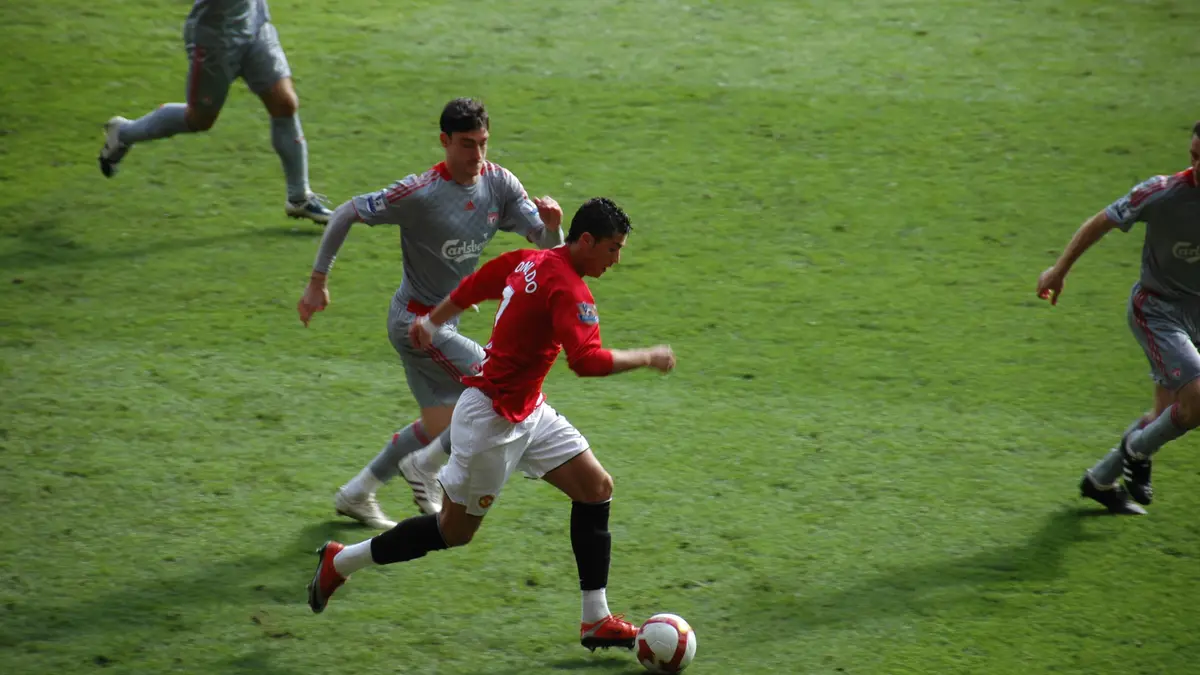
One of the most revealing ways to understand Cristiano Ronaldo’s career is to watch what happens before he touches the ball. In his early Manchester United years, a defender might see him receive near the touchline, turn and attack. Later, a defender could lose him for a moment inside the penalty area—and discover that moment was enough.
The difference is larger than a change of position on a team sheet. Ronaldo made a career out of creating danger in one way, then found a different way to do it as the game, his clubs and his body changed. The dazzling winger became a high-volume goalscorer; the high-volume goalscorer gradually became a specialist in space, movement and finishing.
That evolution helps explain his relevance into his forties. It also carries an uncomfortable truth: becoming exceptionally good at one task can require doing less of another. Ronaldo’s story is therefore as much about football’s trade-offs as its records.
In this article: jump to a section
- The core of Ronaldo’s reinvention
- The Manchester United winger
- Why the change started early
- Real Madrid and the penalty area
- The anatomy of his goals
- Juventus: a different kind of forward
- The difficult United return
- Al Nassr: goals and a league title
- How his role changed
- The tactical price of specialization
- Beyond the 1,000-goal conversation
- Portugal and the end of an era
- What younger players can learn
- Final assessment
- Frequently asked questions
- Sources and methodology
The core of Ronaldo’s reinvention
In football, reinvention is often described as a dramatic moment: a winger suddenly becomes a striker, or a player announces that he has changed his style. It seldom happens so neatly. Roles shift over seasons, through a manager’s instructions, the quality of teammates, changing opponents and the player’s own strengths.
Ronaldo’s transformation was particularly visible because his earliest appeal was so easy to recognize. At Manchester United he ran at full-backs with pace and elaborate footwork. In his peak Real Madrid years, goals arrived from a much wider variety of positions and situations. By the later stages of his European career, his economy of movement had become a subject of tactical analysis in its own right.
This is not simply a claim that an older player “worked harder.” The stronger explanation is measurable production allied to observable football habits. UEFA’s breakdown of his Champions League goals and the positional analysis published by The Coaches’ Voice help separate the on-field story from the mythology.
The Manchester United winger: width, speed and uncertainty
When Ronaldo joined Manchester United from Sporting in 2003, the danger he presented often began far from goal. He could hold a wide position, invite the full-back toward him, change direction and accelerate. The defender’s task was to stop the next dribble. For the young Ronaldo, beating that defender was frequently the start of the move rather than its conclusion.
A winger works with several responsibilities at once: advancing the ball, creating separation, delivering crosses, combining with midfielders and attacking the space behind the defensive line. Ronaldo did these things with enough variety that his next action was difficult to predict. The showmanship, however, was only one part of his education at United.
As he developed, the decisive question changed from “Can he beat his man?” to “What happens after he beats his man?” A dribble that ends in a harmless cross has a different value from one that produces a shot or draws defenders out of position. Ronaldo increasingly connected his individual ability to a repeatable end product.
This was also a tactical lesson from an elite side. United could use other players to connect possession while Ronaldo attacked more valuable zones. His role was never fixed to the white line: it was an arrangement that allowed his speed and ball-striking to become more dangerous near goal.
Why his transformation started before he slowed down
It is tempting to tell this story as a reaction to age: a winger loses a yard of pace and settles inside the box. That leaves out an important part of Ronaldo’s career. He had already begun changing his relationship with goal while still young enough to outrun most defenders.
His first Champions League goals came against Roma in April 2007, according to UEFA’s official record. He helped United win the competition in 2007–08. His significance was expanding from the creator of a dangerous attack to the player most likely to finish it.
That distinction matters. A player can transform by accumulating new skills before older ones diminish. Ronaldo did not abandon the wing overnight; he added ways of scoring to the things he already knew how to do. Only later did he lean more heavily on those scoring habits and spend less time constructing attacks from deep.
The apparent simplicity of his later goals is part of what makes them hard to appreciate. To score with one touch, a striker may have spent several seconds reading a defender’s hips, scanning where a cross could land and timing a run no camera angle fully explains.
Real Madrid: the winger who learned to own the penalty area
Ronaldo’s move to Real Madrid in 2009 accelerated the shift. He still took players on, carried the ball from the left and struck shots from distance. But at Madrid his best seasons were increasingly defined by the volume of chances he turned into goals. In the box he could finish first time, attack a cross or arrive where a loose ball would fall.
The scale is remarkable even when the numbers are kept within their proper boundaries. FIFA credits him with 450 goals in 438 appearances for Real Madrid across competitions. UEFA’s narrower Champions League record lists 105 goals in 101 matches for Madrid. These are separate datasets—one all-competition club total and one competition-specific total—not figures to be added together.
It was a development of judgment as much as technique. Consider the difference between waiting to receive on the left wing and arriving at the far post. In the first case, Ronaldo has to beat a defender while holding the ball. In the second, he wants the defender to look away from him for one second. The finish may be easier; the work of creating that tiny opening is not.
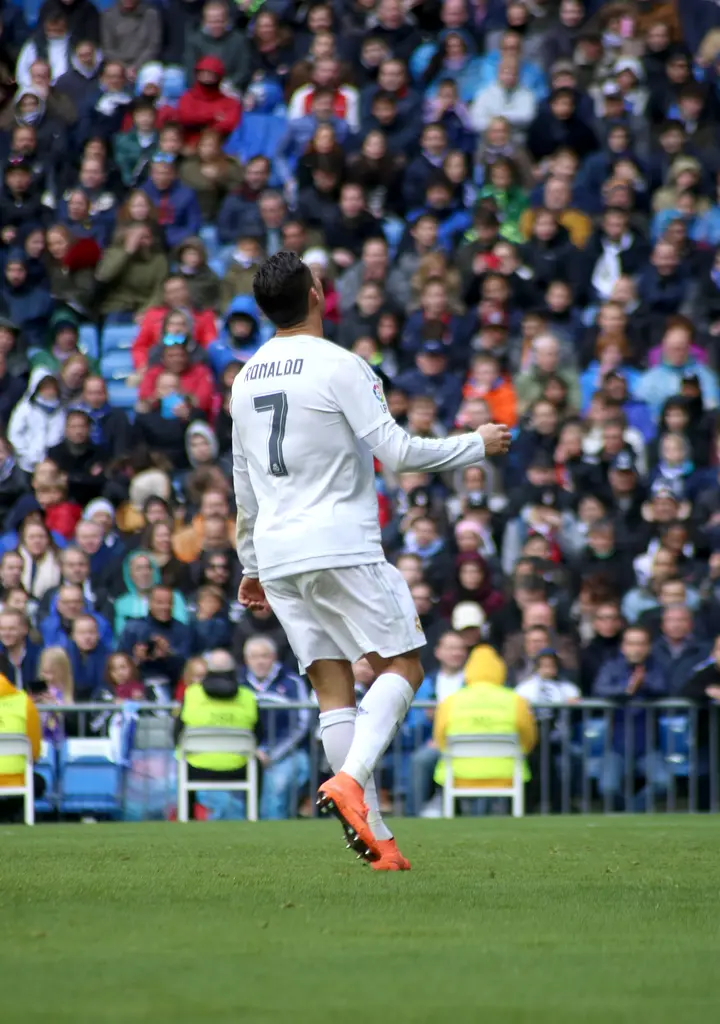
His Madrid success cannot be detached from the rest of the side. Creative teammates, different tactical systems and frequent access to the attacking third all mattered. No player’s goal tally explains a team’s football on its own. Ronaldo’s distinction was the consistency with which he turned that environment into shots and goals over many seasons.
The value of that adaptation becomes clearer when a defender knows exactly what Ronaldo wants. He can still begin outside, take a diagonal line into the area or linger beyond a marker’s shoulder. A specialist is not necessarily predictable: the specialization concerns the destination, while the route can keep changing.
Inside the goals: what movement made possible
UEFA’s Champions League figures offer a useful check against the idea that Ronaldo’s scoring was only about powerful shots. Across the competition proper, he scored 140 goals in 183 appearances. The governing body divides those goals by method as follows:
| Finish | Champions League goals |
|---|---|
| Right foot | 96 (including 19 penalties) |
| Left foot | 19 |
| Head | 25 |
| Total | 140 |
Source: UEFA, competition proper. This is not a count of every goal across his professional career, and the method categories are not a season-by-season comparison.
There is nothing accidental about the aerial number. A header depends on the quality of the delivery, certainly, but also on how a forward reaches the ball: the starting position, the shoulder chosen, the moment of separation and the timing of the leap. Ronaldo’s reputation for jumping should not obscure the craft involved in appearing free of a defender at the decisive instant.
The same applies on the ground. The Coaches’ Voice describes his tendency to anticipate where a pass will travel, attack the blind side of defenders and react quickly to rebounds and second balls. One of the simplest ways to understand his later play is to watch a sequence without following the ball. Notice when he pauses, what he sees, and how abruptly he moves when the passing lane opens.
In other words, the “goal poacher” label describes the final act but misses the thought process. A forward cannot control where every cross or rebound goes. He can improve his odds of meeting the ball by reading its likely path and reducing wasted movement.
Juventus: adapting to partners, systems and narrower spaces
The Juventus years from 2018 to 2021 were another test of the idea that Ronaldo had settled into a single permanent position. He was often thought of as a central finisher, yet The Coaches’ Voice tactical study describes a player who could operate as a narrow left-sided forward or as part of a front two.
Under Andrea Pirlo, Álvaro Morata regularly partnered him. Morata could serve as a central reference point while Ronaldo found spaces beyond or around him. From a left-inside channel, Ronaldo could receive, attack diagonally and aim across goal. In other moments he could supply a cross for a teammate. His game had become more selective, but it had not become one-dimensional.
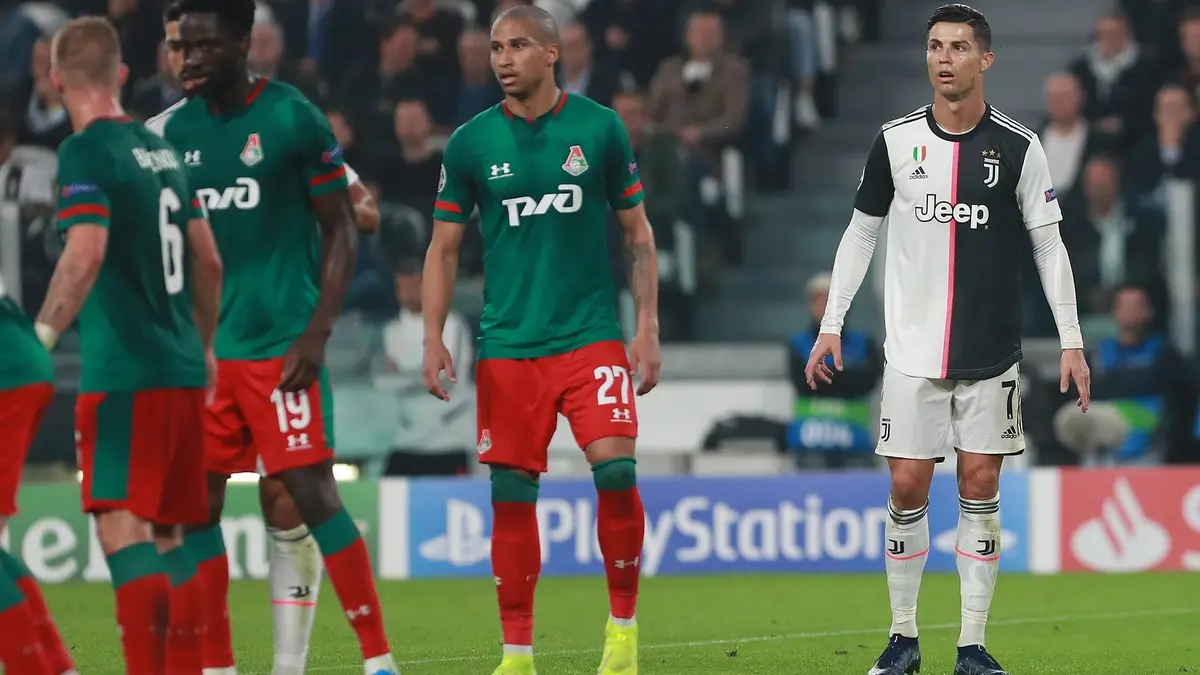
There was a genuine cost to this selectivity. A forward who preserves his most explosive runs for the box will contribute less often to elaborate moves far from goal. That can make the team more dependent on midfielders and wide players to deliver the ball into useful areas. In return, it may gain a more dangerous presence when the delivery arrives.
In the Champions League, UEFA records 14 goals in 23 appearances for Ronaldo at Juventus. That figure belongs to a particular competition, not a verdict on his full contribution in Italy. It does, however, underline how a player can remain threatening in elite European matches while operating differently from his younger self.
The second Manchester United spell was not a rewind
The return to Old Trafford in 2021 created a powerful image: an icon back in the shirt where he became famous. Football rarely cooperates with the idea of a perfect return. The Ronaldo who arrived was an accomplished penalty-area striker, not the young winger who had spent entire afternoons testing a full-back.
That difference created tactical questions beyond individual goals. How much defensive pressure should come from the centre-forward? Who carries the ball through midfield? How should a side arrange itself around a player whose most valuable work happens close to goal? Those questions are not unique to Ronaldo, but they became impossible to ignore when he returned to a club undergoing change.
A footballer can be individually productive and still be a difficult fit for a particular collective plan. The two assessments can both be true. Treating every club chapter solely as a triumph or a failure misses the way elite football depends on relationships among players, coaches and playing styles.
Ronaldo’s changed role was not proof that the old winger had disappeared. It was evidence of what he now prioritized. The player who once demanded the ball to start an attack increasingly sought the moment at which he could end one.
Al Nassr: a scorer’s role, and finally a league title
The Saudi chapter offers a more recent test, with an important correction to older accounts of his career. In May 2026, Al Nassr won the 2025–26 Saudi Pro League title, defeating Damac 4–1 in their final match. Ronaldo scored twice and finished that league season with 28 goals, according to the competition organizer.
It was Al Nassr’s first top-flight championship since 2018–19 and Ronaldo’s first Saudi league title. A correction is essential here: his 28 goals did not win the 2025–26 Golden Boot, which went to Julián Quiñones. The distinction keeps the story grounded in what happened rather than what might suit a headline.
The collective contribution matters just as much. The league’s season review details a title-winning side with goals and assists from João Félix, attacking contributions from other teammates and a much stronger defensive record. Ronaldo’s finishing remained a decisive ingredient, but it was part of an organized championship team.
That league is also a different competitive environment from the Champions League. It would be poor analysis to combine goals from multiple leagues and eras into a single measure of difficulty. What the Saudi chapter does show is that Ronaldo continued to find a productive role in his forties and, in 2025–26, helped convert goals into a domestic title.
Looking forward, the club’s evolving tactics under new coaching staff are another reminder that adaptation never ends. The question each season is practical: how can a team maximize a veteran forward’s strongest movements without becoming predictable in the phases when he does not have the ball?
How his role changed: a tactical reading
The career timeline is easier to grasp as a shift in emphasis than as a collection of rigid positions. Ronaldo often mixed several roles within the same game.
| Career phase | Typical emphasis | Primary challenge or trade-off |
|---|---|---|
| Early Manchester United | Wide dribbles, acceleration, creating from outside | Turn individual breakthroughs into consistent end product |
| Later United / peak Real Madrid | Cutting inside, attacking the box, high shot volume | Choose better moments, depend on supply as well as creation |
| Juventus and United return | Narrow forward, combinations and timed runs | Balance finishing focus with collective buildup and pressing |
| Al Nassr later years | Advanced scoring positions and penalty-area anticipation | Maintain impact within the team’s broader attacking structure |
This table is an editorial synthesis of career roles, not an official positional classification or data-based ranking. Individual managers used him differently.
One thread runs across the stages: the amount of ground a player covers is not the same as the value of the movement. Ronaldo’s early runs often tried to create a chance from nothing. His later runs are more likely to arrive after teammates have built the chance. Both require skill; they make different demands on the side.
The tactical price of specialization
There is a tendency in sports writing to treat adaptation as if every change must be an improvement. The honest account is more complicated. Ronaldo became a more direct threat in scoring positions, but an attack that puts a forward high up the pitch must find other ways to progress the ball and defend transitions.
The Coaches’ Voice analysis notes that his involvement in deep counterattacks, buildup and out-of-possession phases declined as he conserved decisive bursts. This is an observation about tactical behavior, not a judgment of personality or effort. Different managers may consider the bargain worthwhile or prefer a forward who presses and links play more frequently.
Modern elite teams often ask their centre-forward to lead the first wave of pressure, recover the ball or help create passing triangles. The trade-off becomes sharp against opponents who resist pressure well. If a striker does less of that work, others must compensate; if they cannot, the goals he scores may not answer every problem the team faces.
That does not diminish the goals. It puts them in a complete football context. When a side wins, the forward’s finishing and teammates’ running are often described as one successful plan. When it struggles, the same distribution of responsibility can look fragile. The role is inseparable from the structure around it.
What the 1,000-goal conversation can obscure
Ronaldo’s pursuit of four figures in career goals naturally attracts attention, and individual milestones are worth recording with exact dates and definitions. We previously reported the 985-goal tally associated with his October 2026 hat-trick. Such totals can change from match to match and sometimes depend on which categories of goals a publisher counts; this editorial does not present that figure as a live score.
Yet a number—even a historic one—does not tell you why a goal happened. A veteran striker’s success can depend on spotting a small gap, attacking the far post when everyone else is watching the ball, or choosing a run he can make at full speed once instead of three less useful runs. That is where the evolution becomes interesting.
The 1,000-goal conversation asks how many. The tactical story asks how: how he got the chance, where his teammates placed him, what he no longer needed to do and what he could still do exceptionally well.
Portugal: the national-team chapter closes
There is now a completed international chapter to consider. Ronaldo announced his retirement from Portugal duty following the 2026 World Cup. FIFA’s account lists 234 international appearances and 146 goals, alongside Portugal’s Euro 2016 triumph and Nations League victories in 2019 and 2025.
The timeline matters because international retirement is not identical to retirement from all professional football. For the full report on the announcement, context and national-team legacy, see our separate Portugal retirement article. Here, the international farewell is the ending of one important role in an unusually long career.
At his best for Portugal, Ronaldo offered more than one kind of attacking outlet across different generations of teammates. Later, the team too had to consider how to use his finishing and experience within a changing system. That is a football problem familiar at club level, made more emotionally charged by the national shirt.
What younger forwards can learn—and what they cannot copy
The most useful lesson is not to imitate Ronaldo’s celebrations, shot volume or highly individualized public image. A young player has a different body, a different team and different responsibilities. The practical lesson is to remain curious about what the game now requires.
- Study the space before the cross. Ask where the defender is looking, and whether a run from behind rather than in front offers a clearer chance.
- Practise finishing with different surfaces. The UEFA goal breakdown illustrates why both feet and heading are valuable, even if a player’s strongest technique remains dominant.
- Learn the work without the ball. Receiving positions, decoy runs and quick reactions to loose balls rarely make highlight reels, yet can decide a match.
- Understand the team’s bargain. A forward’s freedom to stay high depends on teammates who recover possession, advance play and provide service.
- Adapt gradually. Improve decision-making and movement while continuing to develop the skills the coach currently needs; there is no universal age at which a winger must become a striker.
None of this proves that ordinary players can reproduce his output by following a checklist. Elite talent, coaching, opportunity, availability and team context all influence a career. What can be studied is the football intelligence of changing how one contributes without losing the purpose of the role.
Final assessment: the career is really several careers
If you watched Ronaldo only at Manchester United in the mid-2000s and then saw him decades later at Al Nassr, you would recognize the player but not necessarily the job. The early version wanted the defender to come close enough to be beaten. The later version often wants the defender to forget him until the ball arrives.
His story has room for admiration and criticism. The scoring records are extraordinary. So are the tactical compromises that follow a more specialized role. The most serious way to appreciate the career is to acknowledge both, because football is played by a team even when one name dominates the photograph.
Ronaldo did not survive football’s changing demands by remaining exactly the same footballer. He learned new routes to the moments that mattered. The number of goals explains his place in history; the reinvention helps explain how he stayed in the conversation for so long.
Frequently asked questions
Did Cristiano Ronaldo start his career as a striker?
No. His early senior career at Sporting and Manchester United was primarily associated with wide attacking positions. Over time he moved more often into central goalscoring areas, while occasionally continuing to play from the left.
What was Ronaldo’s biggest tactical change?
He shifted from creating attacks through frequent wide dribbles toward finding and finishing chances through selective runs, positioning and movement in the penalty area. The shift developed gradually and varied by manager and team.
How many Champions League goals did Ronaldo score?
UEFA records 140 goals in 183 appearances in the Champions League competition proper. It separately notes a goal in qualifying; figures from other competitions should not be mixed with this total.
Has Ronaldo retired from football completely?
No. As of this editorial’s review on 7 November 2026, his retirement announcement concerns the Portugal national team; his Al Nassr club chapter is separate. Check current club announcements for subsequent updates.
Sources, verification and editorial methodology
This original football editorial was researched against published competition records and tactical reporting. It does not claim access to Ronaldo, his coaching staff or private training data. Tactical conclusions are clearly interpretations rather than measurements from a new proprietary event-data study. Statistics are attributed to the competition or governing body that published them.
- UEFA: Cristiano Ronaldo’s Champions League records (competition-proper totals and goal methods, July 2026).
- FIFA: Ronaldo’s career evolution and Real Madrid record (March 2026).
- FIFA: Ronaldo’s Portugal retirement and international record (November 2026).
- Saudi Pro League: Al Nassr’s 2025–26 title (May 2026).
- Saudi Pro League: how the title-winning team worked (team contribution context).
- The Coaches’ Voice: tactical analysis of Ronaldo’s roles (movement, partnerships and positional evolution).
Image credits: Feature image by Foad Ashtari/Mehr News Agency (CC BY 4.0); under-title Manchester United image by Sdo216 (CC BY-SA 3.0); Real Madrid image by Rubén Ortega (CC BY-SA 4.0); Juventus image by Anton Zaitsev/Soccer.ru (CC BY-SA 3.0). Each photograph links to its original licensing page in the caption. Images are historical and were resized/cropped and converted to WebP for this publication.
Editorial review: 7 November 2026 (IST). Records and career status may change after publication; reported figures are dated or scoped accordingly.