
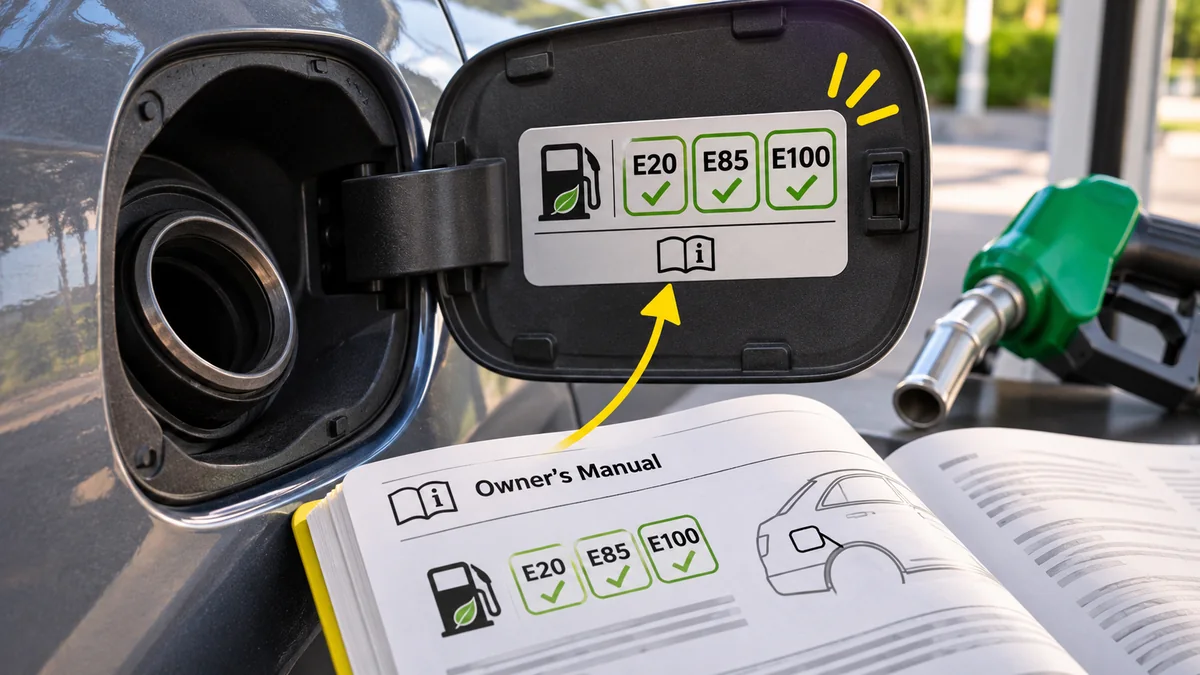
India’s October 2026 rule change creates a clearer certification route for vehicles engineered to run on high-ethanol blends, including E100. It does not turn an E20-compatible petrol car into an E85 or E100 vehicle. Drivers should use a high-ethanol fuel only when the vehicle manufacturer has explicitly declared that blend on the compatibility label and in the owner’s manual.
That distinction matters because the new rule is about approved vehicle design and certification—not permission to experiment with a fuel system that was never built for nearly pure ethanol. This explainer separates the regulatory change from the choice an owner makes at a pump.
In this article
What changed in the E100 rule
On 26 October 2026, the Ministry of Road Transport and Highways said it had amended the Central Motor Vehicles Rules to expressly include E100 alongside E85 in emission-related provisions for eligible flex-fuel vehicles. The official PIB release says the rules took effect from publication in the Official Gazette.
A flex-fuel vehicle uses fuel-system materials and engine controls designed for a declared range of petrol–ethanol mixtures. The engine-management system can adjust for fuel composition, but only inside the range for which that vehicle was engineered and certified. The amendment therefore helps manufacturers certify a vehicle for E100; it does not certify every petrol vehicle already on the road.
Reader takeaway: the decisive evidence is model-specific. A news headline about E100 availability is not a substitute for the label on your vehicle and the instructions supplied by its manufacturer.
E20, E85 and E100 are not interchangeable
| Fuel label | What it describes | What an owner can infer |
|---|---|---|
| E20 | Petrol blended with up to 20% ethanol by volume. | Only E20 compatibility, unless the manufacturer declares a wider range. |
| E85 | A high-ethanol blend containing up to 85% ethanol. | Use only in a vehicle explicitly designed and certified for E85. |
| E100 | Fuel consisting predominantly of ethanol under the applicable specification. | Use only when E100 appears in the vehicle’s approved compatibility range. |
The ministry’s statement is explicit: compatibility with E10 or E20 does not establish suitability for E85. It also says existing owners are not required to switch fuel or modify their vehicles. The same caution appears in the government’s explanatory coverage and the underlying rules: the manufacturer defines the compatible blend and displays it through a visible sticker.
This is also why the words ethanol compatible need a number. A hose, seal, injector or calibration suitable for E20 is not automatically evidence of suitability for a much higher ethanol concentration.
Which vehicles may use E85 or E100
A motorist should look for three aligned pieces of evidence: the factory fuel-compatibility label, the owner’s manual, and current manufacturer guidance for the exact model and variant. If any of those is unclear, the safe action is to contact the authorised service network before filling.
- A clearly visible factory declaration that includes E85, E100 or a stated blend range.
- An owner’s manual that explains approved fuels and any operating or service requirements.
- A fuel-station dispenser that clearly identifies the blend being sold.
- No warning from the manufacturer that limits a specific model year, powertrain or market variant.
A badge or advertisement for a related model is not enough. Cars with the same name can have different fuel-system specifications across model years and countries. Do not rely on a social post, an aftermarket sticker or a salesperson’s verbal assurance when the manual says something narrower.
A safe decision at the pump
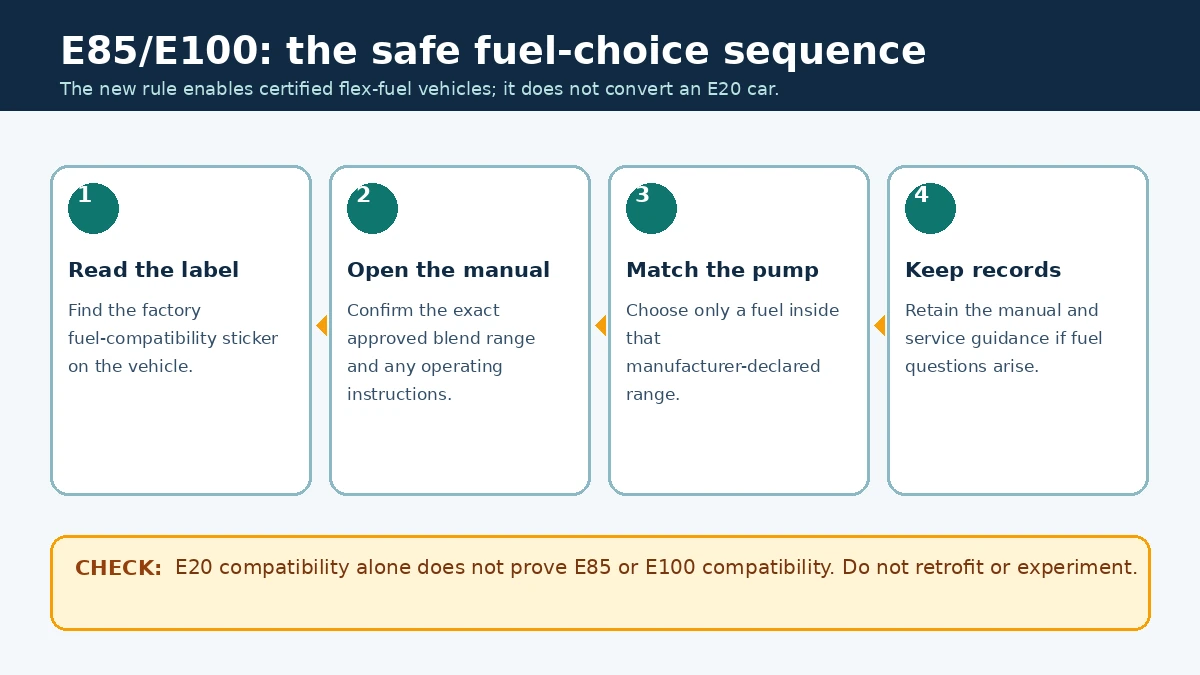
Use the sequence above before the first high-ethanol fill. If the car is labelled only for E20, do not assume an E85 or E100 nozzle is safe. If the dispenser label is ambiguous, do not fill until the station confirms the product. Keep the fuel receipt, especially during the early ownership period, because it records the blend, station and date if a drivability question later arises.
Do not attempt a conversion by changing only a hose or software setting. A genuine flex-fuel design can involve material compatibility, cold-start strategy, injection capacity, calibration and emissions certification. Any retrofit claim should be assessed against written manufacturer approval and the applicable homologation—not a workshop promise.
What the rule means for current owners
For most existing petrol-car owners, there is no immediate action. Continue using the fuel specified by the manufacturer. The new amendment does not order a switch to E85 or E100, and it does not require an existing E20 car to be modified.
For a buyer considering a new flex-fuel car, the change broadens the regulatory path, but fuel availability still matters. In June 2026, a Petroleum Ministry release described an initial high-ethanol retail rollout and a wider planned network. A plan is not the same as a guarantee that E85 or E100 is available on a reader’s regular route, so check actual stations before treating fuel choice as an ownership benefit.
Owners comparing multiple fuel types can also use our petrol-versus-CNG running-cost method as a template: calculate cost per kilometre with real local prices and observed efficiency rather than comparing pump prices alone.
Range, cost and emissions: questions still open
The regulation does not promise a particular running cost, range or resale value. Ethanol carries different energy content from petrol, so a lower price per litre does not by itself prove a lower cost per kilometre. The useful calculation is: fuel price per litre ÷ real kilometres per litre. Repeat it over several full tanks on the same route before drawing a conclusion.
Environmental claims also need scope. The ministry says suitable high-ethanol vehicles can reduce certain exhaust pollutants and may lower greenhouse-gas emissions over the fuel’s production and use, depending on feedstock and production. That is a lifecycle qualification, not a blanket zero-emission claim for every litre or every supply chain.
| Question | Evidence to collect | Why it matters |
|---|---|---|
| Will my usual route have the fuel? | Current station list and pump confirmation | A compatible car offers little flexibility if the fuel is unavailable nearby. |
| What is the real cost per km? | Price, full-tank distance and comparable driving | Pump price alone ignores changes in efficiency. |
| Does warranty coverage differ? | Written warranty and service schedule | High-ethanol operation may carry model-specific maintenance instructions. |
| Can the car use regular petrol too? | Manufacturer-declared blend range | Flexibility depends on the exact certified range, not the category name. |
Questions to ask before buying
- Show me the factory compatibility label on this exact vehicle.
- Which blends are approved in the owner’s manual for this model year and variant?
- Is E85 or E100 available near my home and regular highway route today?
- What real-world efficiency range does the manufacturer disclose for each approved blend?
- Do the warranty, service interval or recommended engine oil change with high-ethanol use?
- What happens if the preferred blend is temporarily unavailable?
- Will the invoice and registration documents clearly identify the flex-fuel specification?
Ask for answers in writing. A correctly scoped buying decision joins the vehicle’s approved range, local fuel access, cost per kilometre and warranty conditions. It does not start from a headline that says E100 is now allowed.
Sources and methodology
This article was prepared from the 26 October 2026 MoRTH/PIB rule explanation, the government’s flex-fuel rollout release, and the compatibility language in the Central Motor Vehicles Rules. Contemporary reports were reviewed to identify common reader questions; the government sources control where summaries differed. No vehicle was tested, no fuel station was visited and no universal efficiency or savings figure is claimed.
Images: original NewsThreads247 editorial illustration and diagram. The illustrative label is not a replica of any named vehicle’s certification sticker.