
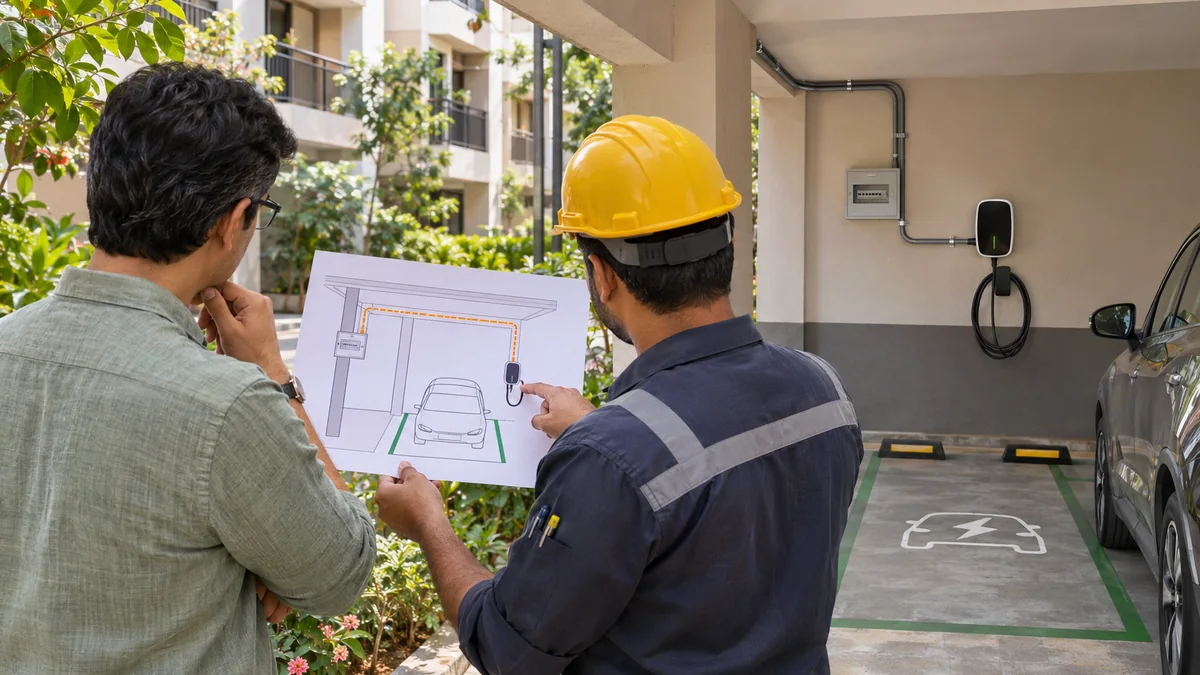
India’s national EV-charging guidelines allow a resident in group housing to seek a private charging point in a designated parking space, supplied through the resident’s meter or a separate sub-meter. A safe installation still requires a workable cable route, enough sanctioned load, written coordination with the housing society and the DISCOM, and electrical protection specified for the charger.
The charger itself is the last purchase in that sequence. Buying a high-kilowatt wall box before checking the parking bay, power route and billing method is a common way to create delay or unnecessary cost.
In this article
What the national guidelines permit
The Ministry of Power’s Guidelines for Installation and Operation of Electric Vehicle Charging Infrastructure 2024, reproduced in the official Lok Sabha record apply to private parking, group housing societies, workplaces and public locations. Clauses 15 and 16, on printed pages 550–551 of that record, describe home and community charging. A homeowner may charge through an existing residential connection, seek a separate metered EV connection, or apply for higher sanctioned load when the proposed charger needs more capacity.
For group housing, the guidelines say residents may install private points in designated parking, with supply through the resident’s existing meter or a separate sub-meter, depending on the consumer’s choice. They also allow an RWA or society to establish community charging, including access for authorised visitors.
Scope: these are national electricity-sector guidelines. A practical approval still depends on the local DISCOM process, state rules, the building’s electrical design and the resident’s parking arrangement. This article does not replace a site inspection.
Private, community and visitor charging
| Model | Works best when | Metering and responsibility |
|---|---|---|
| Private point | A resident has an allotted bay and charges one regular vehicle. | Existing residential meter or an agreed separate sub-meter/connection; resident normally funds and maintains the private installation. |
| Community chargers | Parking rotates, several residents need access, or long cable runs make private points inefficient. | Society agrees access, tariff, service fee, maintenance and load management. |
| Visitor charging | The society wants controlled access for guests or deliveries. | Authorisation, time limits and billing rules should be defined before commissioning. |
The right model is shaped by parking and governance, not only by charger speed. A private point is simple when the bay is fixed and close to an approved electrical route. A shared point can be fairer where parking rotates or demand is still low. A mixed plan often works best: private points for clearly allotted bays plus one or more managed community chargers.
The installation sequence
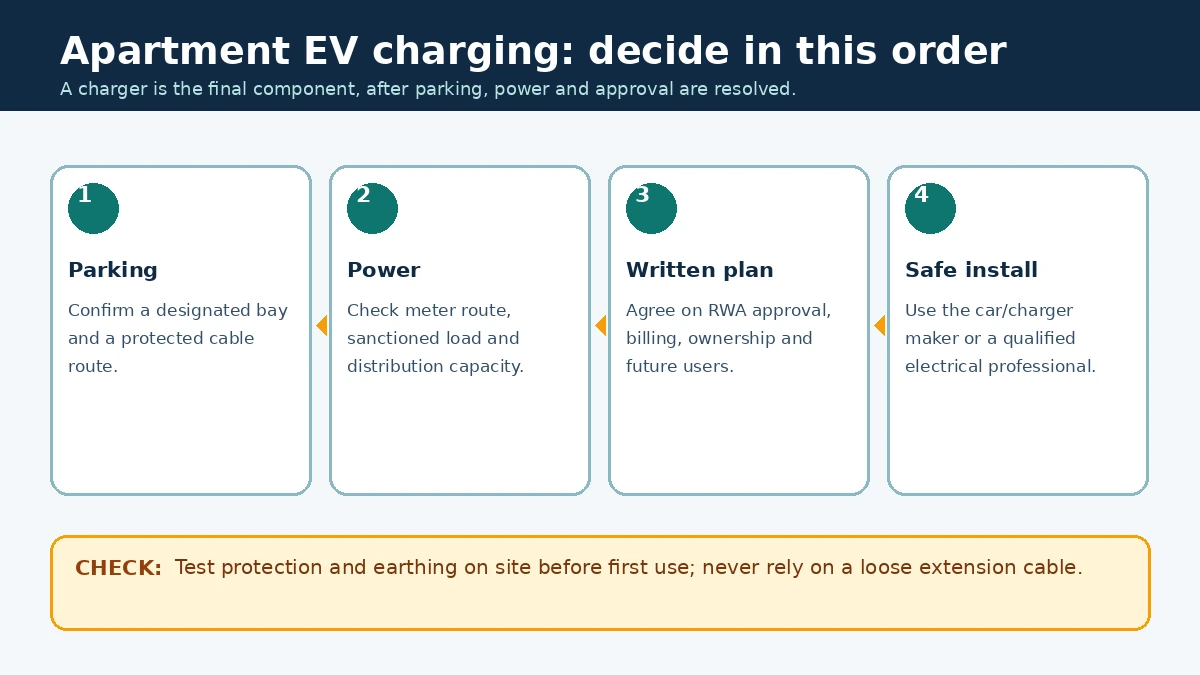
- Confirm the bay. Record whether it is allotted, leased or common, and whether the cable can reach it without crossing a walkway or fire route.
- Map the electrical path. Identify the source distribution board, cable length, containment, meter arrangement and any civil work.
- Check capacity. Compare the charger’s continuous demand with the resident’s sanctioned load and the society’s distribution infrastructure.
- Agree responsibilities. Put equipment ownership, installation cost, electricity billing, maintenance, damage and removal terms in writing.
- Select compatible equipment. Match connector and power to the vehicle’s onboard AC-charging limit. A larger wall box cannot force the car to accept more AC power.
- Commission professionally. Have the installer test protection, earthing and operation before the first unattended charge.
Our related explainer, Why a More Powerful EV Charger May Not Charge Your Car Faster, shows how the car’s onboard charger, supply and wall box create a lowest-limit chain.
How to think about sanctioned load
Charger labels usually state power in kilowatts, while a household connection is approved for a sanctioned load. For a rough single-phase current estimate, divide watts by voltage. At an assumed 230 volts, a 3.3 kW charger draws about 14.3 amperes and a 7.2 kW charger about 31.3 amperes. These are planning estimates, not cable or breaker sizes.
The household also runs lights, cooling, water heating and appliances. If the charger and normal peak use can exceed the connection’s sanctioned load, the resident should request an increase from the distribution licensee or use an approved load-management arrangement. The society must also consider shared transformer and distribution-board capacity when several residents charge at once.
| Planning input | Example question | Decision it informs |
|---|---|---|
| Vehicle AC acceptance | Will the car accept 3.3, 7.2 or 11 kW AC? | Avoids paying for unused charger capacity. |
| Resident sanctioned load | What headroom remains during evening peak use? | Shows whether a load increase or management is needed. |
| Cable length and route | How far is the bay from the approved supply point? | Affects conductor design, containment, voltage drop and civil work. |
| Society coincidence | How many vehicles may charge at once in two years? | Supports phased capacity and smart load sharing. |
Electrical and cable-route safety
EV charging is a long-duration electrical load. Do not run it from a loose domestic extension cable, a damaged socket or an improvised lead across a common passage. The charger manufacturer or qualified electrical professional should specify the dedicated circuit, overcurrent protection, residual-current protection, isolation, earthing and surge protection appropriate to the equipment and site.
Cable containment should protect against vehicles, water, heat and tampering. Keep the route clear of evacuation paths and do not obstruct fire-fighting equipment. Labels should identify the circuit and emergency isolation point. Commissioning should include measured tests at the charging point rather than an assumption that the building earth is adequate.
If the DISCOM or installer finds inadequate wiring, resolve it before energising the point. The older Delhi residential charging guidebook is useful for process examples, but the 2024 national guidelines and current local requirements should control.
What to put in an RWA request
- Flat number, applicant contact and proof of the parking arrangement.
- Vehicle and charger specifications, including maximum AC input.
- A simple route drawing from supply point to bay, prepared or confirmed by the installer.
- Requested meter model: existing residential meter, separate connection or sub-meter.
- Sanctioned-load status and whether an enhancement application is needed.
- Protection, earthing, cable containment and commissioning plan.
- Who pays for installation, electricity, maintenance, repair and later removal.
- A proposal for future residents so the first cable route does not block scalable community charging.
A complete request helps the committee decide a technical plan rather than debate EVs in general. Ask for the decision in writing. If the society proposes community charging instead of a private point, compare availability, tariff, service charge and overnight access with your normal driving need.
Billing, ownership and future growth
Private charging is easiest to audit when the electricity reaches a resident-controlled meter or an agreed sub-meter. For community charging, the society should disclose the electricity tariff, any permitted service fee, the method used to measure each session, and who handles meter or network errors. Avoid a flat fee that hides very different usage unless residents have knowingly chosen it.
Record ownership of the wall box and cable. Decide what happens when the resident sells the vehicle or flat, the parking bay changes, or equipment fails. For a larger society, reserve distribution-board space and cable pathways before demand grows. The September 2024 consolidated guidelines refer the minimum share of common parking reserved for charging to the state’s building bye-laws. Do not treat an older national percentage as a universal rule for every current building; ask the local authority and DISCOM which provisions apply to the property.
The strongest plan solves today’s one-car request without installing a dead end for tomorrow’s ten cars. That usually means a modest compatible charger, a documented electrical route and a society policy that can add managed capacity in stages.
Sources and methodology
This guide is based primarily on the Ministry of Power’s 17 September 2024 consolidated charging guidelines, especially clauses 15 and 16 and the safety and functionality annexures. The Delhi residential charging guidebook supplies practical process examples; it does not override the consolidated guidelines or current local requirements. Current consumer guides were reviewed for common questions, while unsourced cost promises and universal legal claims were excluded.
No apartment was inspected and no electrical design is certified here. Current local DISCOM rules, the equipment manual and a qualified on-site professional must determine the final installation.
Images: original NewsThreads247 editorial illustration and decision diagram. They show a safe planning concept, not a named property or certified wiring design.