
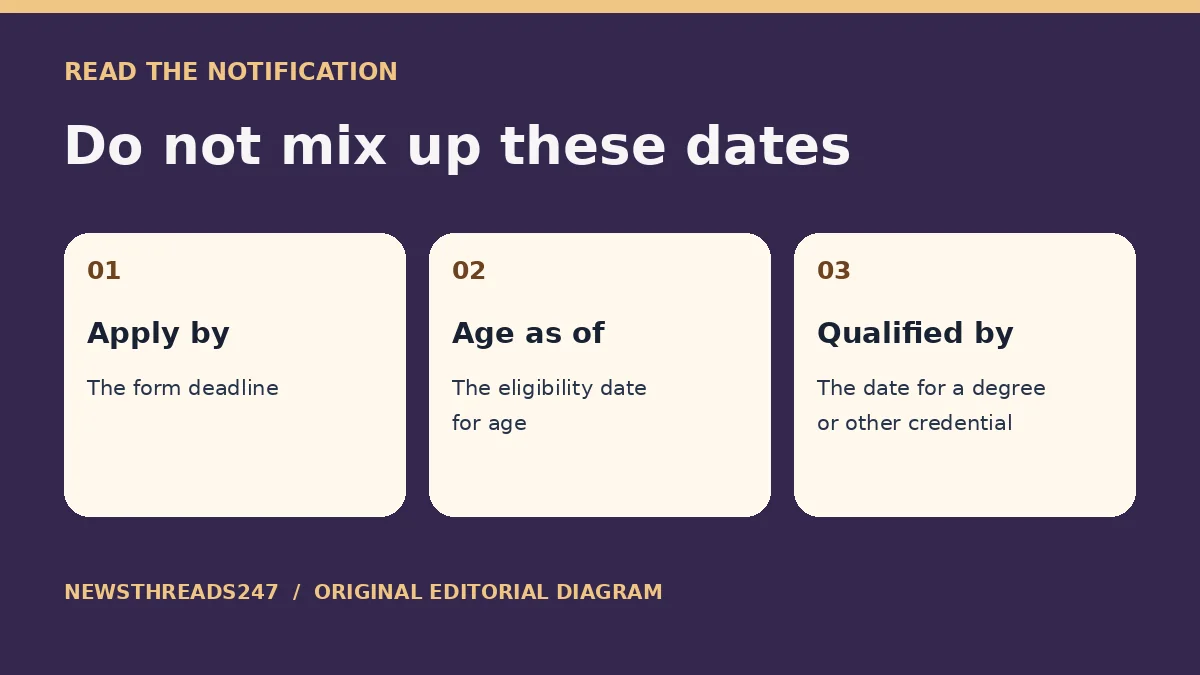
Check your age against the reckoning date stated for the post, even when the application closes on a different day. If the notice prints an eligible date-of-birth range, compare your official date of birth with both endpoints. Use the notice and its amendments rather than a calculator that assumes every recruitment follows the same rule.
In this article
Separate the dates before calculating anything
A recruitment notice can give one date for closing the form, another for determining age and a third for holding a required qualification. Some dates may coincide. That does not make the labels interchangeable. A person can submit a form before the deadline and still miss an age or qualification requirement.
Start with the recruiting body’s official page and confirm the recruitment cycle, post and any amended notice. If a combined recruitment lists multiple posts, find the one you actually want. The guide to matching a recruitment vacancy number explains a separate check for individual advertisements. Record the notification reference and the paragraph you used, not just a date copied from a search result.
A real boundary example from SSC
The SSC Combined Graduate Level Examination 2026 notice reckoned age on 1 August 2026. For posts listed in its 18–27 band, it gave a birth-date range from 2 August 1999 through 1 August 2008. The notice had other bands for other posts. These are historical examples of how to read the wording, not a vacancy alert or a rule for the next cycle.
For that one unrelaxed band, 2 August 1999 was inside the stated window; 1 August 1999 was earlier than the first date. At the other end, 1 August 2008 was inside; 2 August 2008 was later than the last date. A birthday one day away can matter. The birth-date window avoids an argument about whether a headline such as “18–27” includes a person who has already reached the upper birthday.
If the new notification provides a date range, use its own language on inclusivity. If it gives only a limit, work from its reckoning date and read the age wording carefully. For a boundary case or a leap-day birthday where the notice is unclear, use the recruiting authority’s official clarification instead of relying on a shortcut.
| Historical birth date | Result under the example 18–27 band |
|---|---|
| 1 August 1999 | Outside: before the earliest date |
| 2 August 1999 | Inside: earliest stated date |
| 1 August 2008 | Inside: latest stated date |
| 2 August 2008 | Outside: after the latest date |
Check the relaxation for the exact post
An age relaxation is an exception under a particular rule. Check which categories it covers, whether it changes the upper limit and which certificate or service proof the notice requires. A category name in one advertisement does not prove the same concession applies to a different post or institution. If more than one concession seems relevant, use the notice’s rules on combining them rather than adding years yourself.
Write down the base age band and the paragraph for the applicable concession. Keep the date used to decide age separate from any date by which you must hold evidence. If the authority issues a correction, compare the revised clause to the original and save both. The SSC notice board is one example of where to look for official updates.
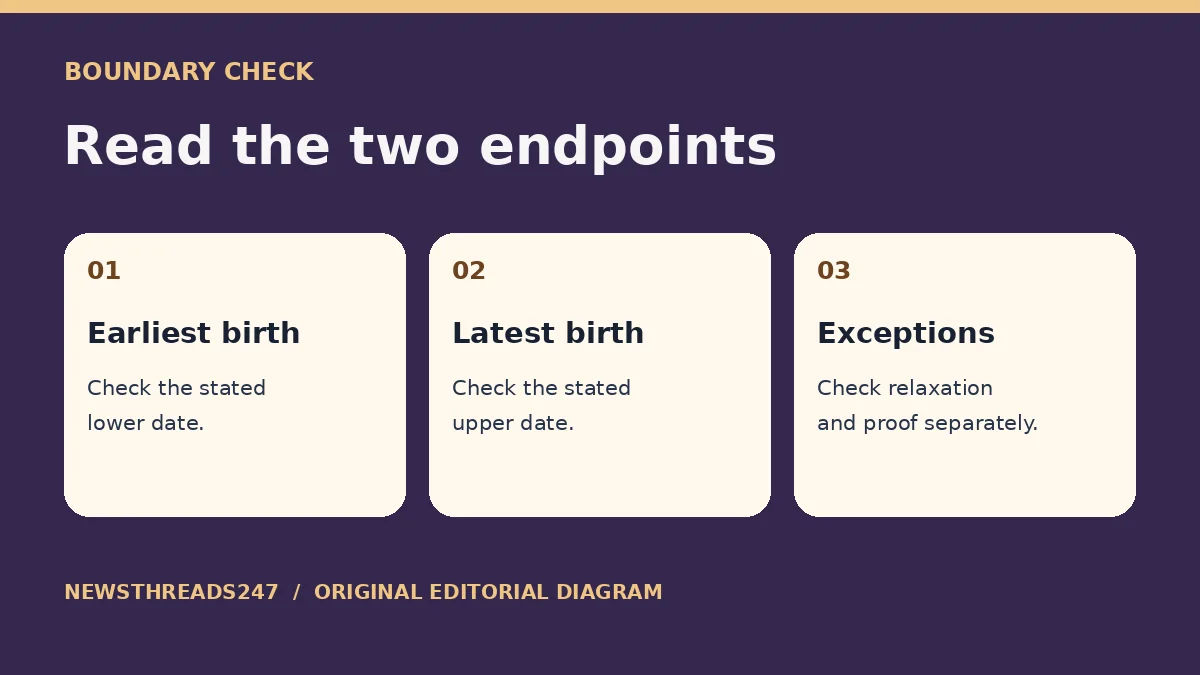
Use the recorded date of birth, not the easiest document
Find the document the notice accepts as proof. In the SSC example, paragraph 5 includes the rules about the date of birth recorded on the application and its documentary basis. For a different recruitment, check its own instructions before assuming a different identity document can substitute. Compare the day, month and year in the accepted record with what the form displays before paying.
If two documents disagree, do not pick the version that puts you inside the range. Ask the authority which document controls and follow its published correction instructions. Keep sensitive numbers, scans and payment details out of public groups. The IBPS registration page for a previous CSA cycle explicitly distinguished online form acceptance from later scrutiny. That is a useful reminder: a form that accepts your entry does not decide your eligibility.
Run a five-minute check before paying
Record the post, recruitment reference and revision date. Mark the age reckoning date and any printed birth-date endpoints. Compare them with the date on the accepted proof, then check the relaxation rules and required evidence separately. Finally, verify the application closing time and qualification date, including the applicable time zone when the notice specifies one.
This process is especially useful if you are applying for more than one post. Keep a separate row for each instead of carrying forward the result from the first one. Save the official document and the application acknowledgment so you can reconstruct what you used if a question comes up at scrutiny. Recheck this guide when a recruiting body changes its wording or document rules. The graphics are original explanations, not notice screenshots.