
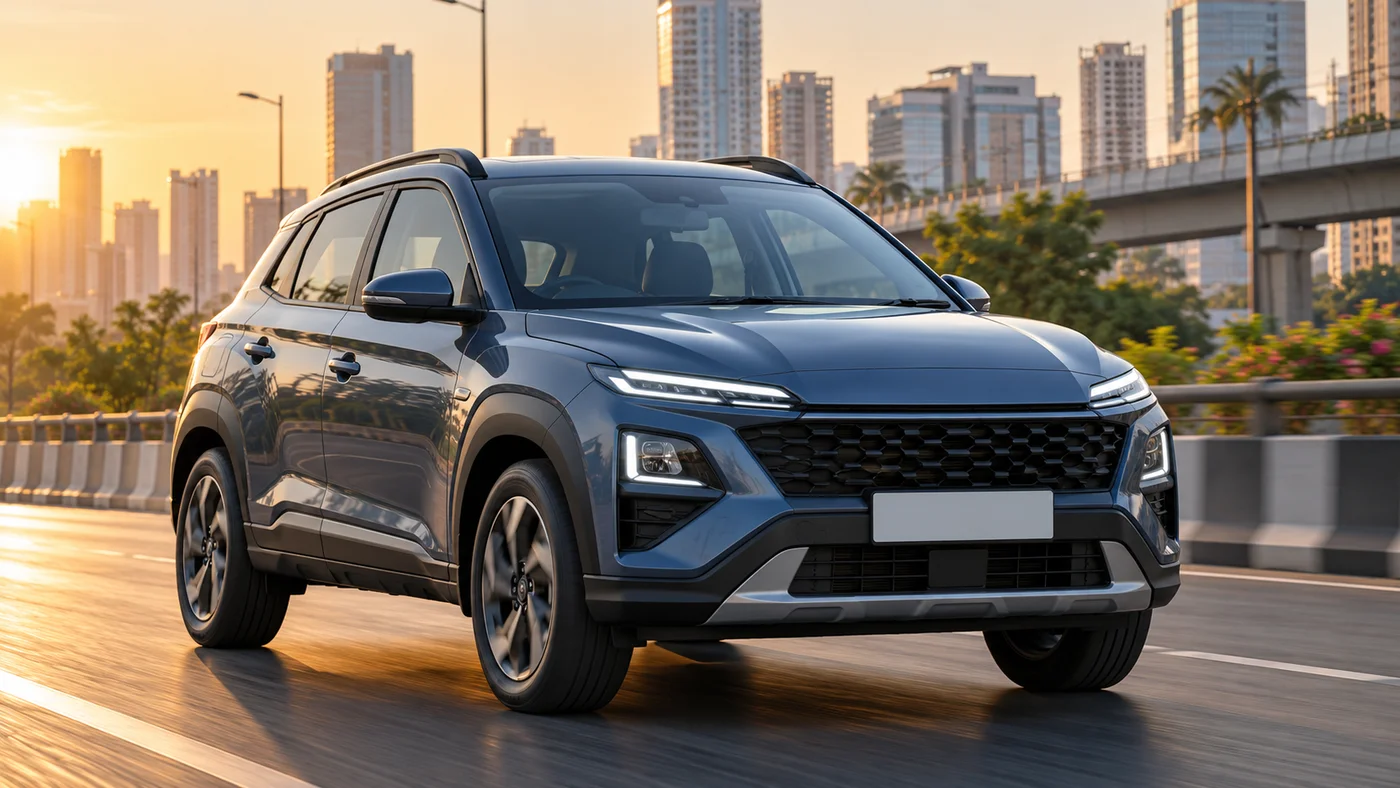
The Hyundai BAYON was launched in India on 26 October 2026 with a stated starting price of ₹9,99,900 ex-showroom. The new compact SUV pairs a 1.5-litre petrol engine with manual or Intelligent Variable Transmission (iVT) options and advertises an AI voice assistant and Level 2 Pro driver assistance on suitably equipped trims. Those headline features are real parts of Hyundai’s announcement, but buyers should not assume the entry variant has every feature.
Hyundai’s official launch release provides the price and powertrain details. The manufacturer’s variant-by-variant feature matrix is the better tool for the final equipment decision. This article separates launch claims, standard equipment, optional/high-grade features and things that still require a dealership quote. It is not an independently conducted road test.
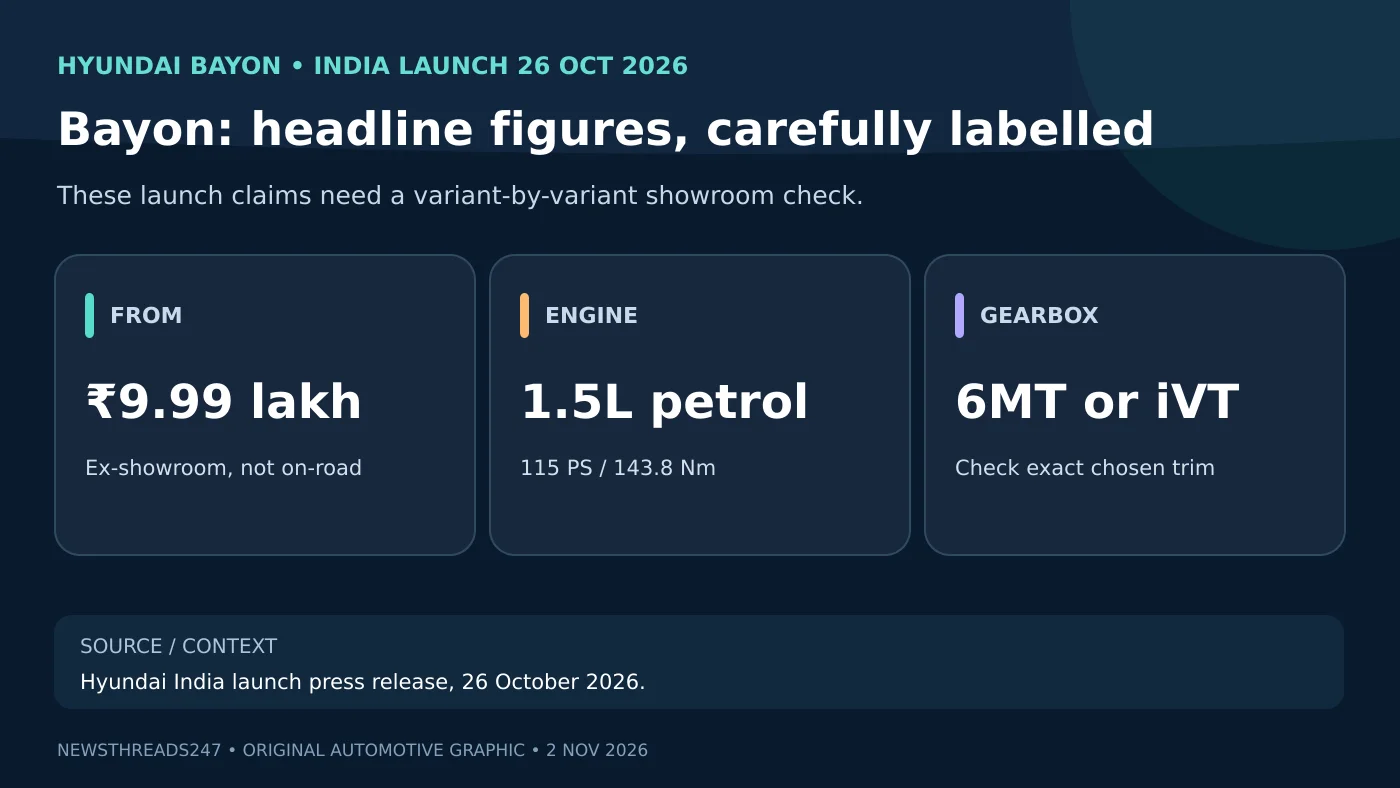
Bayon India launch facts at a glance
| Item | Manufacturer-published information | Practical limitation |
|---|---|---|
| Launch | 26 October 2026 | Check current bookings and delivery by dealer |
| Starting price | ₹9,99,900 ex-showroom | On-road taxes, insurance and other charges extra |
| Engine | 1.5L four-cylinder MPi petrol | Not a claim about fuel economy |
| Power/torque | 84.4 kW (115 PS), 143.8 Nm | Driving feel requires real test drive |
| Transmissions | 6-speed manual or iVT | Availability varies by trim |
| AI assistant and Level 2 Pro ADAS | Highlighted in launch materials | Not available on every variant |
The ₹9.99 lakh number is a starting ex-showroom price, not the amount every buyer will pay. Registration taxes, insurance choices, accessories, extended warranties and location-specific charges change the on-road bill. It would be misleading to label a city-specific quote as a national fixed price or to assume a limited-time dealership offer will still apply later in November.
What does the 1.5-litre engine actually offer?
Hyundai lists a four-cylinder 1.5L MPi petrol engine producing 84.4 kW (115 PS) and 143.8 Nm. It is paired with a six-speed manual or iVT in select grades. Engine output is a specification at an engineering measurement point; it does not state a guaranteed 0–100 km/h time, daily fuel cost or city fuel consumption for every driver. Hyundai’s powertrain announcement discusses the iVT, selectable driving modes and related functions.
An iVT is Hyundai’s variable-ratio automatic transmission branding. Its driving feel differs from a conventional manual or five-speed AMT because the systems manage ratios and shifts differently. A prospective owner should test slow-speed crawling, parking, hill starts and overtaking response in safe conditions. A short enthusiastic showroom spin is not a substitute for checking whether the driving position, visibility and ride suit your family.
AI voice assistant: convenience is not autonomous driving
The BAYON launch describes an in-built generative AI voice assistant, with technologies attributed to Perplexity and SoundHound AI. It also describes Hyundai Bluelink connected functions and a dual-screen connected-car cockpit in its higher-technology package. The important buyer question is the exact variant and subscription or service conditions, not whether the vehicle features the letters “AI” in an advertisement. The official convenience page describes intended uses and capabilities.
Before paying for a particular grade, ask which voice functions work without a data connection, which need mobile-network access, whether updates or connected services incur later costs and how personal voice or location data are managed. The manufacturer’s published trim comparison should be checked against the written sales order, because an advertised technology might be limited to the top variant.
Level 2 Pro ADAS: what the driver must still do
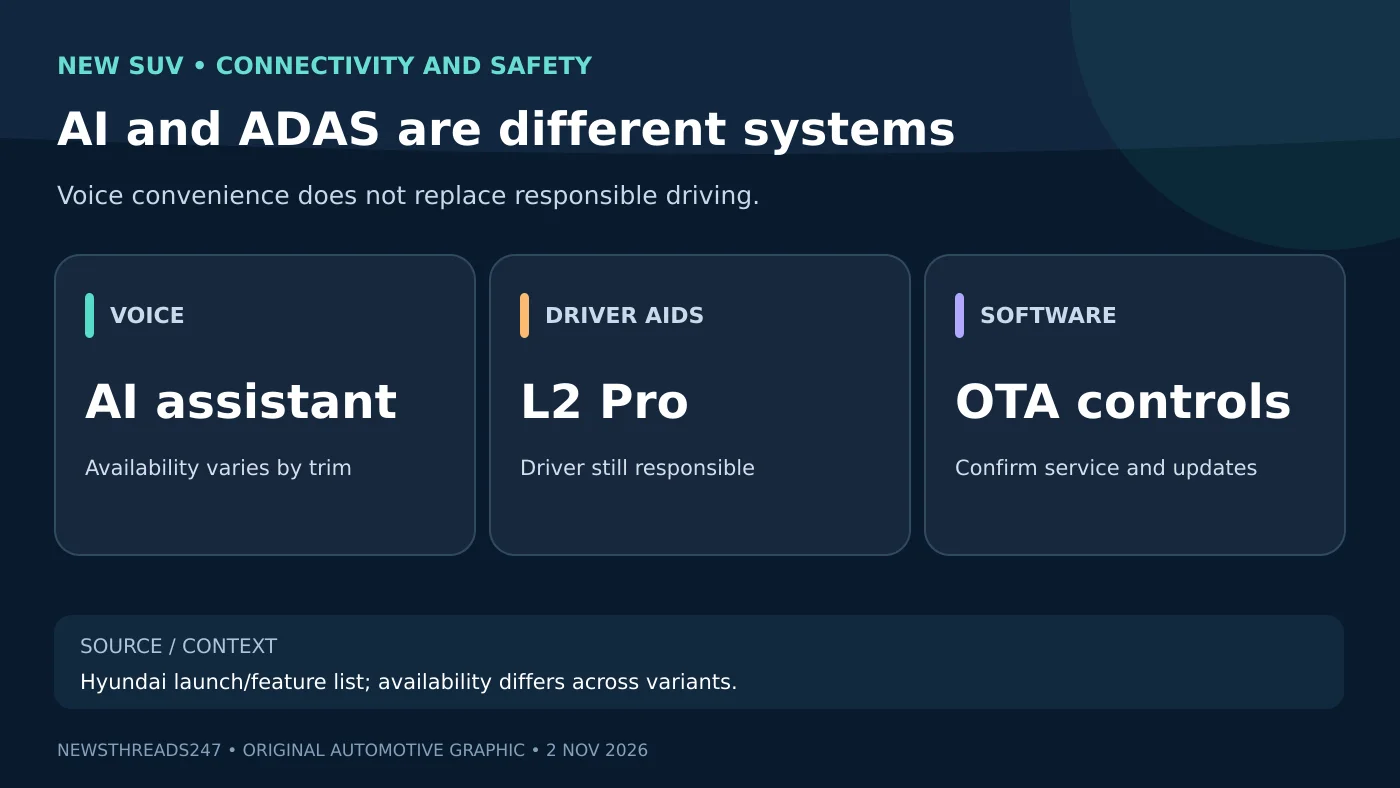
Hyundai’s safety materials list SmartSense Level 2 Pro features such as forward collision functions and highway assistance. Level 2 assistance combines automated elements of speed and steering support under defined conditions; it does not mean the car is self-driving or that the driver can look away, sleep or use a phone. The official safety page and variant matrix should be read for individual feature availability and limits.
Marketing language about a platform “engineered for five-star Indian safety standards” is not a published independent Bharat NCAP crash-test score for a specific variant. Do not represent it as a tested five-star rating unless the assessment body publishes the relevant result. Our Bharat NCAP rating explainer shows why assessment date, tested trim and equipment matter.
Check the variant equipment, not only the launch headline
The manufacturer site lists HX 2, HX 3, HX 3+, HX 5, HX 6, HX 8 and HX 10 grades with different equipment. Its comparison page indicates that the generative AI voice assistant and certain advanced driver-assistance features belong to selected higher trim(s), rather than every version. Buyers should check the precise grade and powertrain combination by name and date. If a salesperson says “all Bayons have this,” compare the claim with the official matrix in writing.
- Request the price and on-road breakup for the exact engine/gearbox/grade, not a model-wide starting figure.
- Check whether the variant has the claimed camera, airbag, ADAS, infotainment and connected features.
- Ask about delivery window, cancellation/refund conditions and any mandatory accessory claims.
- Test rear-seat space, child-seat installation, boot access, visibility and operating controls yourself.
- Review service intervals, warranty wording and exclusions through Hyundai’s current official documents.
What a fair comparison with rivals requires
A car’s launch price or longest feature list does not make it the best choice for every household. Compare a consistent on-road budget, safety equipment, real rear-seat dimensions, service proximity, operating expenses and ride over the roads you actually use. Do not compare a fully loaded BAYON against the lowest-priced variant of a rival and call it a neutral result.
For buyers who already own another car, the decision may depend more on trade-in value, EMI terms, expected annual driving and family needs than on headline horsepower. Fuel-economy claims should be read as certified test figures when they are available, not a guarantee that a particular route will achieve them.
Frequently asked questions
What is the Hyundai Bayon launch price in India?
Hyundai announced a starting ex-showroom price of ₹9,99,900 on 26 October 2026. Ask for a current variant-specific on-road quote.
Does every Hyundai Bayon have the AI voice assistant?
No such model-wide claim is justified. Hyundai’s variant matrix shows equipment differs by grade; check the exact current trim before ordering.
Is the Bayon fully self-driving?
No. Its advertised Level 2 driver assistance requires continuing driver supervision within defined operating conditions.
Has the Bayon achieved five stars in Bharat NCAP?
A platform marketing statement is not a verified crash-test rating. Look for an actual official published Bharat NCAP assessment for the model and applicable variant.
Bottom line and source date
The new BAYON has a verified India launch, price and powertrain, plus noteworthy connected and driver-assistance features on the correct grades. The best next step is comparing the official announcement with the current features-by-variant table and a written on-road quote. Checked 2 November 2026 IST; offers and delivery details can change.
Editorial and image disclosure: Manufacturer claims are labelled, no independent test drive is claimed. The lead art is an AI-created generic SUV, not a real photograph of the Hyundai BAYON; the two supporting visuals are original data explainers.