
If an old Indian savings account will not let you withdraw money, first ask the bank to confirm its exact status. An inoperative account needs an activation process and fresh KYC; a failed app login, expired card, other restriction or closed account can require a different remedy. Sending a small transfer is not a reliable substitute for that diagnosis.
The useful task is to assemble one complete request, obtain a record of receipt and verify activation. This guide uses SBI’s current published process as a concrete example, then shows where other banks’ procedures differ. It covers access to your own account, not a deceased depositor’s claim or a US unclaimed-property search.
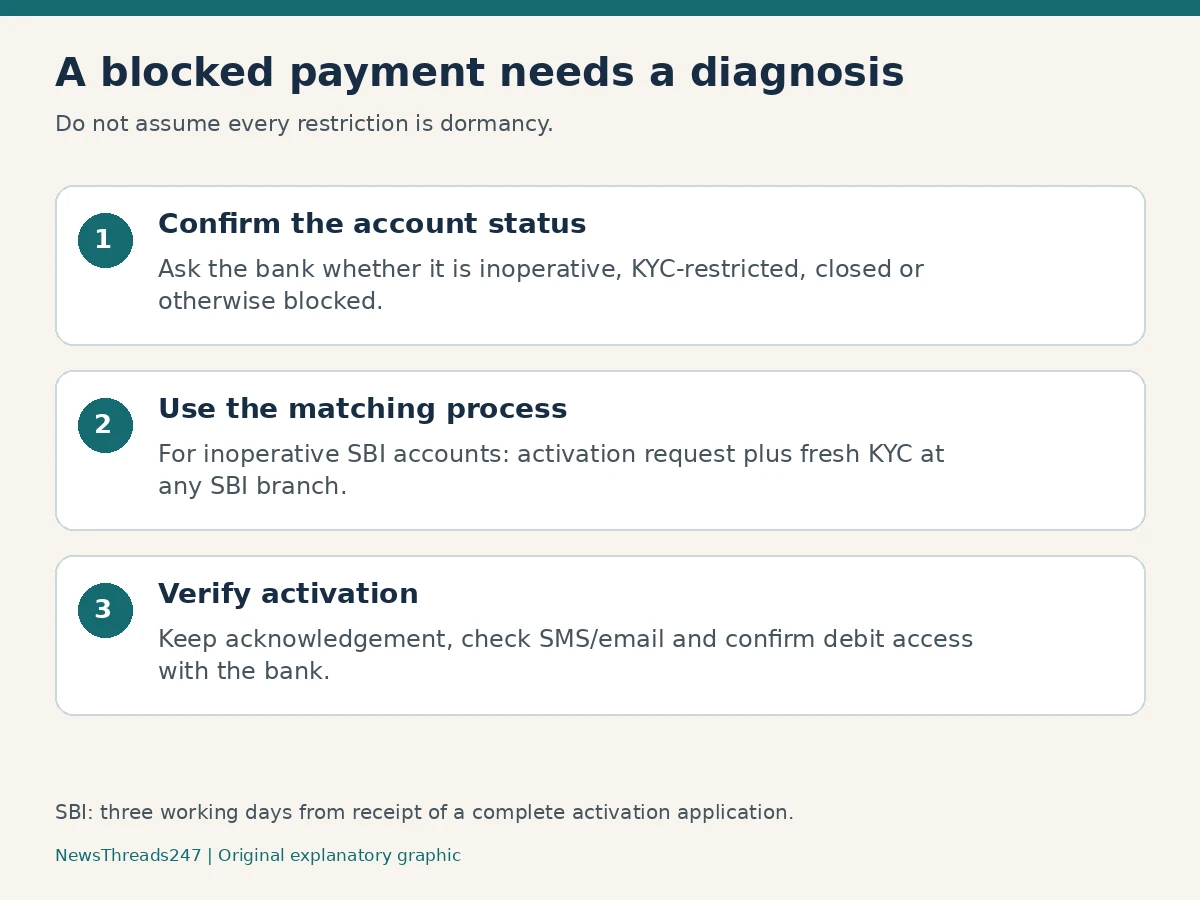
Confirm why access is restricted
SBI’s reactivation page, last updated 10 June 2026, describes a savings or current account as inoperative after more than two years without customer-induced transactions. Its examples include qualifying financial activity, certain authenticated non-financial activity and KYC updates. Merely checking an old statement does not establish which activity the bank has recorded.
Ask the bank to identify the restriction before choosing a form. A useful question is: “Is the account inoperative, restricted for KYC, closed, or blocked for another reason? What process applies to this status?” If a security or legal restriction exists, do not assume a dormancy request will remove it.
| What the bank confirms | Appropriate next enquiry |
|---|---|
| Inoperative account | Activation request, fresh KYC and the bank’s complete-application requirements. |
| KYC or contact details need updating | Which details and evidence must be updated, and whether activation is also required. |
| Digital access or card problem only | Account access, password or card support through the official bank channel. |
| Closed account or deceased holder | The separate closure, settlement or claimant procedure; do not submit as the living account holder. |
SBI: any branch, fresh KYC and a complete application
SBI says customers with an inoperative account can visit any SBI branch with current KYC documents and request activation. It specifies processing within three working days from receipt of the complete application, followed by SMS or email communication. The key phrase is complete application: an initial enquiry or an unfinished document submission is not the same milestone.
For context, a Finance Ministry answer to the Rajya Sabha dated 16 December 2025 also describes fresh KYC at a branch of the relevant bank and the three-working-day standard. That answer is dated background, not a new November 2026 announcement; SBI’s current process is the bank-specific reference here.
Before visiting, ask for the current activation form, acceptable identity and address documents, whether originals must be shown, and requirements for every holder of a joint account. SBI’s KYC information page is a starting point. Do not rely on a forwarded checklist when your address, name or account-holding arrangement has changed.
Build a file that can be checked in one visit
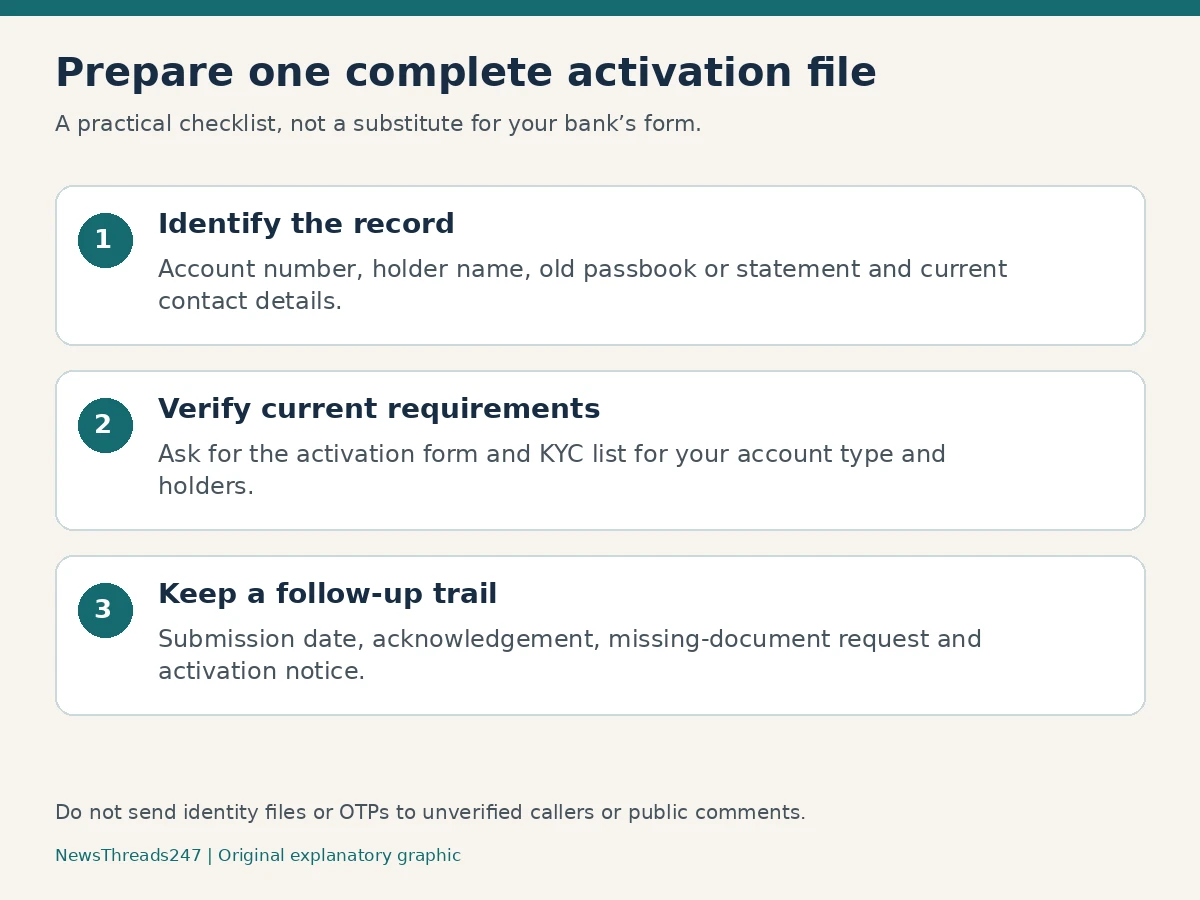
Separate what identifies the old record from what establishes your current identity. A passbook or old statement can help locate the account, while the bank’s current KYC requirements determine the identity evidence it needs. A missing passbook is a reason to ask for the permitted alternative, not to buy an “account recovery” service from an unknown intermediary.
A practical file has the activation request, the account details you already hold, the requested KYC evidence and current contact information. If several holders are involved, check their requirements before arranging travel. Tell the branch about discrepancies rather than silently substituting a different name or address.
On submission, ask whether anything is missing. Keep the acknowledgement or reference, the date and the branch used. If documents remain outstanding, record exactly what is needed and when it was supplied. This makes a later follow-up about completion much clearer than saying only that you “went to the bank last week”.
Online activation is bank- and account-specific
Do not assume that another bank’s app instructions apply to yours. HDFC Bank’s dormant-account page, for example, describes a digital route for eligible singly held resident savings accounts where the customer has another active account with the bank. It gives different branch requirements for joint and current accounts.
Union Bank’s procedure describes a base- or non-base-branch submission with a signed request, valid documents and photograph, with additional evidence for entities. These examples show why an all-banks promise of instant online activation would be misleading.
Use a digital route only when the bank’s own page or app offers it for your account. If it does not, ask which supported route is available. Never give a caller an OTP, install a remote-control app or move money to a supposed verification account to make an old account operative.
Track the outcome, not just the document upload
For SBI, compare the complete-application acknowledgement with its published three-working-day processing period. Working days are not the same as three calendar days; branch holidays can matter. Ask the bank how it is treating your submission date if the expected timeline is unclear.
Consider an illustrative customer who hands over a request on Monday but is asked for a missing document. They provide it on Wednesday and obtain confirmation that the application is complete. A follow-up should include both dates rather than presenting Monday’s incomplete file as the only relevant event. The branch should confirm its recorded receipt and status; this example does not calculate a guaranteed activation date.
If the indicated period passes, follow up with the reference and ask for a specific reason or outstanding requirement. Use the bank’s official grievance channel when ordinary branch follow-up does not resolve the issue. Keep one chronological record rather than sending contradictory requests to multiple unverified addresses.
After activation is confirmed, check that the intended debit facility works through a normal secure channel. Review contact details and pending payment arrangements before relying on the account for an urgent bill. An activation notice does not itself confirm that a separately expired card or forgotten digital password has been fixed.
An inoperative account is different from an unclaimed-deposit search
SBI’s Policy on Depositors’ Rights separately discusses long-unclaimed accounts and the bank’s responsibility for paying a valid claimant after balances are transferred to the Depositor Education and Awareness Fund. This is a different record-and-claim problem from reactivating a recently unused account.
If you cannot identify the old bank deposit, our UDGAM search and claim guide explains the search route. A search result helps locate a record; it is not activation or approval to withdraw. Conversely, no UDGAM match is not proof that a known account has no balance.
For a deceased holder, tell the bank your actual capacity as nominee, heir or representative and request its claim process. Do not log in or submit declarations as though you were that person. A reactivation checklist for a living holder does not establish anyone else’s right to the funds.
Decide what to do with the account afterwards
Once access is restored, decide whether the account still serves a purpose. If you retain it, keep contact and KYC information current and ask the bank which activity it recognises. If you no longer need it, obtain the formal closure procedure and review linked payments before closing. Repeatedly forgetting an unnecessary account creates more record-keeping work.
The best starting action remains simple: confirm the account status and obtain the exact requirements for one complete application. It is safer and more useful than trying random transactions, using another bank’s instructions or trusting a caller who promises to unlock the balance.
Source and production note: linked bank procedures and the parliamentary answer were checked on 4 November 2026. This AI-assisted explainer adds an application-preparation and follow-up workflow; it is general information, not individual legal or financial advice. The lead image is a disclosed AI-generated conceptual illustration; the two diagrams are original NewsThreads247 explanatory graphics.