
Virat Kohli and Rohit Sharma are both named in India’s ODI squads for the five-match tour of New Zealand beginning 4 November 2026. The first match is scheduled for Eden Park, Auckland. The latest official squad lists also show a captaincy change partway through the series: Shubman Gill leads the first three ODIs and Shreyas Iyer leads the fourth and fifth.
The important detail is that India does not have one unchanged list for all five games. The BCCI’s 31 October update brought Auqib Nabi into the first-three squad, while an earlier 30 October advisory ruled Prasidh Krishna out of the ODI series. Here is how to read the changes without confusing a squad place with a confirmed starting XI.
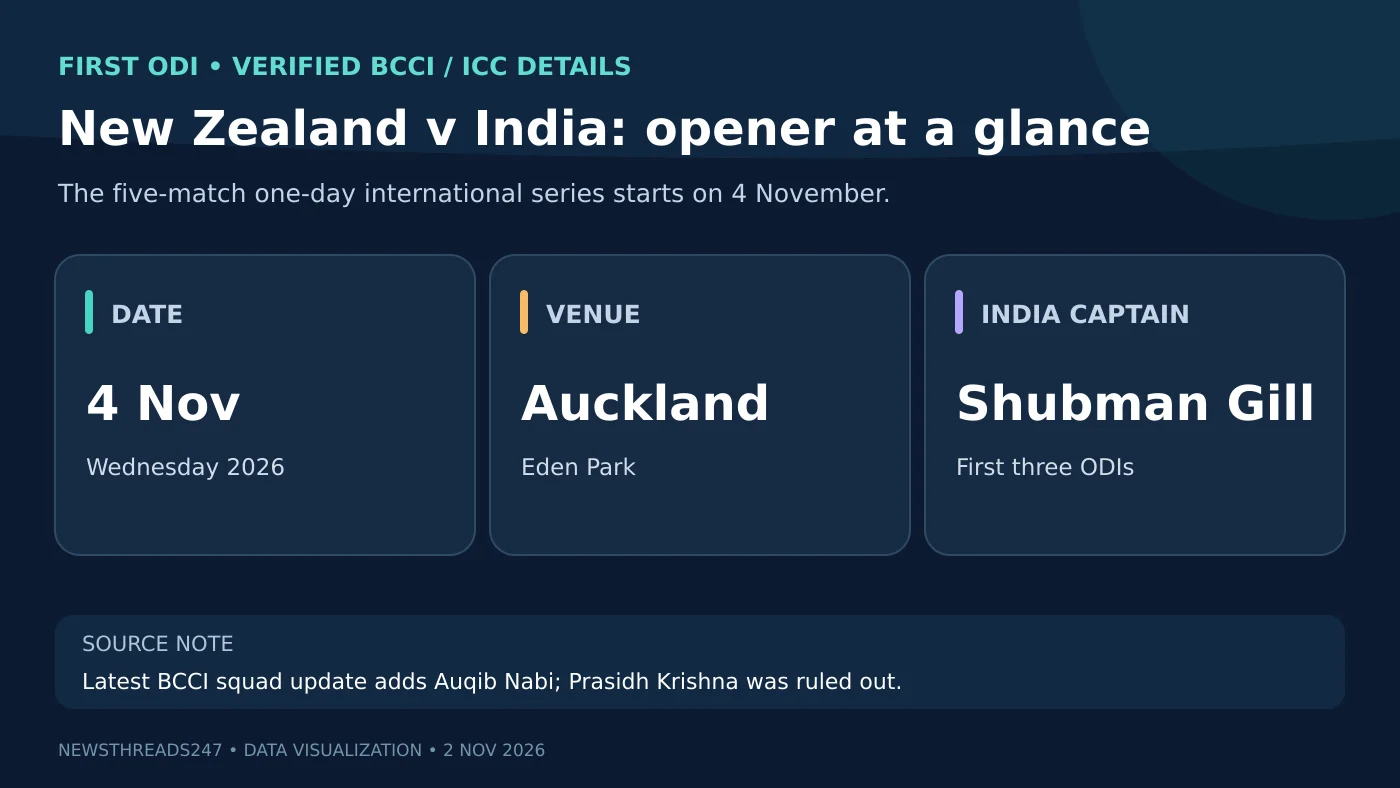
First ODI: confirmed date and venue
| Item | Officially reported detail | What to check later |
|---|---|---|
| Series | Five one-day internationals | Subsequent schedules for local-time updates |
| Opening match | Wednesday, 4 November 2026 | Final confirmed start and weather |
| Venue | Eden Park, Auckland | Venue guidance and travel information |
| India captain (ODIs 1–3) | Shubman Gill | Toss-time playing XI |
| Senior batters | Virat Kohli and Rohit Sharma listed | Whether each is selected in the final XI |
The BCCI first-ODI match page lists Auckland on 4 November, and the ICC fixture is another official checkpoint. In India, overseas tour timings can differ sharply from the usual evening domestic match window; use the local time shown by the official match centre rather than an unsourced social-media graphic.
Why Kohli and Rohit are part of the headline
Both are well-known India international batters, so their presence is naturally relevant to readers tracking the ODI format after a T20I series. But the verified news is precisely their inclusion in the BCCI lists—not an unannounced “comeback” narrative, a guaranteed hundred, or a personal declaration about future retirement. Avoid treating a player’s social-media popularity as evidence of an unreported selection decision.
The updated BCCI first-three list includes Gill, Rohit, Kohli, Shreyas Iyer, KL Rahul, Axar Patel, Naman Dhir, Anshul Kamboj, Gurnoor Brar, Ruturaj Gaikwad, Arshdeep Singh, Ishan Kishan, Mohammed Siraj, Kuldeep Yadav, Nitish Kumar Reddy for the opener only, and Auqib Nabi. That is a squad, not a batting order. The team can select only eleven for a given match, and the composition depends on the actual conditions and management decision.
The leadership split: Gill first, Iyer later
The first three ODIs have Shubman Gill listed as captain and Shreyas Iyer as vice-captain. For the final two, Shreyas Iyer is captain and Ishan Kishan is vice-captain. This distinction matters when readers compare headlines from different dates or see two apparently conflicting squad cards. Both cards may be accurate for different portions of the same series.
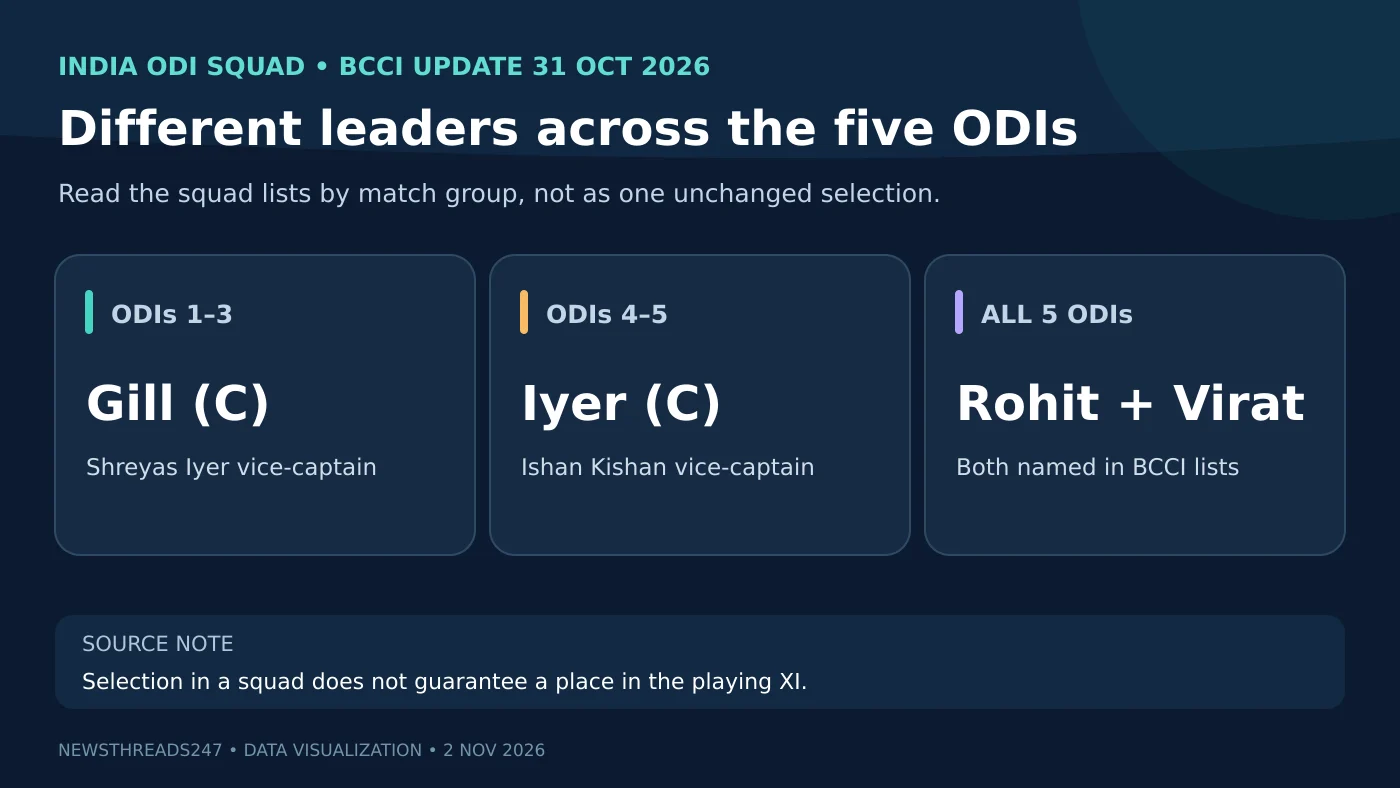
Neither Kohli nor Rohit is named captain in the relevant current BCCI squad lists. It is therefore inaccurate to imply that star status alone transfers captaincy. What can be said is that both are selected in the listed groups. The vice-captain information should be confirmed again if the cricket board issues a later injury replacement or leadership update.
What changed in the pace attack
The BCCI said Prasidh Krishna was ruled out as he continues recovery from a hamstring problem. The board also reported that Mohammed Siraj was joining India A for a four-day match, while still appearing in its ODI squad information. That distinction between a short preparation assignment and ODI selection is easy to lose in abbreviated headlines.
On 31 October, the selectors added right-arm pacer Auqib Nabi to the squad for the first three ODIs; he had originally been listed for the fourth and fifth. This made him available from the start rather than only the closing games. Our separate Auqib Nabi squad-change report explains the selection update itself. Here, the emphasis is how the entire first-match group fits together and what the audience must still verify.
Nitish Kumar Reddy is listed for the opener only
The 30 October BCCI media advisory specified that Nitish Kumar Reddy would remain in the ODI group for the first match and then join the India A squad for the third four-day game against New Zealand A. This is not a blanket statement that the player is unavailable for all of the ODI tour or that a particular person replaces him in the playing XI. It is a schedule and group-management instruction from the board.
The advice illustrates why readers should check the exact date of a squad bulletin. A graphic using the original 16 October announcement may omit later availability changes. Comparing an old list with a new one without dates can create false contradictions. The most recent official advisory should take precedence for the affected matches, subject to an even later update.
T20I momentum is not an ODI selection forecast
India won the five-match T20I series 3–2, while New Zealand took the final two games. The 1 November finale featured Tim Seifert’s 93 and Adam Milne’s four wickets, but a fifty-over ODI changes the pacing, bowling allocations and potential player pool. Our earlier T20I preview describes the Auckland setback; it should not be treated as a prediction that the same batters or bowling combinations will appear in the ODI opener.
The sensible reader questions are: who is currently available, who has been officially assigned to captain, which players are wicketkeeping options, what is the venue, and when is the toss? Without an official XI, claims of “confirmed openers” or “final bowling attack” remain projections. A well-written squad guide makes that limitation visible rather than hiding it under an excited headline.
How to follow the official updates
- Before match day, recheck the BCCI news and match pages for selection, medical and schedule bulletins.
- On 4 November, use the ICC match centre or the board scorecard to see the toss-time XI and official score.
- For a player absence or a venue change, verify the date of the statement and distinguish it from an analyst’s predicted XI.
- If you use a social video or creator roundup, trace numerical claims back to the scorecard or governing-body release before sharing.
Common questions
Are Virat Kohli and Rohit Sharma in the ODI squad?
Yes. Both are in the BCCI’s updated lists for the first three and final two ODIs. Selection in the final playing XI is decided for each match.
Who is India’s ODI captain in New Zealand?
Shubman Gill is named captain for the first three ODIs, with Shreyas Iyer vice-captain. Iyer is captain for the fourth and fifth, with Ishan Kishan vice-captain.
Why is Prasidh Krishna missing?
The BCCI’s 30 October advisory ruled him out of the ODI series during hamstring recovery. Do not speculate beyond the board’s statement about prognosis or return date.
When and where is the first ODI?
It is scheduled for Wednesday, 4 November 2026, at Eden Park in Auckland. Use the current ICC or BCCI fixture for the authoritative start time and any change.
Bottom line
The headline is not merely that two famous batters are on tour. It is that the five-match series begins on 4 November with verified squad changes and a split leadership plan. Check BCCI’s latest first-three list before making any claim about an individual role, and wait for the toss-time XI to settle who actually plays.
Editorial check: 2 November 2026, IST. Squads and match arrangements can change. All leadership and availability claims are tied to published BCCI advisories; no personal interviews are claimed.
Visual disclosure: The lead image is an AI-created conceptual scene of anonymous cricketers, not a real photograph of Kohli or Rohit. The two other images are original data graphics based on official published information.