

New Zealand won the fifth and final T20I against India by seven wickets at Hamilton on 1 November 2026, but India won the five-match series 3–2. The two results answer different questions: New Zealand were stronger in the finale, while India’s first three victories had already secured the series.
At Seddon Park, India made 191/8 in 20 overs. New Zealand reached 195/3 in 18 overs, with Tim Seifert scoring 93 off 50 balls and Glenn Phillips finishing unbeaten on 65 off 38. Adam Milne’s 4/19 had earlier made an enormous difference. These details come from the ICC’s 1 November match report and the published scorecard, not a claimed first-hand view of the game.
The result at a glance
| Question | Verified answer | Why it matters |
|---|---|---|
| Who won the fifth T20I? | New Zealand, by seven wickets | The hosts chased 192 with 12 balls left. |
| What were the totals? | India 191/8; New Zealand 195/3 | The win came at a faster scoring rate. |
| Who won the series? | India, 3–2 | A final-game loss did not reverse three earlier wins. |
| Leading performances? | Milne 4/19; Seifert 93; Phillips 65* | Bowling damage and a sustained chase shaped the game. |
The distinction between a match result and a series result is especially important for readers arriving from a live scorecard, highlight clip or headline. “New Zealand beat India” is true of the Hamilton game; “India won the series” is true of the full five-match contest. Both belong in an accurate headline or summary, with the context made clear early.
How Milne changed the first six overs
New Zealand captain Mitchell Santner chose to field. Milne dismissed Abhishek Sharma for a duck and Sanju Samson for four, leaving India at 19/2 in 3.1 overs. That start placed additional pressure on the middle order: the batting side now needed to rebuild quickly while preserving enough wickets for the final overs. It would be an exaggeration to call the innings finished at that stage, because India still recovered to 191.
Ishan Kishan and captain Shreyas Iyer responded with a 93-run partnership from 43 deliveries. Kishan made 61; Iyer reached his fifty in 22 balls and was dismissed shortly afterward. Naman Dhir’s 33 off 23 also supported the final total. The counterattack shows why the early collapse and the innings total should be read together: India produced a competitive rate despite losing two early batters.
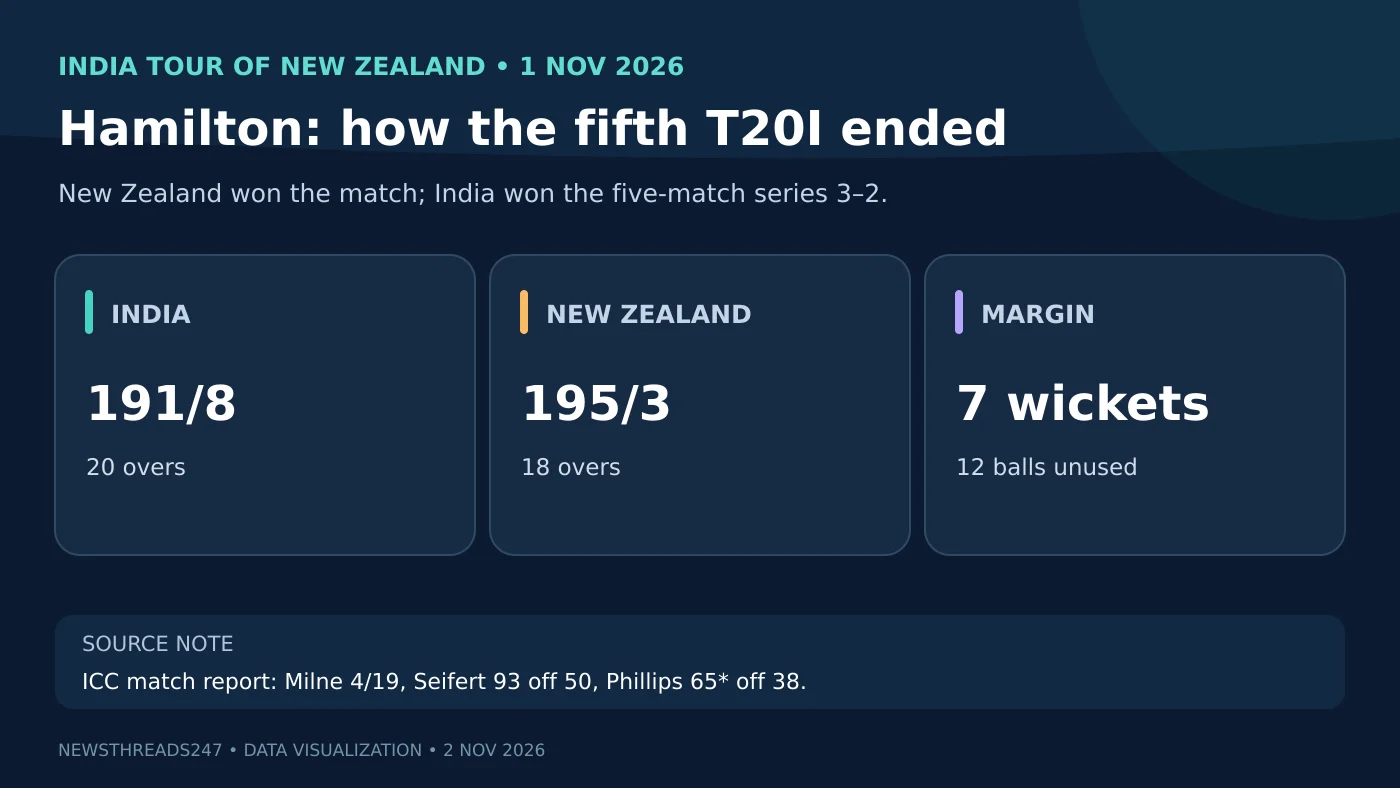
Milne’s 4/19 stands out because wicket-taking and run restriction occurred together. But the numerical score alone cannot establish that a particular line or length “caused” every dismissal. The match report supports his decisive bowling impact; it does not justify assigning unverified intent to individual deliveries or adding a fabricated dressing-room quote.
Why the Seifert–Phillips chase was effective
Chasing 192 required 9.6 runs per over at the start. New Zealand lost Finn Allen for nine, yet reached 59/1 by the end of the powerplay. Seifert reached his half-century from 34 deliveries and ultimately struck 11 fours and five sixes in a 50-ball 93. India had opportunities, including an early dropped catch mentioned in the ICC account, but Seifert continued to score aggressively.
Seifert and Phillips added 86 in a key partnership, turning a demanding target into a more manageable finish. Phillips remained 65 not out from 38 balls and struck the winning boundary; the hosts used 18 overs rather than all 20. Daryl Mitchell’s 29 provided another part of the chase, while Varun Chakravarthy took his wicket. This was not a single-player innings from start to finish: partnerships and overs remaining explain how the result developed.
Phillips also moved to a reported 341 runs across the five matches, which the ICC identified as a new record for the most runs in a five-match bilateral T20I series. That is a series-specific record, not a claim about every T20 international series format. Records should always be described with their precise category.
What the full five-match sequence tells us
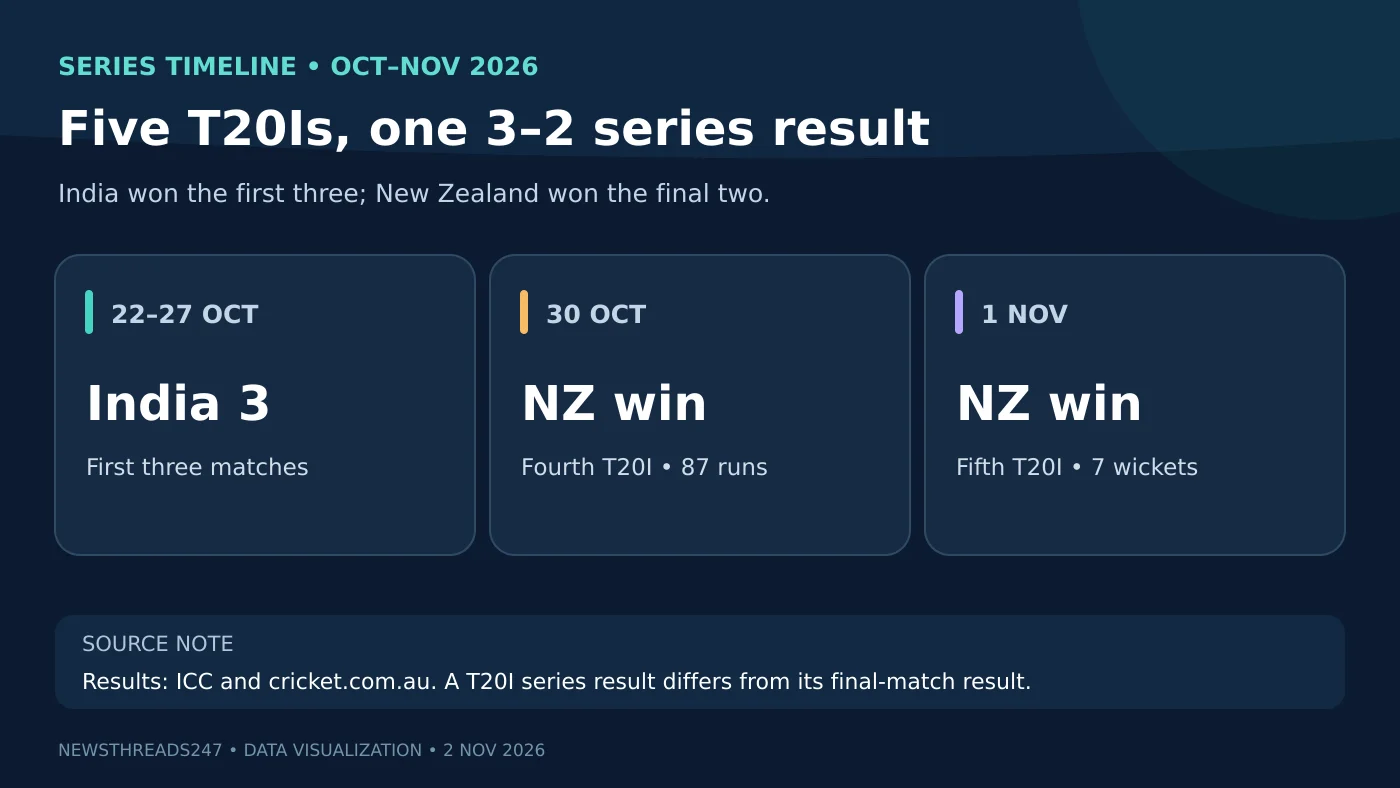
India took the first three games on 22, 24 and 27 October. New Zealand then won the fourth match in Auckland by 87 runs on 30 October and the Hamilton finale by seven wickets on 1 November. The sequence offers two useful points: India had secured the result that counts in the series ledger, while New Zealand ended with consecutive wins and evidence that their batting and bowling combinations could respond.
A 3–2 scoreline is more informative than calling the contest a one-sided win or a dramatic reversal. Both teams had stretches of success; a reader can compare match scorecards, conditions and selection before drawing broader conclusions. Our earlier fifth-T20I preview after the Auckland setback addressed expectations before the final match rather than replacing this completed-result explanation.
Three India takeaways before the ODI series
- Powerplay risk: losing both openers cheaply forced an early rebuilding phase; future tactical judgments need more than a single scorecard.
- Middle-over acceleration: the Kishan–Iyer partnership showed that a damaged start can still lead to a serious total.
- Closing overs and fielding: the chase demonstrated how a missed opportunity and a strong partnership can compress the margin for error.
These are observations from the published match narrative and numbers, not a prediction of specific team selection, a statement about any player’s personal confidence or an accusation about coaching. Twenty-over results should not be copied directly into a 50-over forecast because ODI batting tempo, bowling allocations and squad composition differ.
What comes next: the New Zealand ODIs
The teams change formats for a five-match ODI series beginning Wednesday, 4 November. The latest BCCI squad advisory includes Virat Kohli and Rohit Sharma and adds pace bowler Auqib Nabi for the first three ODIs. Shubman Gill is named captain for the first three; Shreyas Iyer is named captain for the final two. A squad announcement is not a final playing XI.
For the first ODI venue and start time, check the ICC match centre shortly before play. Subsequent weather, fitness, lineup and broadcast information can change. The 1 November T20I score cannot tell you whether a player will start on 4 November.
Common questions
Did New Zealand win the India–New Zealand T20I series?
No. New Zealand won the fifth T20I, but India won the five-match series 3–2 after taking the first three matches.
Who was the standout bowler in the Hamilton finale?
Adam Milne took four wickets for 19 runs according to the ICC match account. His early wickets included Abhishek Sharma and Sanju Samson.
How many runs did Tim Seifert score?
Seifert made 93 from 50 balls, including 11 fours and five sixes. Glenn Phillips stayed unbeaten on 65 from 38 deliveries.
When is India’s next ODI against New Zealand?
The five-match ODI series begins on 4 November 2026. The official ICC and BCCI match-centre information should be rechecked for timing and selection updates.
Bottom line
Hamilton was a New Zealand victory built on Milne’s four wickets and the Seifert–Phillips chase. The completed series still belongs to India, 3–2. Follow the official ICC report for the final T20I and BCCI advisories for the next format.
Editorial verification: 2 November 2026, IST. This report uses published official score and squad information. Any later corrections to the official scorecard or lineup will require an article update.
Visual disclosure: The lead sports scene is an AI-created editorial illustration of anonymous participants, not an image of the actual match. The two supporting graphics are original data visualisations based on the cited results.