

In badminton doubles, the serving side’s own score determines the service court: right at zero or an even score, left at an odd score. It does not let the pair freely choose a server. To work out who serves next, keep track of the partners’ service-court positions as well as which side won the last rally.
In this article
Start with the serving side’s score
That distinction explains the common disagreement at a change of serve. Knowing “we have an odd score” identifies the left service court. You still need to know which partner belongs there. The BWF Laws of Badminton, Law 11 sets out these relationships. This guide concerns ordinary full-court doubles; check the competition’s applicable rules for any adapted format.
Call the score from the server’s perspective before each service. “Three–two” should mean the serving pair has three points and the receiving pair has two. If two people are using different perspectives, they may both correctly remember a number but apply it to the wrong service court. Agree on the score and serving side first; then identify the player.
Partners change service courts after winning on serve
When the serving pair wins an ordinary rally, it gains a point and the same player serves again from the other service court. When the receiving pair wins, it gains a point and becomes the serving pair. Its partners keep their existing service-court positions until they win a point on their own serve. The BWF’s simplified rules describe this sequence. Badminton BC also publishes the service-order explanation with a worked doubles example.
Picture service-court positions as a record that survives the movement of the rally. You may have run to the back line or crossed in front of your partner to reach a shot. That tactical movement does not itself change who should serve or receive next. At the next service, reconstruct the correct positions from the rally result.
There is no extra second-server turn for the partner before the opponents regain service under this system. If the serving pair loses the rally, service changes sides. Do not confuse doubles badminton with a sport or local format that uses a different serving arrangement. Before a social match, settle the agreed rules instead of discovering halfway through that the pairs are counting differently.
Follow four players through six rallies
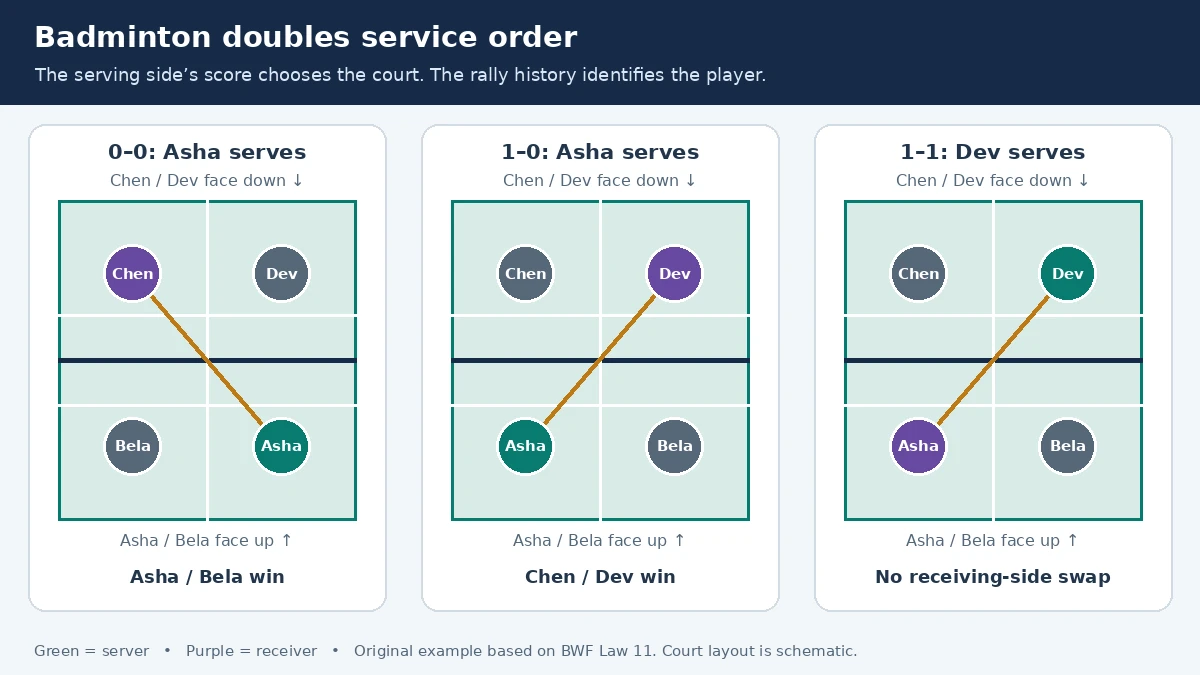
Here is a made-up game starting at 0–0. Asha and Bela are one pair; Chen and Dev are the other. Asha begins from her right service court, with Bela in the left. Chen receives diagonally opposite Asha, so Chen is in his own right service court and Dev is in his left. Right and left always mean each pair’s perspective facing the net.
Asha’s pair wins the first rally. At 1–0, Asha serves again, now from the left; Dev is the diagonal receiver. Suppose Chen and Dev win that rally. Their score is now 1–1, and Dev, who belongs in their left service court, serves. Chen has not automatically become server just because he received the opening serve.
Dev’s pair wins again. At 2–1, Dev changes to the right service court and serves to Bela. Now Asha and Bela win the next rally. They have two points, so Bela serves from their right service court at 2–2. She was there before they won the rally while receiving; she does not need to swap with Asha.
If Bela’s pair wins once more, Bela serves from the left at 3–2. If they then lose, Chen and Dev take service with three points. Chen is in their left service court and serves at 3–3. The successive service turns in this example are Asha, Dev, Bela and Chen. A turn can contain several rallies, because a server stays on while the serving pair keeps winning.
Try replaying those results with four coins on paper before your next game. Mark each pair’s right and left courts and move the serving pair’s coins only when it wins on serve. That simple exercise shows why score parity alone is insufficient: two pairs can have the same score but different players assigned to the relevant courts, depending on the earlier rallies.
Check the receiver, then resolve an error calmly
The player diagonally opposite the correct server receives the service. Once that service has been returned, either teammate may play the next shot for their side; doubles does not require partners to alternate strokes within a rally. The pre-service receiving order and the movement used to cover the court during play answer different questions.
If you discover a service-court or order error, use Law 12 and the competition official’s procedure. The published BWF laws preserve the existing score when correcting a service-court error. Do not invent a retrospective score deduction or replay every earlier rally because someone notices a position mistake. In an officiated match, ask the umpire to resolve the order; in social play, pause between rallies and reconstruct the last correct service.
A helpful between-rally check is short: who won, which side now serves, what is that side’s score, and which partner belongs in the required court? Make that a habit before swinging the racket. For another example of a role-specific rule that spectators often miss, read our volleyball libero setting guide. Recheck the BWF laws when entering a new competition or when its regulations change.
Cover: AI-generated editorial illustration of amateur doubles; no real match, athlete or service ruling is depicted.