

Before buying a used textbook, confirm two things independently: that the physical book matches your course’s requirements, and that you can obtain any required digital access. The right title on the cover does not prove that the edition, package or online homework access is right.
Start from the current course and section’s materials list, not a seller’s search result. This guide focuses on the purchasing decision, using US campus-store and publisher guidance as named examples. Product availability, access terms and return rights vary by seller and country. The prices below are fictional calculations, not current offers or promises of savings.
In this article
Match the required item before comparing its condition
Record the title, author, edition, format and ISBN from the course’s approved list. Add the term and section so you can distinguish your instructor’s requirements from a similar course. If the list is incomplete or conflicts with the syllabus, ask the instructor or campus store which item to use before paying.
The International ISBN Agency explains that an ISBN continues to identify a title’s particular edition and binding, and that separately available parts of a kit may have their own identifiers. That is why a book-only item and a package should be compared carefully rather than treated as equivalent because their titles match.
Check the actual copy or a clear seller description against the required item. Different formats can have different identifiers; a mismatch is a question to resolve, not automatic evidence that a book is unusable. An instructor may approve an alternative edition, but that permission should be explicit.
The Johns Hopkins campus-store textbook FAQ warns that older editions may differ in material or assignment page numbers. If an earlier edition is approved, ask how you should follow readings and exercises. A low purchase price is less useful if each homework task requires guessing the corresponding question.
Once identity is settled, inspect condition: missing pages, loose binding, unreadable highlighting and any consumable workbook sections already completed. “Used” describes previous ownership; it does not answer whether this particular copy is complete enough for the course.
Treat online access as its own requirement
Find out whether the course needs only the reading text or also an online platform for graded work. An eBook, a homework platform and optional study resources can be separate products. Ask for the exact platform, course connection method and required access period, rather than simply asking whether the book “comes with online access.”
Pearson’s access-code help warns that a code in a used textbook has probably already been used. A printed code card inside a copy is therefore not proof of an unused licence. Check the product and seller’s terms; do not buy another code merely because one is visible in a photograph.
Some courses have access supplied through an institution or an existing purchase. Check your course’s official learning-platform instructions and current account before buying. Cengage’s enrolment guidance, for example, starts from the course link and then offers the applicable access route. A course link or key identifies a class; it should not be confused with proof of payment.
Confirm duration as well as activation. Access that ends before the final assessment is not the same offer as access covering the whole course. Do not assume temporary access will last until the term ends or that last term’s purchase covers a new course. The answer belongs in the particular product’s current terms.
Compare a complete usable route, not the book price alone
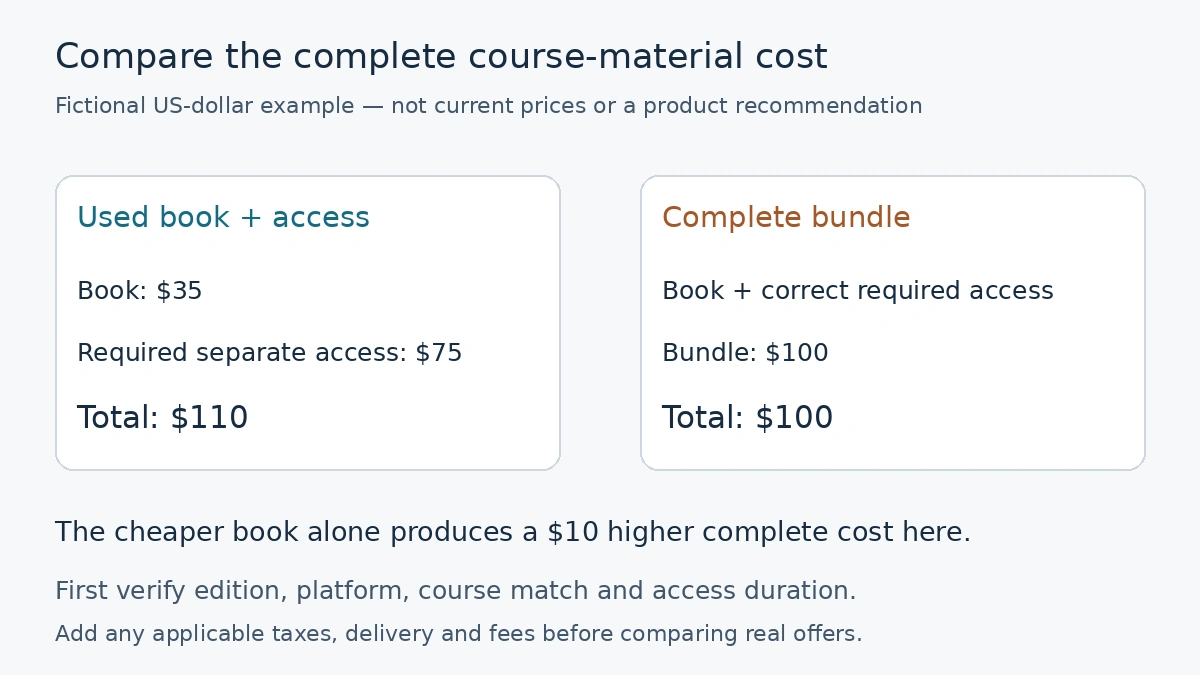
Consider fictional offers for one course. A used book costs $35, but the required separate platform access costs another $75. The usable total is $110. A correct book-and-access bundle costs $100. In this illustration the cheaper physical book produces a complete route that costs $10 more. These are invented teaching numbers, not market prices.
The result can go the other way. If the course requires the book alone, the $75 access purchase is unnecessary; if access is already valid and sufficient, include only the cost still needed. The point is to compare equivalent requirements before choosing a route, rather than assuming either used or bundled materials always win.
Add any delivery charge, taxes and mandatory fees to both routes. For a rental, read the return date, damage terms and any restrictions on marking the copy. For digital materials, check whether you are buying continuing ownership or a time-limited licence and whether the permitted format works for you.
Keep alternatives practical. Ask whether the library has a permitted reserve copy or whether the instructor provides an approved open resource. Check availability, borrowing duration and simultaneous access before relying on it for a deadline. Do not assume a library copy includes a student’s individual homework-platform licence.
Preserve your options until the match is confirmed
Read the actual seller’s return terms before opening sealed materials or activating a digital product. The Illini Union Bookstore’s digital-materials FAQ illustrates the risk: its code returns are restricted once the protective covering is removed or the code is redeemed, and activated eBooks are not refundable under that stated policy. Those are that store’s terms, not a universal law.
Keep the receipt, product description and any written approval for an alternative edition. Check your schedule and course details before activation, while leaving enough time to start required work. If something is wrong, ask the seller or publisher about the supported remedy rather than experimenting with multiple accounts or buying the same item again.
If the platform reports an already-used code, establish whether you previously redeemed it on your own account. Use the publisher’s official support route and provide purchase evidence privately if requested. Do not post a code, account password or student identifier in a public review or class discussion.
Before checking out, you should be able to finish one sentence: “This item matches my course, this is how I will access every required component, and this is the complete cost under the stated terms.” If the digital part is still uncertain, obtain that answer before committing to a nonreturnable purchase.
For the wider registration decision, our guide to prerequisites, corequisites and permission explains a different check: being able to buy materials does not establish eligibility to enrol in the class.
Sources checked 18 November 2026. Recheck the instructor’s current list, publisher access terms and seller’s return policy before each purchase. Original worked example and comparison method by NewsThreads247 Editorial; no product testing, affiliate recommendation or current price survey is claimed.