

A prerequisite is preparation expected before a course; a corequisite links study that must be taken alongside it under the institution’s rules. An instructor or department permission requirement is another condition. Meeting one does not automatically settle the others. For a U.S. college registration problem, read the current course and section details, the exact error message and your own institution’s instructions together.
In this article
Read the requirement as a sentence
The MIT subject-listing guide distinguishes prerequisites completed beforehand from corequisites taken concurrently. It also explains how its punctuation and formatting distinguish combinations and alternatives. Those conventions belong to that catalog. Do not assume that a comma, slash or bracket in another college’s listing means the same thing without reading its key.
Translate a requirement into a plain sentence before planning your term. Does the listing require both courses or either one? Is a minimum grade stated? Does it name a class year, a major or permission? Write down the exact condition, then the evidence you have for satisfying it. “I studied something similar” is a starting point for a question, rather than proof that the registration system must accept it.
Read the current section details as well as the general course description. A linked laboratory, discussion or restricted section can introduce a practical registration condition you did not notice in a short catalog summary. Keep the course number, section and term together in your notes so an adviser can see precisely what you are trying to add.
Work through a fictional course plan
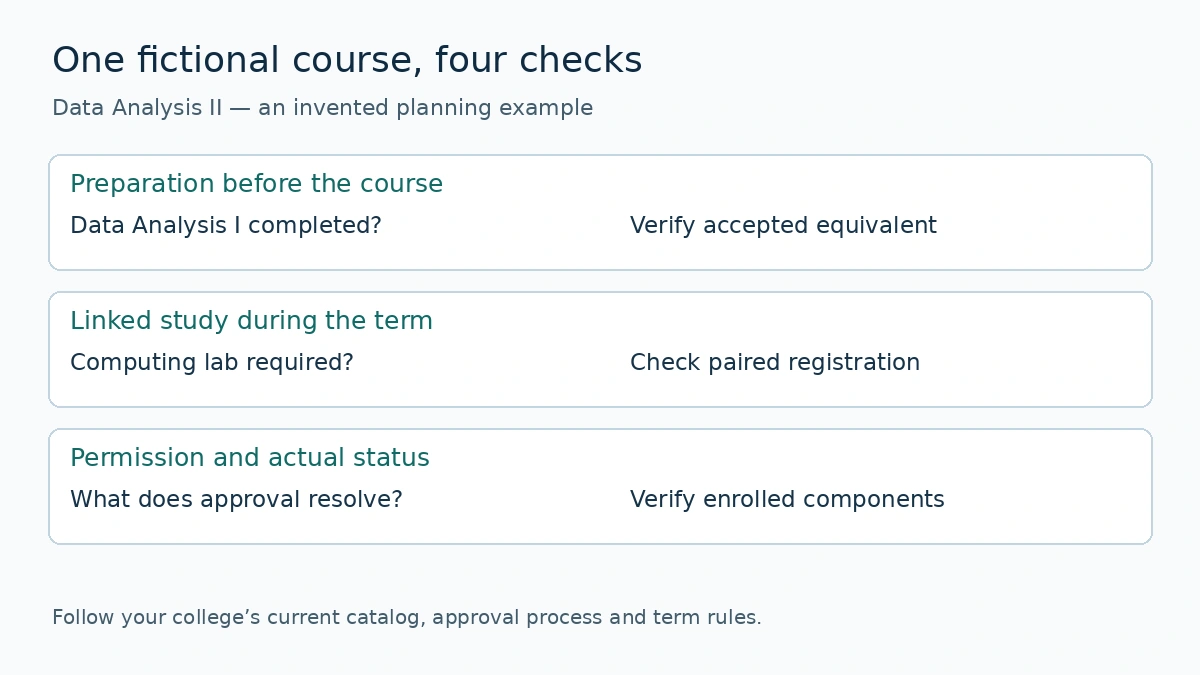
Suppose a fictional college lists “Data Analysis II” with Data Analysis I as a prerequisite and a companion computing lab as a corequisite. Maya has passed Data Analysis I, but adds only the lecture to her proposed schedule. Her prior course addresses the preparation condition. It does not address the linked lab condition. She needs to check how that college requires the lecture and lab to be selected and submitted.
Now change one fact: Maya completed a similar introductory course at another institution. Before assuming she must retake it, she asks whether the college has evaluated it as meeting this prerequisite. She can provide the course title, institution, term and the syllabus or transcript through the college’s approved process. The question is whether the preparation requirement is satisfied, not merely whether credits appeared somewhere on her record.
A third version has both academic conditions satisfied, but the chosen section requires department permission. Maya’s evidence that she is prepared remains useful, yet it does not supply that permission. She needs the department’s process. A fourth version has permission granted but no available seat. She should ask which restriction the permission resolves and confirm her actual enrollment rather than interpreting an encouraging email as a seat.
This example is invented to separate the decisions. It is not a listing from MIT or another named college. Its value is the sequence: identify the exact condition, match your evidence to it, resolve the remaining condition, then verify the saved registration result. The same reasoning prevents a vague “I have approval” from hiding an unfinished step.
Use your college’s permission process
Institutional procedures differ. University of Minnesota Rochester’s guide directs students with a prerequisite taken elsewhere to a Permission to Enroll form for review. It also describes requests concerning corequisites and instructor permission. This is a concrete example of why an apparently suitable previous course may still need a formal check. Use your own college’s process and published timing.
MIT’s registration policy, by contrast, tells students without the stated prerequisites to obtain instructor permission. It says that a permitted waiver or substitution leaves the student responsible for mastering missing background. An exception to registration is therefore not a promise that the course will be taught at a different level for you.
Before requesting an exception, compare the expected preparation with what you can actually do. Identify the specific gap and ask what you should review if permission is granted. If the preparatory course is still in progress, ask how the system treats it and what happens if you do not complete it as required. Do not turn a conditional arrangement into an unconditional assumption in your plan.
A concise request can say: “I am trying to register for [course, section, term]. The message says [exact text]. I completed [course and institution], and the attached material shows [relevant preparation]. Does this meet the prerequisite, and what approval or registration step is still required?” Use your own accurate details, send documents only through approved channels and avoid including unrelated personal records.
Verify enrollment after the block is resolved
Boston College’s registration guide separately identifies prerequisite, corequisite, instructor-permission, department-permission and seat-availability errors. Its corequisite instruction is to include both courses in the plan and submit them together. These distinctions show why copying a solution from a different error can waste time. They are examples from Boston College, not universal menu steps.
When an approval arrives, read its scope. Does it identify the term and section? Does it tell you to enter a permission code, retry registration or wait for a staff action? Complete that instruction and check the system’s actual result. Keep the confirmation until you can see the correct enrolled classes and linked components. If another error appears, record that new message; resolving the first condition may simply reveal the next one.
Keep a viable alternative while a request is pending. Ask your adviser what changing this course would do to later courses in the sequence. A course offered infrequently can create a different planning problem from one with several available sections. Do not drop an existing class merely because an exception seems likely; review the consequences first using our guide to checks before dropping a class.
The final question is concrete: are you enrolled in the right lecture, lab and other required components for the right term? A degree audit, permission response and registration status serve related but different purposes. If they conflict, ask the responsible office to reconcile them. Reverify this guidance when a college changes its catalog rules or registration procedures, and always use the term-specific calendar for deadlines.
Cover image: original AI-generated editorial illustration. People and scenes are fictional; no real event, device capture or first-hand test is depicted. This guide explains linked official documentation and uses expressly labelled hypothetical examples.