

White residue on clothes after washing can come from detergent that did not dissolve or rinse away properly. Start by checking the dose and load instead of adding more detergent to the next wash. Pale marks alone do not identify the cause: lint, product buildup and fabric damage can look similar. The useful question is whether the marks change after a care-label-compatible rinse and a more carefully measured wash.
In this article
Look at the residue before changing the routine
LG’s detergent-residue guidance identifies excessive or hardened detergent, cold water and bulky loads as possible contributors. That gives you several things to investigate, rather than one universal fix. Check whether the marks are clumps, loose fluff or a change in the fabric itself. Take a quick photograph for your own comparison before treating the garment.
If a shirt is otherwise clean and its care instructions allow it, try the washer’s appropriate rinse or rewash option without another dose of detergent. Follow the machine manual. If marks remain in exactly the same place, or the color itself has changed, stop assuming they are soap. Repeated washing or a hotter cycle may make a damaged garment worse. Delicate, dry-clean-only and color-sensitive items need their own care instructions.
Match the dose to this detergent and this load
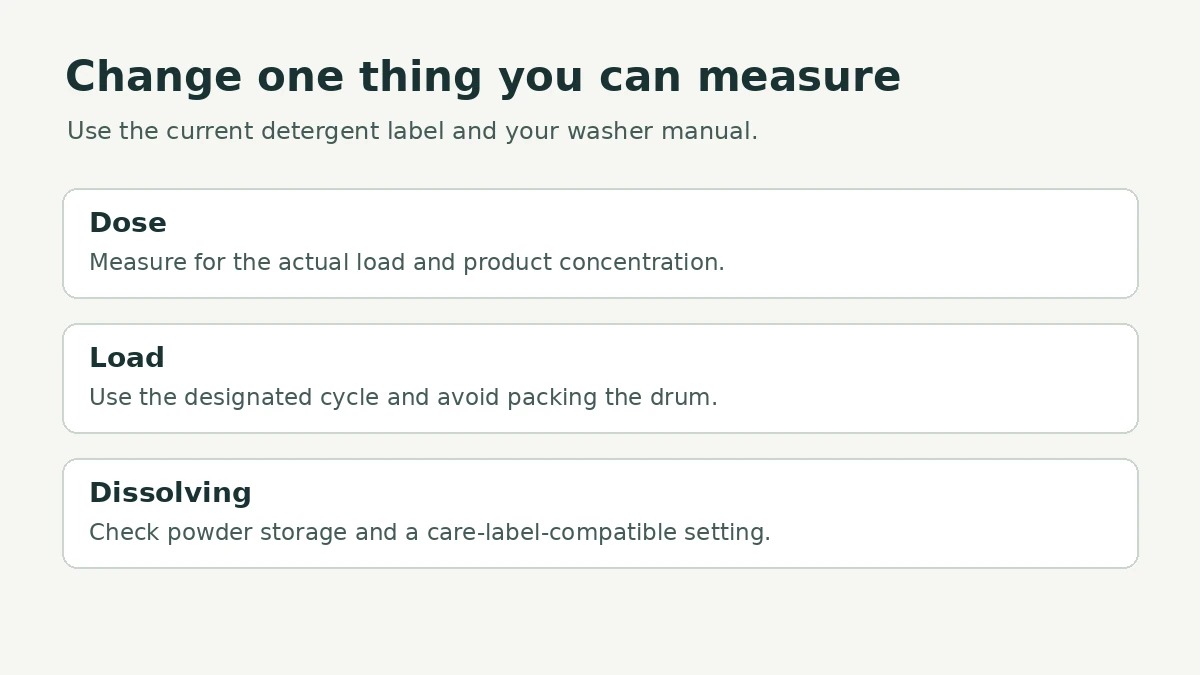
A cap is a measuring tool, not an instruction to fill it. Read the product’s dose guidance for the load and soil level you actually have. Check whether the product is suitable for your washer; a high-efficiency machine needs the type of low-sudsing detergent its manufacturer specifies. Whirlpool explains that detergent concentration varies and excessive detergent can produce poor rinsing and longer cycles.
Imagine that the label on a hypothetical detergent specifies 30 mL for your normal load. Pouring 60 mL uses two labeled doses, even if it looks like a small amount in a large cap. This is an arithmetic example, not a recommended dose: another product may need a different amount. If your washer dispenses detergent automatically, check the concentration setting when switching bottles. A setting retained from the old product can undermine otherwise careful measuring.
Give yourself a repeatable starting point. Note the label’s relevant dose, the amount you used, and whether the drum held a small everyday load or a bulky one. Avoid switching detergent, softener, temperature and cycle together. If you do, you may get cleaner clothes without learning which adjustment helped. A simple measured comparison is more useful than accumulating several “laundry hacks.”
Check load size and whether powder dissolves
A tightly packed blanket behaves differently from a few cotton shirts. Laundry needs the movement and water access designed into the selected cycle. Follow the manufacturer’s loading guidance rather than pressing another item into the drum because the door still closes. Give bulky items their designated cycle if the washer has one, and check its stated capacity for that kind of load.
If you use powder, inspect the product itself. Clumps in a damp or poorly closed container may not behave like fresh, free-flowing powder. Cold water can also leave some powders incompletely dissolved. Check both the detergent directions and the care label before changing temperature or preparation. Do not assume every fabric tolerates warm water or every dispenser accepts pre-dissolved detergent.
The manufacturer’s residue troubleshooting guide also points to washer buildup and dispensing settings. Look for leftover product in the drawer and clean accessible parts as the manual directs. Run the prescribed maintenance cycle when due. Do not pour a homemade mix of cleaning chemicals into the dispenser; use a method approved for your machine.
A practical comparison might use two similar loads on separate wash days. Keep the detergent product and suitable cycle the same, measure the label-directed amount, and load the machine correctly each time. Compare the garments after washing and drying according to their labels. Record what changed. This is household troubleshooting, not a controlled product test or a claim that one detergent performs better than another.
Use the next wash to narrow the cause
If loose residue disappears after rinsing and does not return with measured dosing, keep that routine and watch the next few loads. If only one bulky item has the problem, investigate its cycle and loading instructions. If powder keeps clumping, check storage and whether the product is appropriate for your wash temperature. These observations narrow the possibilities; they do not prove the chemistry of the mark.
If residue persists despite the correct product, dose and loading, consult the washer’s model-specific troubleshooting guidance. A recurring drain, dispenser or rinse fault needs a different response from simply reducing detergent further. Give support a useful description: the cycle, product type, amount, load, water setting, any error code and whether the marks rinse out. There is no need to keep repeating a routine that fails.
For a related decision, read our guide to clothing care labels before choosing a hotter wash or a different drying method. Recheck this process whenever you change machines or detergent concentration. The directions on the current package and your appliance manual should determine the details, not a fixed internet spoonful.
Cover: AI-generated editorial illustration of measuring detergent; no actual product test or brand is depicted.