
A garment-care label is useful before you buy the item, as well as before its first wash. Read the cleaning method, temperature, drying, ironing and warnings together. A familiar fabric name does not tell you how every lining, trim, dye or finish in the finished garment will behave.
The practical aim is to choose a routine you can actually follow. If a shirt needs a service you rarely use, or a knit needs drying space you do not have, its purchase price tells only part of the story. This guide explains how to turn small-print care instructions into an everyday decision without treating an internet symbol chart as more authoritative than the actual label.
In this article — jump to a section
Read the garment, not just the fabric name
The US Federal Trade Commission’s care-labelling guidance addresses the finished garment, including components that remain attached. The useful consumer lesson is that the shell fabric alone is not the whole product. A lining, decorative element or colour combination can affect the instructed care method.
Before removing packaging, locate and read the care label. Compare it with the seller’s description and check whether there are separate instructions for detachable pieces. A statement about fibre content answers a different question from how to clean and finish the garment.
This article is intended for readers comparing clothing in India or the US, but it does not claim that US labelling law applies in India. Symbol systems, legal requirements and wording vary by market. Use the system on the garment, the accompanying written instructions and the manufacturer’s clarification where needed.
Treat the symbols as a complete instruction
Start with the category of care rather than memorising every icon. The Australian product-safety guide groups widely used symbols into washing, bleaching, drying, ironing and professional care. Those categories help you look for an omitted step; they are not a claim that every garment everywhere uses identical symbols.
| Look for | Turn it into a question |
|---|---|
| Washing | Which method, temperature limit and cycle does this garment permit? |
| Bleaching | Does the label prohibit bleach or limit its type? |
| Drying | Is tumble drying allowed, or is a particular natural-drying method specified? |
| Ironing | What heat and steam restrictions apply? |
| Professional care | Does the instruction specify a professional process or a restriction? |
Numbers, dots, bars and added marks carry meaning within the relevant system. The Canadian Office of Consumer Affairs guide explains temperature indications, gentler treatments and natural-drying methods. Check the complete symbol and its key. Do not identify a process from a roughly similar shape and ignore the marks around it.
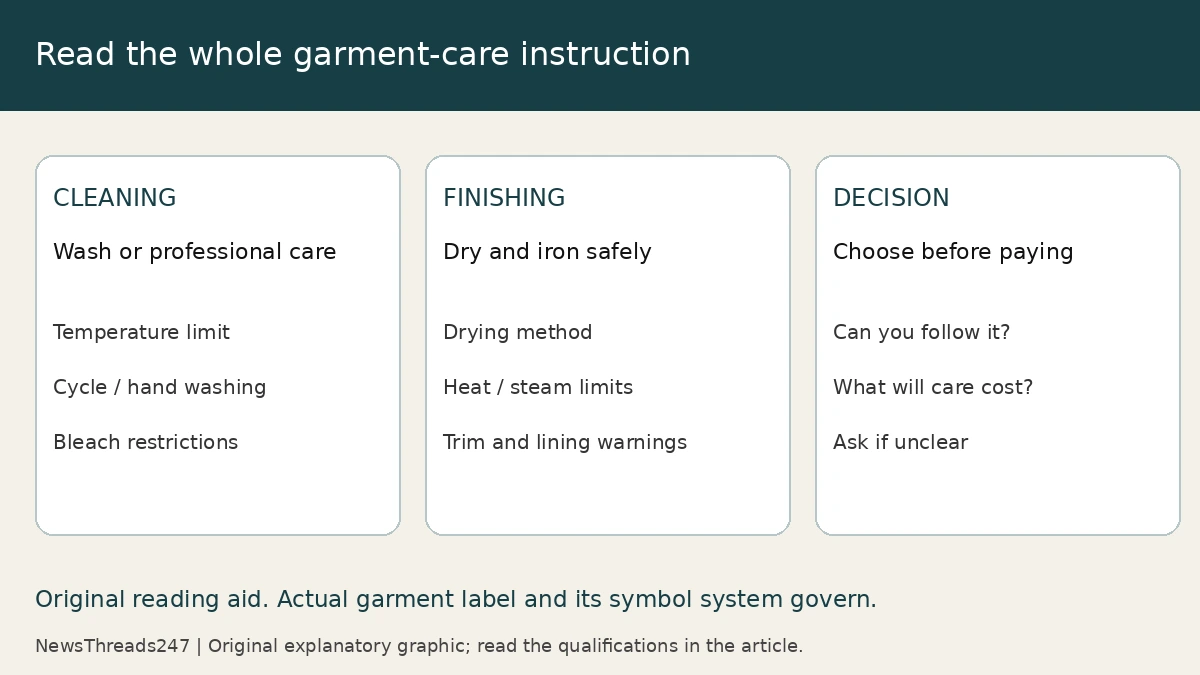
For example, if a particular label specifies a maximum wash temperature of 30°C, a 40°C machine programme is not compliant merely because both settings feel moderate. Equally, knowing the wash setting does not tell you whether tumble drying is permitted. Check the remaining instructions before starting the load.
Do not substitute the normal setting you use for another item made from a similar fibre. Two garments can have different construction and care requirements. A chart can help decode a label; it cannot inspect the garment or override a warning.
Dry clean and dry clean only need different attention
Read qualifying words carefully. A recommended method and an express prohibition of another method do not make the same statement. In the FTC’s US guidance, “Dryclean Only” warns against washing, while “Dryclean” identifies a care process without necessarily carrying that same explicit warning. Neither phrase gives a consumer permission to improvise a different process without understanding the risk.
Some labels provide an acceptable washing method alongside a preference for professional cleaning for appearance or durability. Others add restrictions concerning steam, heat or components. Read those parts as part of the instruction, not optional small print.
If you would prefer washing an item whose label does not specify it, ask the manufacturer or a competent cleaner before proceeding. The FTC guidance notes that using a method not on the label can be risky. A social-media claim that someone washed a similar jacket successfully is not evidence about yours.
Turn the label into a realistic care routine
Convert the instruction into a few concrete tasks: where the item will be cleaned, which machine or hand process can follow the label, how it will dry and whether finishing requires special attention. Check your machine’s manual if its programme names are unclear. Marketing names such as “delicate” should not be assumed to answer every temperature, agitation or drying requirement.
The American Cleaning Institute’s laundry guidance also directs readers to garment and product instructions. A care label and a detergent or other laundry-product label serve different purposes. Respect both, including product safety instructions, rather than assuming a garment symbol tells you how much of a product to use.
Sort a load only after comparing the actual requirements. If two items need incompatible temperatures or drying methods, sharing a colour does not solve the conflict. A practical routine may involve separate care or deciding not to buy an item that would be difficult to maintain.
Drying deserves its own plan. If a garment requires a particular natural-drying method, identify a suitable place before washing it. Do not discover halfway through that your only available option conflicts with the label. Keep the instructions available to anyone else who helps with the laundry.
If stored clothes repeatedly smell damp, a care label does not diagnose the room. Our guide to damp walls and mould explains the separate task of finding and addressing recurring moisture.
Include care in the buying decision
Consider a fictional purchase comparison, using invented costs solely to show the method. Garment A costs ₹900 and needs 12 professional cleaning visits during the period you are comparing. At an assumed ₹100 per visit, its purchase-plus-cleaning total is ₹2,100. Garment B costs ₹1,400 and, if its label permits your home routine, has an assumed incremental care cost of ₹15 for each of 12 washes: ₹1,580 in total.
These are not market prices, a promise that the garments last equally long or a recommendation to wash everything at home. The arithmetic simply shows that the cheaper purchase can cost more under stated assumptions. Real comparisons need your local cleaning quote, expected frequency, time, drying space and the care the actual items require.
Ask whether the service price includes the garment’s required finishing and any special handling. Consider convenience as well as money. If you rarely have access to the appropriate cleaner, a low purchase price does not remove that practical problem. Conversely, professional care can be a reasonable preference when it fits the garment and your routine.
When the label is missing or confusing
Pause before guessing. Photograph the available label, product details and seller’s description, then ask the manufacturer or seller for complete instructions for that exact item. If the wording conflicts, request clarification in writing. Do not assume the most permissive instruction is the correct one.
For a valuable, structured, embellished or sentimental garment, discuss uncertainty with an appropriate professional cleaner. Explain any previous cleaning, damage or missing label honestly. A professional should have the information needed to assess the risk; this guide cannot guarantee a safe substitute method.
Keep useful clarification with the purchase record. If damage occurs despite following the instructions, preserve photographs, the label, the receipt and what was done. Raise the issue factually through the seller’s process; consumer remedies depend on the market and circumstances, so no automatic refund is promised.
A small label becomes much more useful when it is read as a complete instruction and a buying constraint. Check whether the cleaning, drying and finishing requirements fit your home, budget and habits before the item joins the wardrobe.
Sources and maintenance: Source-based editorial checked on 6 November 2026 using FTC guidance, Canadian consumer guidance, Australian product-safety guidance and the American Cleaning Institute. Jurisdiction-specific requirements are not presented as universal law. Recheck when a product label changes, a manufacturer clarifies instructions or a relevant symbol standard is revised. Numerical costs are hypothetical. AI illustrations are not readable product labels; the reading aid is original artwork. No garment cleaning test was performed.