

Negative marking changes the cost of a wrong answer, but it does not create one sensible guessing rule for every examination. Start with the marks for a correct response, the penalty for a wrong one and the treatment of a blank. Then consider what you actually know and how much time a decision will consume.
A simple expected-value calculation can explain the trade-off. It cannot tell you your true probability of being right, guarantee a higher score or reproduce an adaptive examination’s scoring model. Used within those limits, the arithmetic helps you question advice such as “always attempt” or “never guess.”
In this article — jump to a section
Read the marking rule for this question type
Read the current official instructions for the exact examination, paper, stage and question type. “There is negative marking” is incomplete information. A multiple-choice question with one correct option, a multiple-select item and a numerical-answer item may have different rules within the same paper.
For a current Indian example, the official GATE 2027 question-paper pattern specifies a one-third-mark deduction for a wrong 1-mark MCQ and a two-thirds-mark deduction for a wrong 2-mark MCQ. It states that wrong MSQ and NAT responses have no negative marking, and that MSQs have no partial marking. These are identified cycle-specific rules, not a statement about all entrance or recruitment tests.
The official brochure revised on 17 October 2026 also distinguishes single-correct MCQs from multiple-select and numerical-answer formats. Check the current version and any later official clarification before your examination. A strategy based on selecting one of four options cannot simply be carried across to an item that asks for several selections or a typed number.
Also distinguish “a quarter of the question’s marks” from “a quarter of a mark.” If a hypothetical question earns 2 marks, a penalty of one-quarter of its marks is 0.5 mark. Writing the reward and deduction in actual marks prevents a small wording error from distorting every later calculation.
Calculate the break-even chance carefully
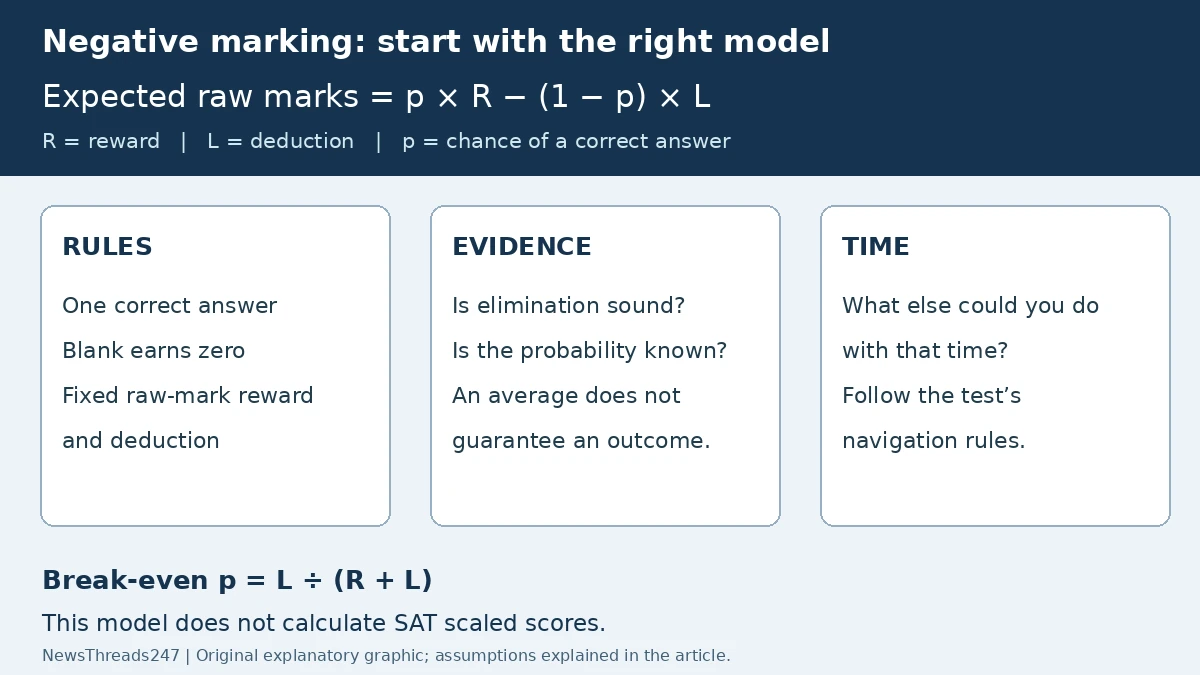
The following model is deliberately limited: one answer is either correct or wrong, a blank earns zero, a correct answer earns R positive marks and a wrong answer loses L marks. Let p be the probability that the answer you choose is correct.
Expected marks from answering = p × R − (1 − p) × L. The first term is the gain weighted by the chance of being correct; the second is the deduction weighted by the chance of being wrong. Expected value is a probability-weighted average, not a possible fractional award on an individual question.
Setting that expression equal to zero gives the break-even probability: p = L ÷ (R + L). Above it, the model gives positive expected marks; below it, negative expected marks. At the threshold, answering and leaving blank have the same expected raw-mark value in this model.
| Hypothetical reward / penalty | Break-even probability | What the calculation says |
|---|---|---|
| +1 / −0.25 | 0.25 ÷ 1.25 = 20% | Above 20% gives positive expected raw marks. |
| +1 / −1/3 | (1/3) ÷ (4/3) = 25% | Exactly 25% gives an average of zero. |
| +1 / −1 | 1 ÷ 2 = 50% | Exactly 50% is break-even, not a positive average. |
These examples are calculations under stated assumptions, not a directory of current exam patterns. If blanks are penalised, partial credit is available or the scoring process has other outcomes, this two-outcome comparison needs adjustment. Do not silently force those rules into the formula.
An average of zero does not mean no risk
Take a hypothetical single-correct question with four options, +1 for correct, −1/3 for wrong and zero for blank. If you genuinely select uniformly at random, the chance of a correct answer is 1/4. The calculation is 1/4 − (3/4 × 1/3) = 0.
That average does not mean a guess cannot lower your actual score. Imagine four independent questions with those same rules and a uniformly random choice on each. There are 256 equally likely combinations of choices. The following outcomes are calculated from that model; they are not observed candidate results.
| Correct answers among four guesses | Effect on total raw marks | Probability in this model |
|---|---|---|
| 0 | −4/3 marks | 81/256 ≈ 31.64% |
| 1 | 0 marks | 108/256 ≈ 42.19% |
| 2, 3 or 4 | Positive: +4/3, +8/3 or +4 marks | 67/256 ≈ 26.17% |
The probability-weighted average is zero, while both losses and gains remain possible. In particular, the positive result is less likely than the negative result here; the positive outcomes include larger gains that balance the average. “Neutral on average” and “a safe way to protect this score” are different claims.
Real candidates are not necessarily making independent uniform guesses. Questions can share a topic, and a misunderstanding can affect several answers. The model illustrates why an average is not a guarantee; it is not a forecast of your paper or a recommendation to gamble near an assumed cutoff.
Eliminating an option requires a reason
If you can correctly rule out two of four options and choose uniformly between the remaining two, the probability is 1/2 in the model. With +1 and −1/3, the expected raw marks become 1/2 − (1/2 × 1/3) = 1/3. The gain comes from reliable information, not from crossing out two choices mechanically.
The important word is “correctly.” If the right option was removed because of a misunderstood concept, the remaining pair is not a genuine 50–50 opportunity. Nor does feeling familiar with two answers establish that they are equally likely. Look for an actual reason: an incompatible unit, a contradiction with the question or a concept you can explain.
Do not infer the next answer from a run of previous option letters. In the independent model, several previous A answers do not make B due next. An exam-specific rule would need official support; an answer-pattern hunch supplies none.
Time can change the practical decision
The formula compares answering with a zero-mark blank; it does not include the value of time. Spending several minutes to create a small theoretical advantage can leave less time for a question you understand much better. Consider the remaining section, the navigation rules and what progress you are making.
For a fictional planning example, a student repeatedly spends a long time trying to eliminate one option, then leaves an accessible calculation unseen. The review should examine the stalled reasoning and the missed opportunity. It should not conclude that the penalty fraction alone caused the problem.
Practise a way to recognise a stalled approach and return later where the rules allow it. Avoid a universal seconds-per-question instruction: reading passages, multi-step problems and short recall items have different demands. Any personal checkpoint should be tested on appropriate practice and must fit the actual examination interface.
Do not transfer one exam’s advice to another
For the digital SAT, College Board’s current scoring explanation says that, for most students trying their best, guessing is preferable to a blank, especially after eliminating options. It also explains that adaptive scoring uses more than the number of correct answers. The raw-mark calculation above is not an SAT scaled-score calculator.
The September 2026 digital SAT assessment framework distinguishes its evaluation of response patterns from the older question-by-question guessing penalty. It advises answering to the best of your ability and warns against treating random responses as a useful scoring tactic.
This comparison is here to demonstrate scope, not to merge Indian and US testing systems. Follow the authority for the examination you are taking, including its question types, module boundaries and answer-entry rules. A familiar coaching slogan can remain online long after a test changes.
Build a decision habit in practice
During permitted practice, keep a small record of uncertain answers: what you knew, which options you ruled out, why you ruled them out, time spent where available and the result. Record your reasoning before revealing the key where feasible. Afterward, examine whether the elimination itself was sound.
A handful of correct guesses does not establish your future accuracy. Review enough comparable questions to notice recurring reasoning problems, while keeping the limits of a small or uneven sample in mind. Our mock-test review guide explains how to turn that evidence into a correction task and a fresh-question check.
Before the examination, you should be able to state the relevant marking rule plainly, identify the situations where a simple probability model applies and recognise when you are substituting confidence for evidence. That understanding is more useful than carrying an untested attempt quota into the hall.
Sources and maintenance: Educational editorial checked on 6 November 2026 against IIT Madras’s GATE 2027 pattern and revised brochure, and College Board’s current scoring guidance and September 2026 framework. The hypothetical examples, probability table and interpretation are original calculations, not official strategy advice or measured exam outcomes. Reverify rules before every cycle and after an official scoring or format change. No selection, rank or score gain is promised. AI images show fictional practice scenes; the explanatory graphic is original artwork.