
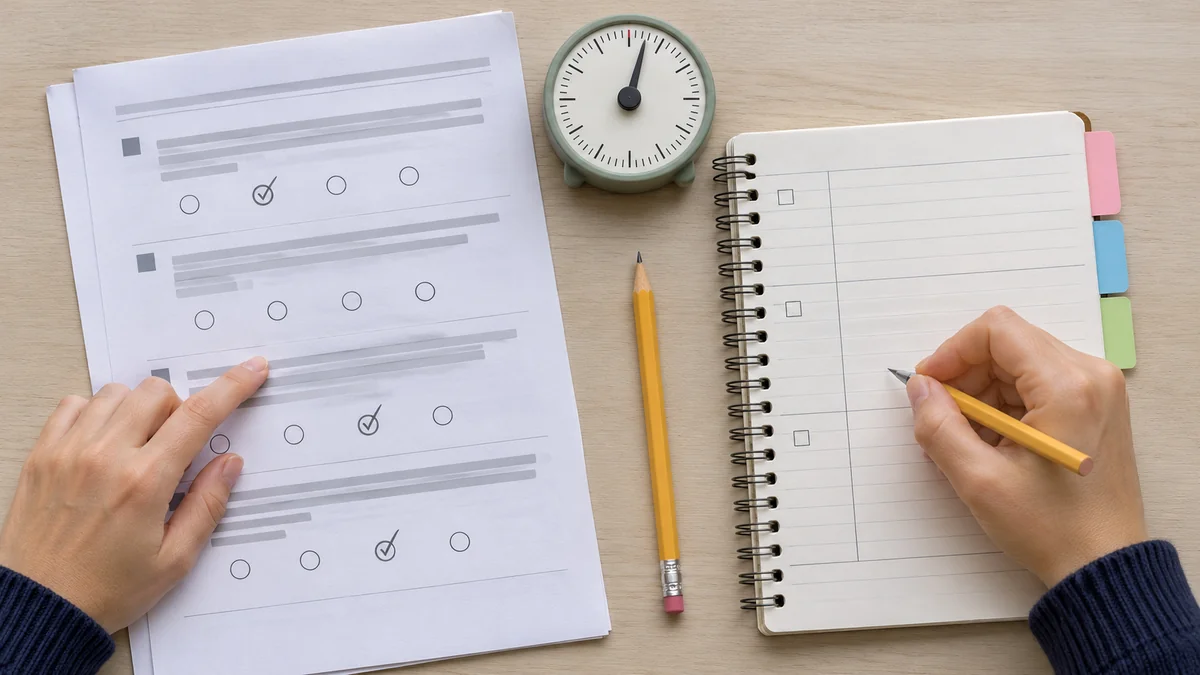
To review a mock test, compare your answers with reliable explanations, identify why each important mistake occurred, and choose a specific task that addresses it. Review uncertain correct answers and useful skipped questions as well as wrong ones. Finish by checking whether you can solve a fresh problem without the solution beside you.
The result should be a manageable study plan, not a longer list of reasons to feel behind. A total score cannot tell you whether the next useful step is learning a concept, correcting a recurring calculation error or changing how you allocate time. Those decisions need evidence from the actual attempt.
In this article — jump to a section
- Decide what the practice session was meant to measure
- Record enough to interpret the score
- The same score can call for different work
- Describe the error before choosing a remedy
- Reattempt before reading the full solution
- Turn the review into a small study plan
- Compare like with like, and leave predictions aside
Decide what the practice session was meant to measure
First identify the kind of practice you completed. A timed full paper, an open-book topic exercise and an interface demonstration answer different questions. Each can be useful, but treating them as interchangeable makes progress difficult to judge.
For example, College Board distinguishes its non-adaptive paper practice tests from adaptive practice in Bluebook. It recommends that students planning to test in Bluebook try an adaptive practice test in the app to become familiar with that experience. A paper exercise can support learning without reproducing every feature of the actual delivery format.
Before your next session, write one sentence about its purpose: “I want to practise completing this section under its stated time limit,” or “I want to find which ratio problems I cannot yet set up.” For the second purpose, looking up a concept may be appropriate. For the first, an unrecorded pause or extra time changes what the attempt measures.
Record enough to interpret the score
Keep the paper or test identifier, date, topics covered, time allowed, time actually used and scoring rules. Note material interruptions, help or notes used. This is a record for interpreting your own practice, not a demand for perfect test conditions every day.
Where the provider offers a question-level report, preserve the permitted record and inspect it. College Board’s My Practice guidance, for example, explains how SAT practice users can see their selected answer, the correct answer and explanations, then access targeted practice. That is a specific service for its tests, not a feature every mock platform provides.
For a simple objective test, useful starting counts are correct, wrong and blank. Accuracy among attempted questions is correct answers divided by attempted questions, multiplied by 100. State the denominator: “80% accuracy” means little if it is unclear whether it describes attempts or the whole paper. Use the official scoring method where a test uses adaptive, scaled or otherwise more complex scoring.
The same score can call for different work
Consider an invented 40-question practice paper worth 2 marks for a correct answer, minus 0.5 for a wrong answer and zero for a blank. These are hypothetical rules, not a statement of the current pattern of a named examination. The maximum is 80 marks.
| Illustrative attempt | Correct / wrong / blank | Raw score | Accuracy among attempts |
|---|---|---|---|
| A | 26 / 6 / 8 | 26 × 2 − 6 × 0.5 = 49 | 26 ÷ 32 = 81.25% |
| B | 25 / 2 / 13 | 25 × 2 − 2 × 0.5 = 49 | 25 ÷ 27 ≈ 92.59% |
Both attempts produce 49, but they leave different questions to investigate. In A, were the six wrong answers caused by knowledge gaps, unsupported guesses or avoidable slips? In B, were the thirteen blanks deliberate skips, unfamiliar topics or questions never reached? The counts do not diagnose those causes on their own.
It would be premature to tell B to attempt everything or A to slow down throughout the paper. Either instruction could make the actual problem worse. Review the relevant questions and the working before changing the strategy. A small set of recorded decisions is more useful than a confident explanation invented after seeing the score.
Describe the error before choosing a remedy
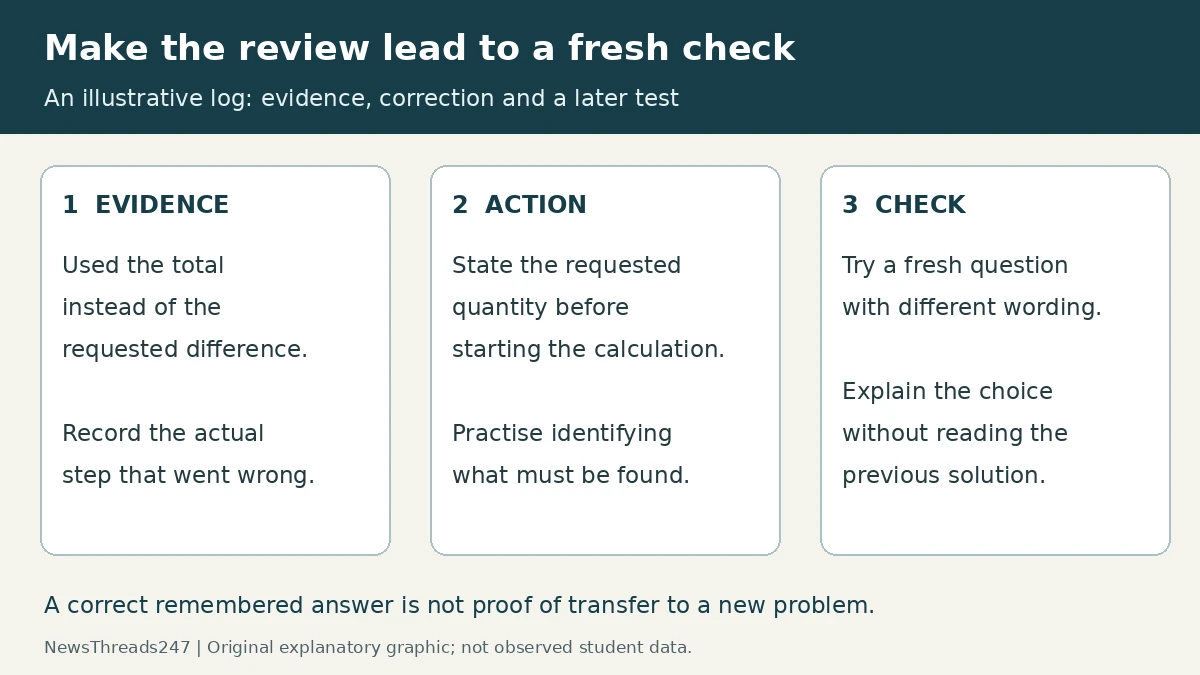
Carnegie Mellon University’s exam-wrapper approach asks students to reflect on preparation, the nature of errors and changes to future learning. The practical principle is to use an assessment as feedback. The review log below is an original way to organise that task; it is not a validated diagnostic instrument or a copied university worksheet.
| Record what happened | A more useful next action | Evidence to check later |
|---|---|---|
| Used the total instead of the requested difference | Explain what the question asks before calculating | A fresh question with a different wording |
| Could not explain why the formula applied | Relearn the relationship and work through a simple case | Set up a comparable problem without notes |
| Changed a sound answer without finding a reason | Review the evidence behind both choices | Record why any later answer change was justified |
| Never reached the last questions | Inspect where time was spent and what stalled | A comparable timed section with a planned review point |
Avoid ending the explanation at “silly mistake.” A reversed sign, overlooked unit and misread instruction need different checks. Write what you actually did: “I calculated the annual amount but selected the monthly option.” That description suggests a check you can practise. It does not turn one mistake into a judgement about your ability.
Some questions have more than one cause. You may have been unsure of the concept and then rushed the arithmetic. Record the main obstacle and the evidence for it. If you cannot establish the cause, mark it uncertain and discuss the working with a teacher rather than forcing every answer into a tidy category.
Reattempt before reading the full solution
Before revealing the full explanation, try an important missed question again under clearly recorded conditions. Keep the original working. Ask whether you can now identify the required quantity, choose an approach and carry it through. If you need a hint, record where it was needed.
Then read the explanation carefully, including why plausible alternatives fail. Compare the reasoning with yours rather than copying the final steps. If the key appears inconsistent, check the provider’s correction process and an appropriate authoritative explanation. Do not build a revision rule around a disputed answer simply because it appeared on a dashboard.
A successful immediate reattempt is encouraging, but you have just seen the problem. It cannot by itself establish that you will handle a different version later. Choose a comparable fresh question after a suitable interval and explain the method without looking at the worked answer. There is no universal waiting period that proves mastery.
For instance, recognising the answer to a remembered percentage problem is different from identifying the correct base in a new one. A useful follow-up changes the values or context while preserving the idea you are trying to learn. Keep copyrighted questions private and follow the provider’s terms rather than posting entire paid papers publicly.
Turn the review into a small study plan
Choose a few actions you can actually complete before the next appropriate assessment. A correction task needs a topic, an action and a way to check it. “Revise maths” is too broad; “explain the percentage base, solve fresh examples and check the setup before calculating” gives the next session a purpose.
As an illustrative plan, use one available study session to rebuild a weak concept, another to work through new questions without notes, and a later session to test the same skill in a mixed set. Adapt that sequence to your timetable and examination. It is a planning example, not a promised score-improvement schedule.
Leave time for material not tested in this mock. A short paper samples the syllabus; it does not demonstrate that an unasked topic is unimportant. Use the current syllabus and the actual examination specification alongside the error log. If several tests repeatedly expose the same difficulty, seek a clearer explanation rather than simply increasing the number of full mocks.
Compare like with like, and leave predictions aside
Compare attempts with similar content, format, scoring and conditions. Repeating a familiar paper, taking a shorter section and sitting a new full paper can produce different scores for reasons unrelated to a lasting change in skill. Note those differences before drawing a trend line.
A provider’s rank is also tied to its own participant group and method. It is not automatically an official examination rank. Our percentage and percentile explainer addresses the separate distinction between marks and relative position; neither should be inferred from an unlabeled practice accuracy figure.
End the review with three concise records: what the attempt revealed, what you will change and what evidence would show that the change helped. The next test then has something concrete to examine. That makes the review useful even when the headline score has not moved.
Editorial method and maintenance: Source-based educational editorial checked on 6 November 2026 using first-party College Board and Carnegie Mellon guidance. The calculations, log and study sequence are original illustrations, not observed student results or guarantees of admission, rank or marks. No mock platform was tested. Reverify links and platform instructions after changes, and check the current syllabus and scoring rules before each examination cycle. The photographs are AI editorial illustrations of fictional study scenes; the diagram is original explanatory artwork.