

For a US job application, a reasonable accommodation can change how you access an application, test or interview because of a disability. Start by identifying the specific barrier and the adjustment that would help you participate. Send the request to the employer’s stated accommodation contact, or ask the recruiter for that route.
The purpose is equal access to consideration, not a guaranteed interview result, a waived essential qualification or a promise of employment. A useful request gives the employer enough information to understand the access problem while keeping unrelated medical details out of ordinary recruitment correspondence.
In this article — jump to a section
What an interview accommodation does
The EEOC’s applicant guidance explains reasonable accommodation in the hiring process. Title I of the Americans with Disabilities Act covers private employers with 15 or more employees and state and local government employers. Federal applicants have a different framework and complaint route. State or local protections may also apply. This guide is about the US disability-accommodation context; it is not a statement of Indian employment law.
Examples can include an accessible interview location or communication support, depending on the disability, process and effective options. A request has to relate to an actual access need. Simply preferring another interview time or wanting an easier assessment is not, by itself, the same issue.
The Job Accommodation Network’s hiring-process guide emphasises practical communication about the barrier and potential solutions. This is an interactive process: an employer may need clarification, and there may be more than one effective way to provide access.
Describe the barrier in the hiring process
Read the invitation for its format, duration, venue and any assessment. Identify the point at which the process becomes inaccessible. Is the difficulty entering the venue, hearing questions on a call, reading the test format or using the assessment interface? A precise description helps avoid a vague exchange about whether the entire process is “suitable.”
You do not need to diagnose yourself for an employer in a cover letter. Describe the functional problem accurately and connect the requested change to it. If you are unsure which adjustment could work, ask to discuss options rather than claiming that a specific tool is the only possible solution.
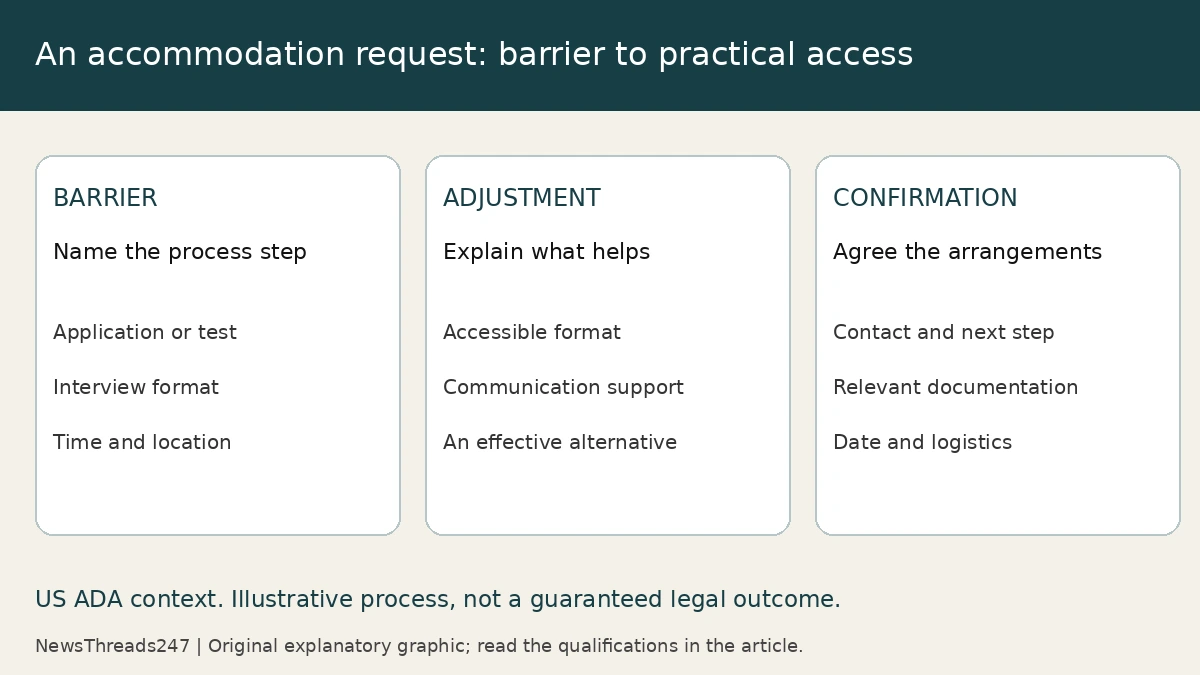
For example, a fictional applicant is invited to a video interview but cannot reliably hear spoken questions without an accessible communication arrangement. The practical request concerns participating in that interview. The employer still assesses the candidate’s qualifications through an accessible process. This example does not establish what accommodation a particular person is legally entitled to receive.
Write a request that can be acted on
Use a short message with the role reference, interview date, access barrier and requested next step. A written record is useful, although an accommodation request does not have to use a special legal formula. Keep the message focused on what needs to happen before the relevant process stage.
Illustrative wording to adapt: “I am applying for [role/reference] and have been invited to [stage] on [date]. Because of a disability, I need an adjustment to participate in this stage. The barrier is [brief functional explanation]. Would [proposed adjustment] be possible, or could we discuss another effective arrangement? Please let me know the accommodation contact and any relevant information needed through your secure process.”
Replace the brackets with truthful information; do not send a template containing claims that do not apply to you. The message is an original communication aid, not legal advice or an assurance that the proposed adjustment must be granted exactly as requested.
Raise an access need when you know it affects the process, allowing practical time where possible. There is no universal rule that every request must be made a fixed number of days before an interview. Avoid inventing a deadline. If the invitation is short-notice, explain the timing and ask promptly how the employer can address the barrier.
Documentation and privacy have limits
The EEOC’s accommodation guidance says reasonable documentation may be requested where the disability or need is not obvious. The scope should relate to establishing the covered disability and accommodation need; complete medical records will often contain unrelated information. When the disability and need are obvious, documentation should not be demanded simply as a routine extra hurdle.
Ask who should receive supporting information and which secure channel to use. Do not attach a full medical history to every recruiter message as a precaution. Equally, do not ignore a relevant request for clarification. If the requested scope seems unclear, ask what information is needed and why.
The EEOC’s current disability-discrimination overview distinguishes pre-offer inquiries from later stages and explains confidentiality requirements for medical information. An accommodation discussion is not permission to treat all medical questions as appropriate. The details and exceptions matter.
Confirm the practical arrangements
An acknowledgment is a start, not confirmation of the arrangement. Before the interview, establish who is coordinating it, what adjustment will be provided, whether the time or location changes and whom to contact if the agreed setup does not work.
| Record | Useful confirmation |
|---|---|
| Process stage | Which interview, test or application step the arrangement covers. |
| Adjustment | What will be provided and how it addresses the barrier. |
| Logistics | Time, location, format and any advance preparation. |
| Contact | Who can resolve an access problem on the day. |
If an alternative is offered, assess whether it actually removes the barrier. Under EEOC guidance, an employer may choose an effective accommodation rather than the applicant’s preferred option. Explain concretely if a proposed alternative would not work; a preference and an access limitation are different considerations.
Keep hiring access separate from the job itself
You must still meet the relevant job requirements and be able to perform essential functions with or without reasonable accommodation. The interview-access request does not decide every possible accommodation needed after hiring. Keep the immediate process issue distinct from a later conversation about performing the job.
JAN’s job-search guide for applicants with disabilities treats disclosure and accommodation as decisions connected to the actual barrier. Do not assume every applicant has to disclose every disability at the same stage. The information needed can change as the role and hiring process become clearer.
For another US onboarding issue, our Form I-9 document-choice guide addresses employment-verification documents. That is a separate process; it should not be confused with evidence requested for a disability accommodation.
If the request is unresolved
Follow up through the employer’s stated route and preserve the invitation, request, acknowledgment and meaningful replies. Ask for a clear explanation if the proposed adjustment is refused or remains uncertain. Record the access problem factually rather than assuming what caused a hiring decision.
If you think discrimination occurred, consult the EEOC’s current filing-time guidance promptly. Many non-federal charges have a 180-day limit, extended to 300 days in specified circumstances; federal applicants generally have a different process involving contact with an agency EEO counselor within 45 days. An internal grievance does not generally pause the EEOC filing clock. A disputed personal deadline needs case-specific advice.
Source and maintenance note: This source-based US editorial was checked on 6 November 2026 against EEOC and JAN guidance. It is general information, not individual legal advice, and does not promise a particular adjustment or hiring outcome. Reverify after a legal change, revised agency guidance or a change in the employer’s process. The example and request wording are original and illustrative. AI visuals depict fictional settings; no applicant interview or legal consultation was conducted.