
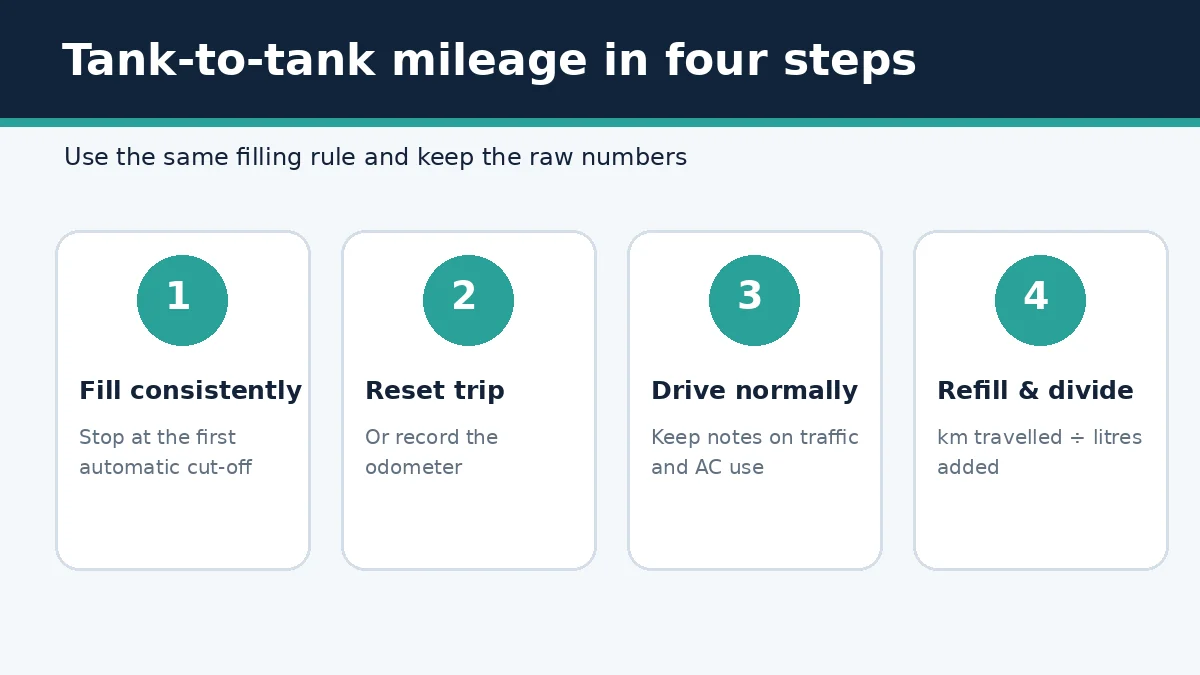
The most useful real-world mileage number is not a single dashboard reading. It is an average built from consistent fuel records. Fill the tank to the same automatic shut-off point, record the distance travelled, refill in the same way and divide kilometres by litres added. Repeat the process across several tanks before deciding that the car—or a recent repair—has changed.
This method cannot reproduce a laboratory test. Traffic, temperature, air-conditioning, gradients, tyre pressure, passenger load and filling technique all affect the result. Its strength is different: it measures your car on your routes with a transparent calculation that you can repeat.
In this article
The formula and a worked example
In India, fuel economy is commonly expressed in kilometres per litre. The basic calculation is: distance travelled ÷ litres used = km/L. The U.S. Department of Energy’s FuelEconomy.gov describes the equivalent miles-per-gallon method using odometer distance and fuel purchased, and says the calculation is valid only when both the previous and current purchases filled the tank completely.
| Record | Example |
|---|---|
| Previous full-tank odometer | 24,180 km |
| Current full-tank odometer | 24,618 km |
| Distance travelled | 438 km |
| Fuel added at refill | 31.6 L |
| Calculated mileage | 438 ÷ 31.6 = 13.86 km/L |
Do not round the distance or litres before dividing. You can round the final result to one or two decimal places. If you track fuel cost, keep the actual receipt total as well; prices may change between fills.
How to run a fair tank-to-tank test
- Start at a normal fuel station and fill until the nozzle’s first automatic shut-off. Do not keep topping up after it clicks.
- Reset the trip meter or photograph the odometer. Save the receipt with litres, price, date and station.
- Drive normally. Note exceptional congestion, long idling, a highway trip, heavy cargo, tyre work or unusually strong air-conditioning use.
- At the next measurement, return to the same pump position and filling rule when practical. Refill to the first shut-off and record litres.
- Divide the trip distance by litres added. Average at least three comparable full-tank results before interpreting a trend.
Using the same station and pump is a useful control, not a requirement. Pumps are regulated measuring devices, but the vehicle’s parking angle, foam and the nozzle shut-off point can still change how much fuel fits before the click. Consistent behaviour matters more than squeezing in the maximum amount.
Dashboard mileage versus tank-to-tank
The trip computer estimates fuel use from vehicle sensors and software. It is convenient for comparing routes or noticing a sudden change, but it is not the same measurement as litres dispensed at a refill. A small gap between the display and your calculated average is not by itself proof of a fault.
| Tool | Best use | Main limitation |
|---|---|---|
| Dashboard average | Immediate feedback across a trip | Depends on the vehicle’s estimation and reset period |
| Tank-to-tank result | Actual distance divided by fuel added | Sensitive to filling consistency and short-term conditions |
| Multi-tank average | Ownership budgeting and trend detection | Takes time and needs careful records |
If the dashboard and tank-to-tank figures differ, first confirm that both cover the same distance. A display that has not been reset may include months of driving, while the refill calculation covers only the latest tank.
Why one tank is not a verdict
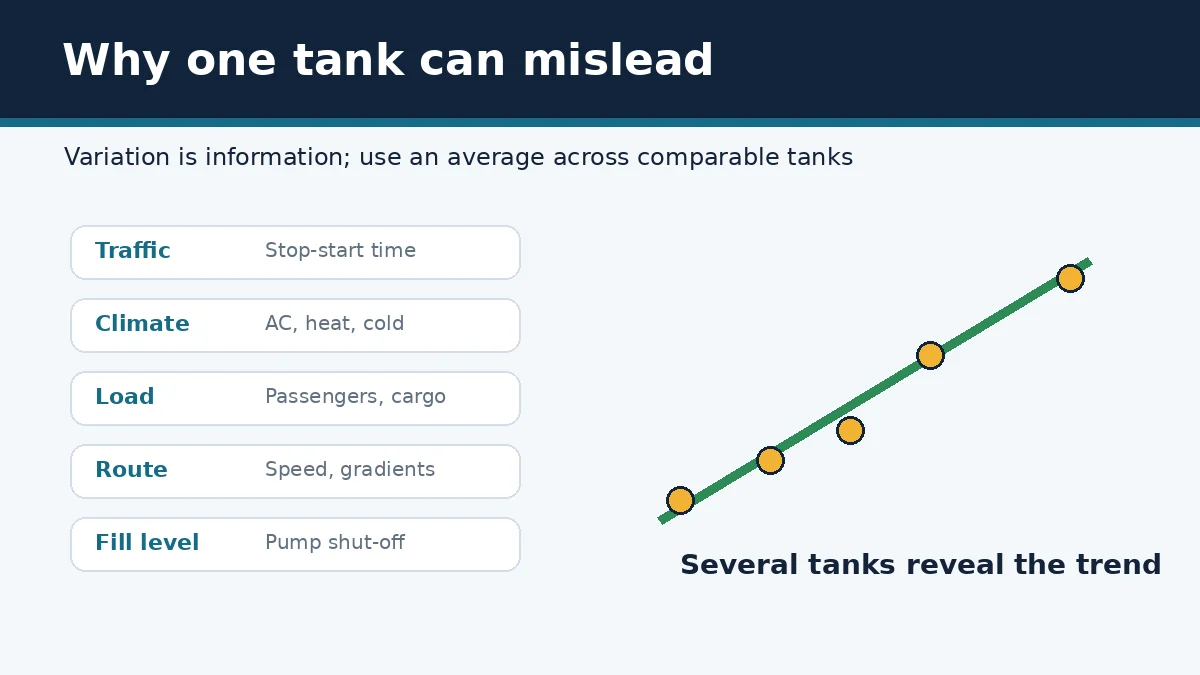
A single tank can be unusually good or bad without indicating a mechanical change. Dense traffic adds idling and repeated acceleration. High speed increases aerodynamic drag. Short trips may keep an engine below its efficient operating temperature. Air-conditioning, hills, tyre pressure, roof carriers and extra load can all alter energy demand.
Compare like with like. A holiday motorway tank should not be used to judge an urban commute, and a winter result should not be compared casually with a mild-season result. Keep a rolling average and annotate unusual tanks. The pattern is more useful than the record.
When lower mileage needs investigation
First verify the measurement. Then check simple items against the owner’s manual: cold tyre pressures, an overdue air-filter inspection, the correct engine oil specification, dragging brakes, warning lamps and visible fuel leaks. A change that follows new tyres, roof accessories, a route change or heavier use may have an ordinary explanation.
Arrange qualified inspection if the drop is large and persistent, or if it arrives with rough running, smoke, a fuel smell, overheating, a warning light, hard starting or poor performance. Do not search for better mileage by over-inflating tyres; use the pressure label specified by the manufacturer. For a no-start diagnosis, see our guide to battery, starter and charging-system checks.
Turn mileage into fuel cost
Mileage becomes more useful for decisions when converted to cost. If petrol costs ₹105 per litre and the car returns 13.86 km/L, the estimated fuel cost per kilometre is ₹105 ÷ 13.86 = about ₹7.58. A 1,000 km month would therefore use roughly ₹7,580 of fuel at those assumptions.
Keep the price as an input rather than putting it in the headline: fuel prices vary by city and date. For comparing two cars, also consider insurance, depreciation, servicing, tyres, financing and expected annual distance. A small mileage difference may matter less than a large purchase-price or maintenance difference.
Common measurement mistakes
- Calculating after a partial refill. The litres added do not represent the fuel used since the previous full tank.
- Topping up repeatedly after the nozzle clicks, which adds inconsistency and can create safety or emissions-system problems.
- Comparing a short, congested trip with a long, steady journey.
- Resetting the trip meter late or copying the wrong odometer figure.
- Treating a manufacturer or regulatory test figure as a promise for every driver and route.
- Reacting to one result instead of checking a multi-tank trend.
Sources and maintenance trigger
Primary references: U.S. Department of Energy FuelEconomy.gov: using fuel-purchase records; FuelEconomy.gov: driving more efficiently; and FuelEconomy.gov: understanding fuel consumption. Vehicle-specific pressure, maintenance and fuel requirements should come from the current owner’s manual.
Reverification trigger: review this guide if official fuel-economy measurement guidance changes. Readers should recheck their vehicle manual after a tyre-size change, software update or maintenance instruction revision.
Editorial note: The graphics are original explanatory illustrations. This article provides general vehicle-care information and does not replace inspection by a qualified technician.