
Wheel alignment, wheel balancing and tyre rotation are three different services. Alignment adjusts wheel angles. Balancing corrects uneven mass in a wheel-and-tyre assembly. Rotation moves tyres between permitted positions to spread wear. A workshop may recommend more than one because the same visit can reveal several problems, but one service does not automatically substitute for the others.
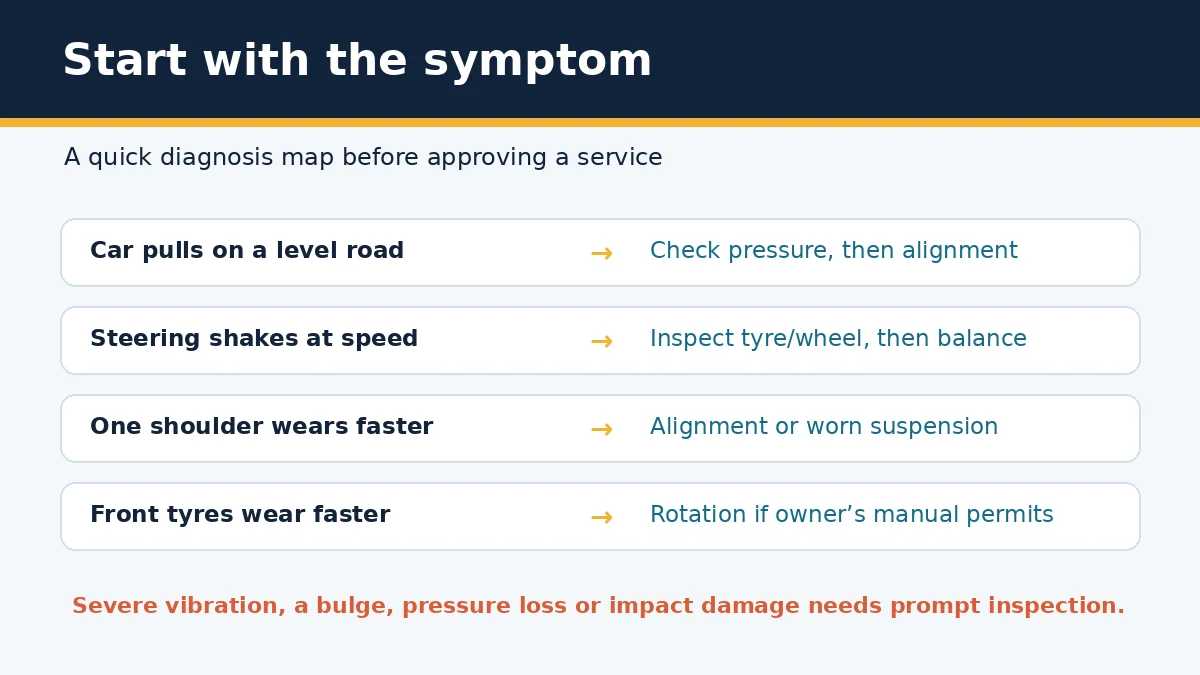
Start with the symptom, inspect tyre pressure and visible condition, then use the vehicle maker’s maintenance guidance. Pulling on a level road points toward pressure, alignment or a mechanical issue; vibration that appears in a speed range often points toward the tyre/wheel assembly; predictable front-to-rear wear may call for rotation when the owner’s manual permits it.
In this article
What each service actually changes
| Service | What is adjusted | Typical reason |
|---|---|---|
| Wheel alignment | Toe, camber and caster or other maker-specified angles | Vehicle pulls, steering is off-centre or tyres wear on one edge |
| Wheel balancing | Small weights offset mass variation in the wheel-and-tyre assembly | Vibration or shimmy, often within a speed range |
| Tyre rotation | Tyres move to approved positions on the vehicle | Spread normal wear and preserve service life |
| Tyre pressure check | Air pressure is set to the vehicle label when tyres are cold | Uneven wear, warning lamp, poor handling or efficiency |
The U.S. National Highway Traffic Safety Administration explains that balancing helps wheels rotate without shaking, alignment helps prevent veering and maximise tyre life, and rotation helps reduce irregular wear. It also advises checking the owner’s manual because the correct interval and pattern depend on the vehicle.
Match the symptom to the first check
- Pulling left or right: compare cold pressures first. If they are correct, have alignment, tyre condition and steering/suspension inspected. Road camber can create a mild drift, so diagnosis should use a suitable road or workshop equipment.
- Vibration at a repeatable speed: inspect for damage, missing weights, mud or debris, and request a balance check. Bent wheels, out-of-round tyres, driveline or suspension faults can produce similar symptoms.
- Steering wheel off-centre: alignment may be needed, especially after a pothole impact or steering work.
- Uneven front-to-rear wear: rotate only in a pattern permitted for the tyre size, direction and drivetrain. Correct the cause of abnormal wear before relying on rotation.
- Sudden severe vibration, a bulge or pressure loss: slow down safely and arrange prompt inspection; do not treat it as a routine maintenance decision.
When alignment makes sense
Alignment describes the angles at which the wheels meet the road and point relative to the vehicle. When those angles move outside specification, a tyre may scrub rather than roll cleanly. The result can be one-sided wear, an off-centre steering wheel or a pull on a level road.
An alignment check is sensible after a hard pothole or kerb impact, after relevant steering or suspension work, when installing tyres that replace an abnormally worn set, or when the symptoms appear. A proper report should show the before and after readings against the manufacturer’s range. Alignment cannot repair a bent wheel, damaged tyre, loose joint or worn suspension component; those issues must be addressed separately.
When balancing makes sense
A tyre and wheel are never perfectly uniform. A balancing machine identifies where small weights are needed so the assembly rotates smoothly. New tyres should be balanced when fitted. Rebalancing may be appropriate when vibration develops, a weight is lost, a tyre is remounted or a repair changes the assembly.
Balancing does not change wheel angles. If a car pulls steadily but does not vibrate, adding balance weights is unlikely to correct the underlying alignment, pressure or mechanical cause. Conversely, an alignment may leave a speed-related vibration unchanged if the assembly is out of balance.
When and how to rotate tyres
Rotation aims to share wear because front and rear positions often do different work. NHTSA says to follow the owner’s manual and notes that, when recommended by the manufacturer, a 5,000–8,000 mile interval may be used, sooner if uneven wear appears. That U.S. range is a general reference, not a replacement for the interval specified for an India-market car.
Some setups cannot use a conventional cross pattern. Directional tyres must keep their rolling direction; staggered front and rear sizes may not move between axles; temporary spares usually stay out of the pattern. After rotation, set cold pressures to the front/rear values on the vehicle label and reset or relearn the tyre-pressure monitoring system if the manual requires it.
What wear patterns can reveal
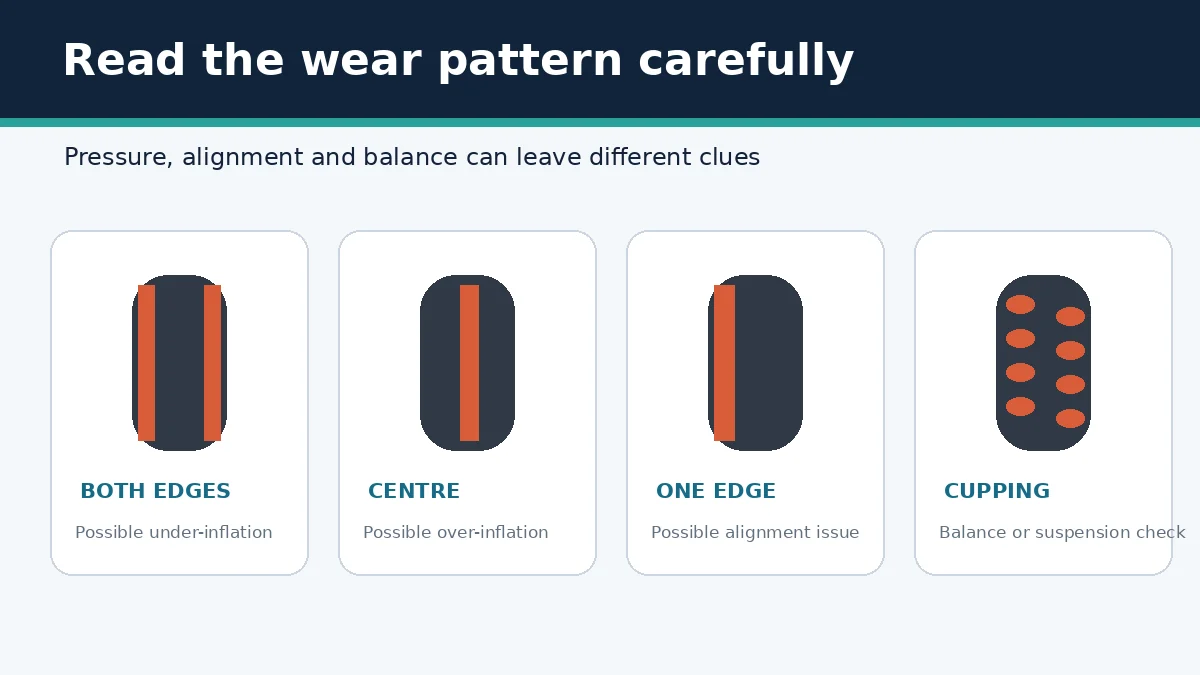
Wear is evidence, not a complete diagnosis. Both shoulders wearing faster can be consistent with prolonged under-inflation; centre wear can accompany over-inflation in some conditions; one-sided wear can indicate alignment or mechanical trouble; scalloped or cupped patches can accompany imbalance, worn dampers or looseness. Driving style, load, tyre design and previous damage complicate the picture.
Inspect all four tyres, including the inner shoulders that are easy to miss. Compare tread depth across the width and around the circumference. A rotation can redistribute future wear, but it cannot replace missing rubber or make a damaged tyre safe.
Questions to ask the workshop
- What symptom or measurement supports each recommended service?
- For alignment, can I see the manufacturer specification and before/after printout?
- For balancing, which wheel needed weight and was the tyre checked for damage or runout?
- Is the proposed rotation pattern allowed for my tyre direction, sizes and spare?
- Were cold pressures reset to the vehicle placard rather than the number moulded as a maximum on the tyre sidewall?
- If wear is abnormal, were steering, suspension and wheel condition inspected before the service?
Keep the report and photograph the tread. At the next pressure check or service, compare whether the symptom and wear trend improved. If a pull, vibration or unusual noise remains, return for diagnosis rather than repeatedly buying the same adjustment. Our guide to safe steps during engine overheating covers a different roadside warning where continuing to drive can also make damage worse.
Safety limits and sources
Primary reference: NHTSA TireWise: tyre pressure, tread, balance, alignment and rotation. Supporting tyre-maker explanations: Michelin: wheel alignment and balancing and Michelin: tyre rotation. Use the current owner’s manual for the vehicle-specific interval, pattern, pressures, torque and TPMS procedure.
Do not drive on a tyre with exposed cords, a bulge, serious cut, rapid pressure loss or other obvious structural damage. After an impact, severe vibration or steering change, reduce speed safely and arrange qualified inspection.
Reverification trigger: review this guide when NHTSA or major vehicle-maker maintenance guidance changes. Vehicle owners should recheck after changing tyre size, wheel specification, suspension components or manufacturer instructions.
Editorial note: The graphics are original explanatory illustrations and do not depict a specific vehicle or actual damaged tyre. This article provides general maintenance information, not a remote diagnosis.