
The temperature warning appears while you are driving. Perhaps the gauge is entering the red area, the dashboard displays an engine-overheating message, or steam is escaping from under the bonnet. A driver may be only a few kilometres from home, which makes continuing tempting. Yet those remaining kilometres can turn a cooling-system fault into expensive engine damage—or expose someone to hot pressurized coolant.
The essential priority is to get out of moving traffic safely and stop the engine, following the vehicle’s handbook. A red temperature warning should not be dismissed simply because the car still seems to move normally. If you can safely reach a nearby stopping place, use it; if the car is unsafe to move, prioritize your own safety and seek roadside support.
An overheating engine is not automatically one diagnosis. Low coolant, leaks, failed fans, thermostat problems, radiator issues, a damaged water pump or other mechanical faults can all disrupt heat management. The driver cannot reliably distinguish them from the temperature gauge alone. What the driver can control is the immediate response and the decision not to take risks with a hot engine.
Recognize an Overheating Warning Before Damage Spreads
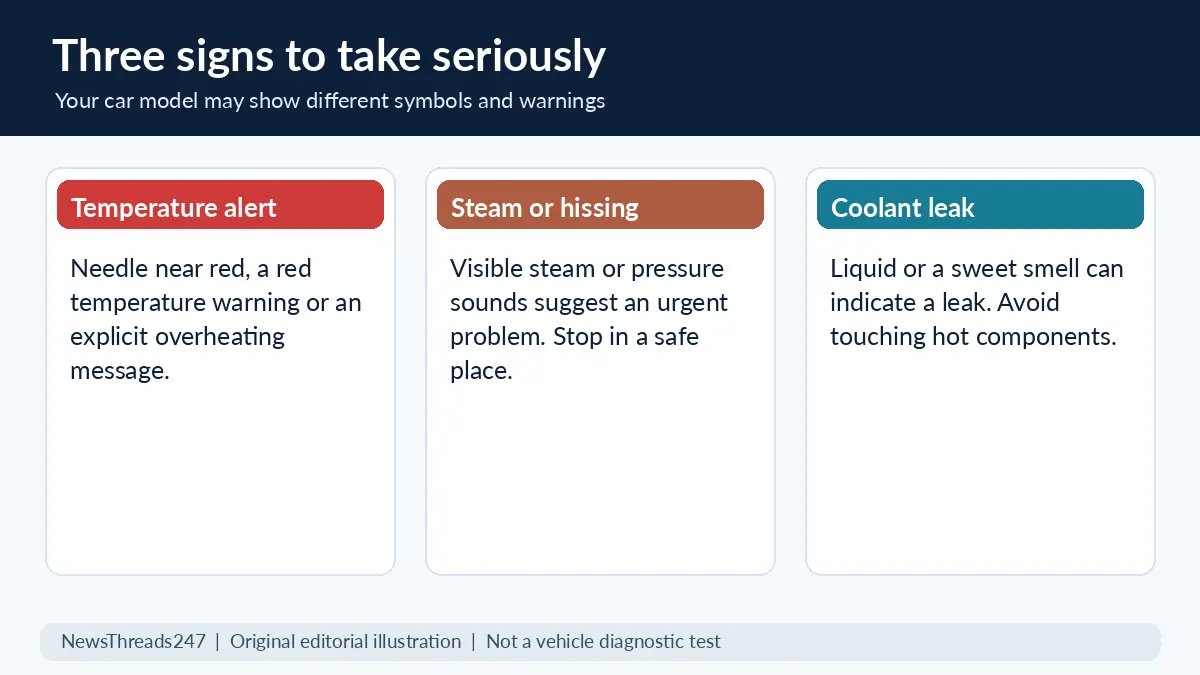
The dashboard may show a needle, an illuminated thermometer symbol, a red message or a digital temperature display. Vehicle-specific thresholds differ, so do not interpret a universal number from a generic graphic. AAA recommends monitoring the gauge and responding promptly when it reaches the red zone.
Other clues can precede or accompany the warning: steam around the bonnet, a hissing sound, a sweet-smelling liquid from a coolant leak, unusual knocking, or loss of performance. Some vehicles warn of reduced engine power when temperature is excessive. These signals require attention even when the dashboard reading appears uncertain.
An engine produces heat whenever fuel is burned. The cooling system circulates coolant, controls flow through a thermostat and transfers heat through the radiator and its airflow. A failure in any part of that process can cause temperature to rise. The effects are not limited to the radiator: excessive heat can damage engine seals, gaskets and internal components.
On a hot day with heavy traffic or steep inclines, the engine may work harder. A healthy cooling system should still operate within the manufacturer’s intended range. Persistent overheating is not something to normalize as merely part of summer driving.
What to Do Immediately While Driving
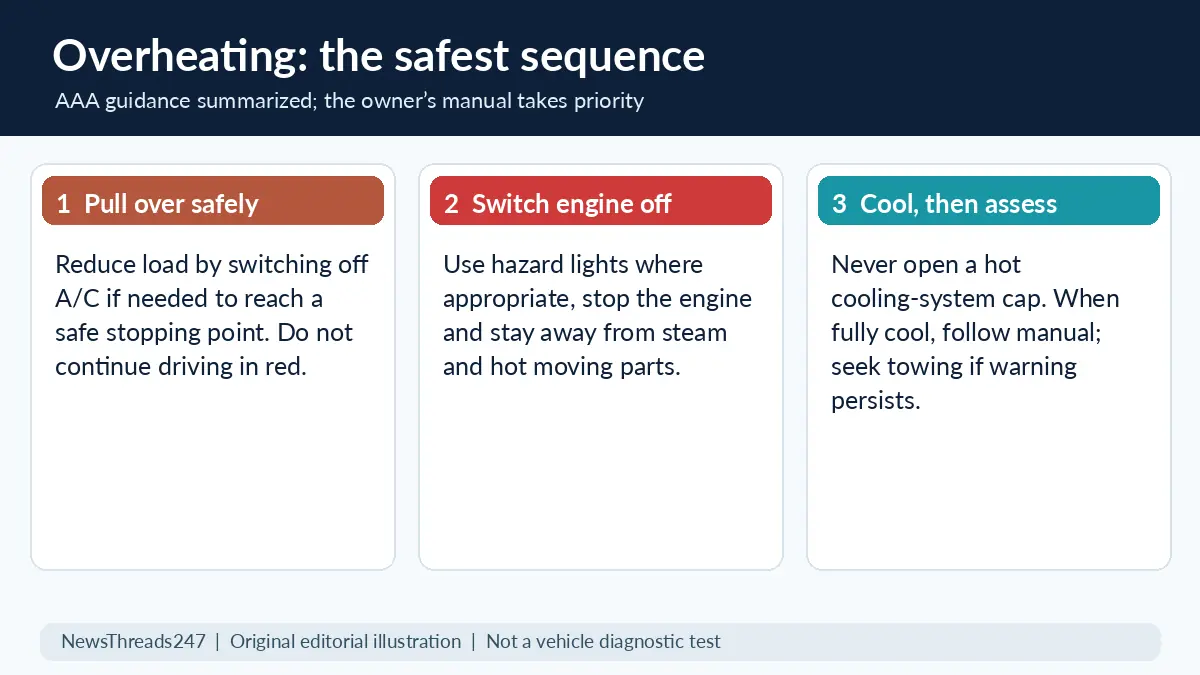
First, assess the road. Signal, reduce speed safely and move to a safe shoulder or parking area if you can. Avoid sudden steering or braking that could create a traffic collision. If steam is visible or the warning is severe, stop at the first safe opportunity rather than trying to make it to a distant workshop.
AAA advises switching off the air conditioner, which can reduce load. If you cannot stop immediately and must move only a short distance to safety, turning the cabin heater on may draw some heat away temporarily; it is not a repair and should never be treated as permission to keep driving while the warning persists.
Once safely stopped, apply the parking brake, switch off the engine according to the vehicle manual and turn on hazard lights where appropriate. Be alert for passing traffic, hot road surfaces and potential vehicle fire. The safest place for passengers depends on the location and local roadside safety guidance.
If there is smoke suggesting fire, flames, or a dangerous leak, move away from the vehicle to a safe location and call emergency services. Do not lift a hood into a fire or stand directly over steam. Do not assume that the absence of visible steam means the cooling system is safe to open.
If an assistance operator asks whether the vehicle can be driven, describe the warning, the distance from a safe stopping place, any steam or coolant loss, and the current condition. A tow may be cheaper and safer than continuing with a severe unresolved overheating fault.
Why You Must Never Open a Hot Coolant Cap
Most engine cooling systems are pressurized to raise the coolant’s boiling point and maintain effective circulation. Removing a radiator cap or pressurized expansion-tank cap while the system is hot can cause boiling coolant and steam to erupt, producing serious burns.
AAA repeatedly warns drivers not to remove a hot radiator cap. Waiting a fixed short number of minutes is not a substitute for confirming the system has cooled completely. Cooling time varies by engine design, weather and severity of overheating. The vehicle manual may specify a safe inspection procedure or recommend that only a qualified technician opens the system.
Even when the engine is switched off, cooling fans may continue to turn on automatically, and metal parts can remain extremely hot. Keep hands and loose clothing away from fans, belts and exhaust components. Never pour cold water over a visibly overheated engine to force rapid cooling.
If the vehicle is fitted with an opaque pressurized reservoir, do not try to loosen its cap merely to check the level. Use any permitted external markings only after the area is safe, and follow the manual. Where there is doubt, professional roadside inspection is the safer option.
The Difference Between Low Coolant and a Cooling-System Failure
Low coolant is an important clue, but it is not a diagnosis by itself. In a closed cooling system, coolant should not need frequent replacement between services. A consistently dropping level can indicate a leak, loss through a defective cap or another cooling-system problem.
A damaged hose or radiator may leak externally. A failed thermostat can prevent proper coolant circulation. An electric fan can stop operating, especially showing up in slow traffic. A worn water pump or drive-belt problem may reduce flow. In more serious cases, a head-gasket issue can affect coolant or engine operation.
Coolant colour is not a reliable shortcut for choosing a replacement fluid. Manufacturers specify formulations, compatibility and dilution rules, and different vehicles use different systems. Adding the wrong product can create additional corrosion or material-compatibility issues. Consult the handbook before topping up, even after the engine is cool.
Water may be described in some manuals as an emergency temporary substitute under strictly defined conditions, but that is not general advice to pour tap water into a hot engine. If the coolant level is very low, a leak is visible or a serious warning persists, arrange roadside assistance rather than attempting an unverified repair.
Is It Safe to Restart or Drive to a Workshop?
One of the most common mistakes is restarting an overheated car merely because the temperature gauge falls after the engine is switched off. Cooling down addresses the symptom temporarily; it does not repair a blocked radiator, failed fan or coolant leak.
If a manufacturer-approved check after full cooling identifies a simple correctable condition, the manual may specify limited steps and warning signs. Even then, avoid a trip if the cause has not been established. AAA advises towing or professional assistance when overheating continues or cannot be safely assessed.
Do not drive with an active red temperature warning, heavy steam, obvious coolant loss, loss of power or an abnormal engine sound. Serious coolant-system faults may worsen quickly under load. The safest decision for a driver without diagnostic tools is often a tow to a competent workshop.
A short, apparently successful restart is not proof the car can complete a journey. If you choose to move under a manufacturer-approved procedure, monitor the warning carefully and stop again immediately if the temperature rises. Never allow the desire to avoid a towing bill to outweigh traffic or burn risk.
What a Technician Should Check
The useful workshop question is not simply ‘How much coolant does it need?’ It is ‘Why did the temperature rise?’ A competent diagnosis may involve verifying coolant level and condition, checking for leaks, testing pressure, looking at fan operation and control systems, evaluating thermostat function, and inspecting the water pump, belt or radiator as appropriate.
Some leaks appear only when the system is pressurized or hot. A technician can test components with appropriate equipment when it is safe to do so. If coolant has repeatedly disappeared, ask whether the system was pressure-tested or the source was visually identified.
The cost and work required vary sharply. A loose external connection is different from an internal engine problem. Ask the workshop to document observed symptoms, test findings and why each proposed repair follows from those findings. Avoid approving major replacement solely because a dashboard light appeared once.
After repairs, the workshop should confirm that the vehicle maintains appropriate temperature under a relevant operating test, using manufacturer service procedures. Replacing the coolant alone without investigating a persistent leak is unlikely to prevent a repeat.
When Overheating Happens Only in Traffic
A car that stays cool on the open road but overheats in stop-and-go traffic may be struggling when natural airflow through the radiator is low. A faulty electric cooling fan, its controls, or an obstruction could be involved, though the symptom alone does not prove which part is at fault.
The important observation is the pattern. Does the temperature rise while idling and drop after moving? Does the cooling fan operate under the conditions the manual describes? Are there additional warning lights? A technician can use this history without the driver needing to touch hot components.
Never put your hands near the fan to see whether it is working. Electric fans can start automatically, sometimes even after the ignition is switched off. If you are stopped in traffic with a red temperature warning, find a safe stopping place and shut the engine down rather than experimenting at the roadside.
When Overheating Happens on Hills or Highways
A heavily loaded vehicle climbing a long hill uses greater engine power than one cruising on level ground. The cooling system must transfer that additional heat. AAA notes that carrying luggage and passengers, high ambient temperature and steep terrain can increase stress on the system.
If overheating appears only during climbs or fast highway driving, a partially blocked radiator, inadequate coolant circulation, underperforming water pump or another fault may emerge under load. The same symptom could have more than one cause. Avoid diagnosing it from a social-media list and ask the workshop to reproduce the relevant conditions safely.
Towing heavy loads, travelling with a full car or driving through extreme heat makes a pre-trip service check more important. Inspect the maintenance schedule, cooling hoses, approved coolant and warning-system operation with a professional before attempting another demanding journey.
Preventing the Next Overheating Incident
Preventive cooling-system maintenance begins with the owner’s manual. It specifies the correct coolant, inspection points and replacement schedule. Guessing based on colour, topping up repeatedly without finding a leak or mixing unidentified fluids can be costly.
Before long journeys, look for visible leaks beneath the parked vehicle, review service records and arrange an inspection if the temperature gauge has behaved unusually. Hoses, radiator condition, drive belts, cooling fans and the water pump may all deserve attention depending on the vehicle’s age and history.
A roadside emergency kit should include safe communications and visibility equipment, not just tools. Our pre-trip tyre repair kit guide explains another common breakdown scenario where checking the equipment before departure matters.
If a used car repeatedly overheats, ask for repair records and a genuine cooling-system check before assuming the issue is trivial. Our used-car delivery checklist covers broader inspection and paperwork questions that deserve attention before a purchase is completed.
Three Roadside Situations and Safer Choices
Situation A — red gauge in slow traffic: The engine temperature enters the red zone as traffic stalls. Find a safe place to pull over and switch off the engine. A failed fan is one possibility, but the driver should not diagnose or repair it next to moving traffic. Record the pattern for the workshop.
Situation B — steam while climbing: A family car releases steam during a hilly trip. The priority is immediate safe stopping, not making it to the next tourist stop. Keep clear of hot coolant, use warning equipment appropriately and contact roadside assistance.
Situation C — coolant was topped up yesterday: The warning returns the next morning. Repeated topping-up did not repair the leak or underlying issue. Seek diagnosis, because recurring temperature rises risk further damage even when the car seems normal for a few kilometres.
All three cases show the value of separating urgent driver decisions from mechanical diagnosis. Stop the heat-related risk first, protect passengers and other road users, and let a qualified technician identify the cause.
Frequently Asked Questions
Can I drive a car that has briefly overheated?
Do not continue with a red temperature warning, steam, visible leak or repeated overheating. A falling gauge after stopping does not identify or repair the cause. Follow the manual and seek professional assessment.
How long should I wait before checking coolant?
Wait until the cooling system is fully cool, not merely a fixed short interval. AAA warns against opening a hot radiator cap because boiling coolant can cause severe burns.
Does turning on the heater fix overheating?
No. It may temporarily reduce engine heat in some cars while reaching a safe stopping point, but it does not correct the underlying cooling-system fault.
Why does my car overheat only in traffic?
Limited airflow at low speeds can expose problems with cooling fan operation or other components. A technician must test the system; one symptom does not establish the cause.
Can I use plain water instead of coolant?
Only if the manufacturer explicitly permits a particular emergency procedure after full cooling. Correct coolant formulation and safe system handling matter; a significant leak generally calls for repair or towing.
Sources, Illustrations and Safety Disclosure
This is a general driver-safety explainer, not a model-specific repair manual or an inspection of any vehicle. It draws on AAA automotive advice and publicly available manufacturer guidance. Warning displays, recommended procedures, coolant types and emergency responses differ by vehicle.
- AAA, June 2025 — Why Is My Car Overheating?: recognition, common causes, and safe roadside response.
- AAA Oregon/Idaho — Dealing With an Overheating Car: warning signs and hot-cap precautions.
- AAA Automotive — Car Overheating: Causes and Solutions: cooling-system components and failure modes.
- AAA — How to Prevent and Handle Overheating: safe waiting and professional repair guidance.
- Ford India Owner Guide — Starting and Stopping: example of cooling fan operation after engine shutdown; owner guides vary by model.
Illustration disclosure: The featured dashboard warning is a conceptual graphic, not a photograph of any particular vehicle. Both body diagrams are original NewsThreads247 visual explainers, not diagnostic tests or actual instrument readings.
Safety disclaimer: Hot coolant, pressurized caps, moving fans and traffic can cause serious injury. Never open a hot cooling-system cap or continue driving with a severe overheating warning. Follow local roadside rules and the vehicle’s manual; seek qualified assistance whenever conditions are unsafe.