
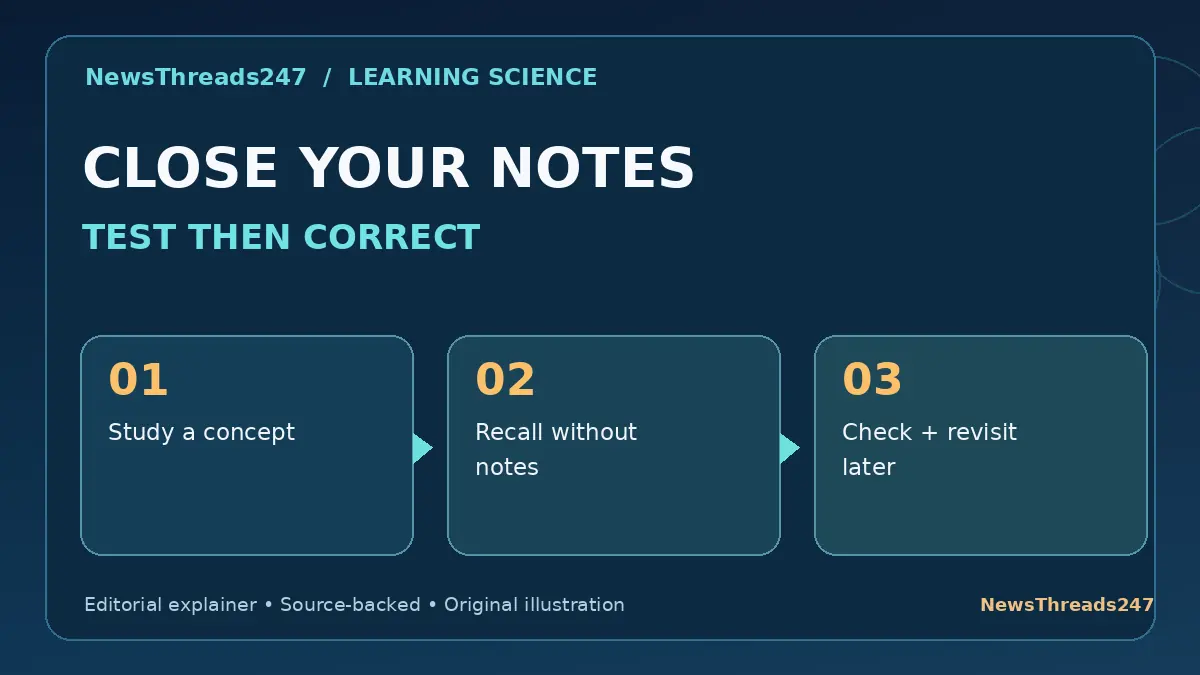
A desk covered in highlighted notes can look like evidence of a successful evening. The real test arrives later, when the book is closed and a new question asks the student to apply what seemed familiar. Research gives us better ways to measure and strengthen that learning.
This guide explains how to use retrieval practice, corrective feedback and spaced study in ordinary school or college revision, without promising that one technique will solve every learning difficulty.
Table of Contents — Expand or Collapse
- Why a Familiar Page Can Fool You
- What Retrieval Practice Actually Means
- Why Feedback Matters as Much as the Question
- Distributed Practice Means Revisiting Across Time
- What Highlighting and Summarizing Still Do Well
- A Worked Plan for a Student With Ninety Minutes
- When Practice Tests Are Not Enough
- How to Review an Actual Mock Test
- A Sustainable Weekly Revision Routine
- Frequently Asked Questions
- Sources and Editorial Transparency
Why a Familiar Page Can Fool You
A student reads a chapter twice and feels ready to answer questions. Ten minutes later, with the book closed, an explanation that looked obvious on the page becomes difficult to reproduce. The problem is not necessarily carelessness. Recognition and independent recall are different tasks.
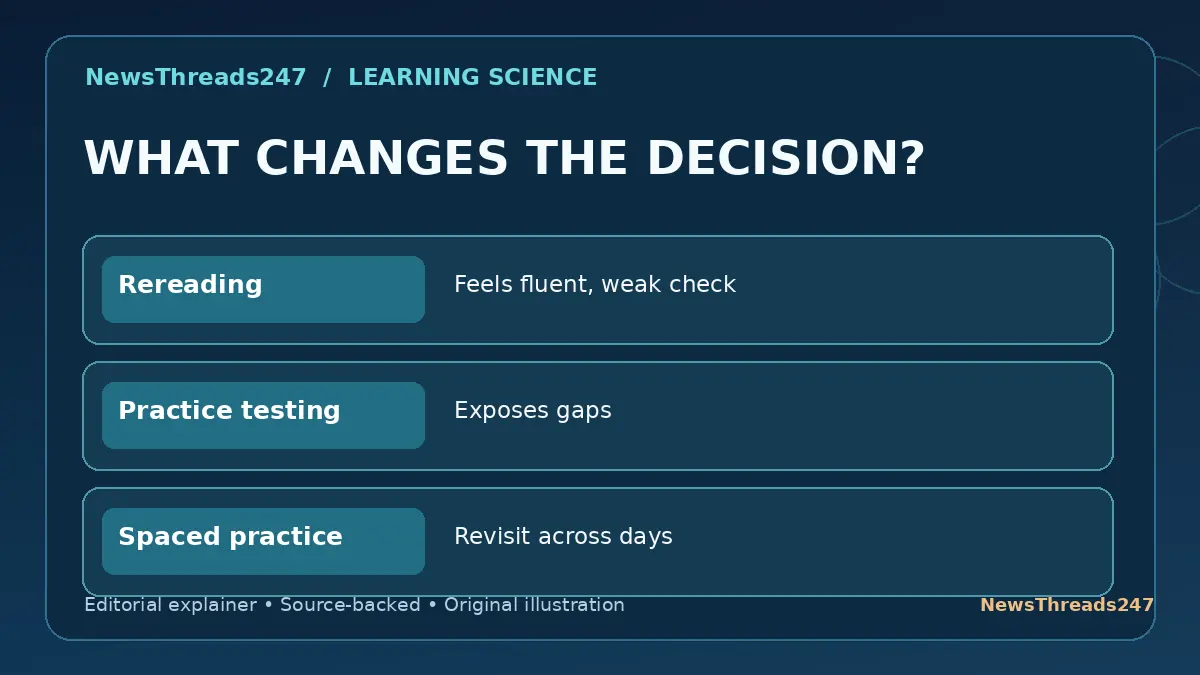
Rereading exposes the student to the material again. It can increase familiarity, but that feeling may overestimate how well the information can be retrieved without the page in front of them. The most practical alternative is to check recall directly, then use the errors to guide revision.
A 2013 review by Dunlosky and colleagues examined ten commonly used learning techniques. It rated practice testing and distributed practice as having relatively high utility across many learning conditions, while simple rereading and highlighting received lower overall assessments. That is a comparison of evidence, not proof that highlighting is always useless.
What Retrieval Practice Actually Means
Retrieval practice is the act of bringing an answer, explanation or method back from memory without immediately looking it up. Examples include answering short questions, explaining a concept aloud or solving a problem from a blank page.
The word ‘testing’ can sound stressful because many students associate it with grading. Here, a practice test can be low stakes or completely private. Its role is to reveal what can be recalled and what needs better understanding.
Suppose you read the causes of inflation. Close the material and write two demand-side examples, one cost-side example and a limitation of each explanation. Then reopen the source and compare your answer. The correction is an essential part of useful practice, not evidence that the first attempt was a failure.
Why Feedback Matters as Much as the Question
An incorrect practice response can reinforce a mistake if the learner repeatedly leaves it uncorrected. Feedback closes that loop by explaining why the answer was wrong and what the correct reasoning requires.
After an attempt, label the gap precisely: forgotten fact, misunderstood concept, careless calculation, or inability to recognize which rule applies. Each needs a different repair. A forgotten formula may call for further recall practice; a misunderstood concept needs explanation and worked examples.
Researchers caution against treating raw practice-test scores as a universal measure of ability. The difficulty of the questions, prior knowledge and timing influence performance. Track whether your errors become fewer or more specific after meaningful correction.
Distributed Practice Means Revisiting Across Time
Distributed practice spreads contact with important material over multiple sessions rather than concentrating it in one long sitting. A useful study plan returns to earlier topics after an interval, because durable recall has to survive the time when the material is no longer immediately fresh.
For example, a student studies a science concept on Monday, checks recall on Tuesday, revisits it during a Thursday practice set and incorporates it into a mixed quiz the following week. These dates are illustrative, not a research-backed universal schedule that every learner must follow.
Dunlosky’s review found strong support for distributing study. The appropriate intervals depend on the complexity of the content, how quickly it is forgotten and when it must be used. A language vocabulary list and an advanced mathematical proof may require very different practice.
What Highlighting and Summarizing Still Do Well
Highlighting can help identify important material during a first reading, and good summaries can support understanding. The research does not require students to throw away every marked page. It does warn against treating colourful notes as proof of learning.
The problem is passive repetition. If a student spends an hour rewriting textbook sentences with no attempt to explain or recall them, there is little direct evidence that the knowledge can be used independently.
Turn a highlight into a question. Turn a paragraph into a worked example. Turn a summary into a prompt for explanation with the notebook closed. The same source material can then support deeper active study.
A Worked Plan for a Student With Ninety Minutes
Imagine a student preparing for a maths test. Start with a short review of the method, then solve two straightforward examples with guidance. Remove the worked solution and attempt similar questions independently, checking the steps afterward.
Spend the next portion on errors: write down whether each mistake arose from the concept, the formula, arithmetic or interpreting the question. Later, mix the topic with previously studied material rather than practising a long uninterrupted list of one nearly identical question.
End by recording what needs to be revisited in a later session. Avoid converting the clock into a rigid recipe—someone struggling with a fundamental prerequisite may need a longer explanation before another test is useful. The structure matters more than exact minute allocations.
When Practice Tests Are Not Enough
Retrieval practice works best when the student has something accurate and meaningful to retrieve. If an entire subject is unfamiliar, starting with difficult quizzes alone can create frustration. Initial instruction, demonstrations and worked examples remain necessary.
Similarly, memorizing answers does not automatically develop the ability to transfer principles to unfamiliar problems. A learner needs varied questions, explanations of why a method works and feedback on reasoning—not just repeated exposure to the same question bank.
Students with exam anxiety, reading barriers or disabilities may need accessible assessment formats and accommodations. Using an evidence-based technique should broaden opportunity rather than create another demand that all students learn identically.
How to Review an Actual Mock Test
The useful part of a mock test begins after the score is calculated. Sort errors into content gaps, misread instructions, time pressure, careless execution and wrong strategy. Prioritize patterns that repeatedly cost marks.
Next choose a focused repair task. For a conceptual error, return to the explanation and a new problem. For a calculation error, practise the underlying operation. For a timing problem, examine whether the student is spending too long on one category rather than assuming every mistake means inadequate effort.
Our mock-test review guide applies this diagnostic approach to real revision work. Use the two articles together: one explains how learning practice works, the other organizes feedback after a full practice exam.
A Sustainable Weekly Revision Routine
Choose a small number of important objectives. Write questions that actually test those objectives, schedule revisits across the week and leave room to repair misunderstandings. There is no benefit in creating an elaborate tracking spreadsheet that is never used.
A study session can finish with three short prompts: what can I explain now, what still needs checking, and when will I return to it? That creates a usable next action without turning the evening into a performance of productivity.
Breaks, sleep and ordinary responsibilities remain part of a workable plan. This article does not claim that practice testing replaces adequate teaching, healthy routines or timely exam guidance.
A realistic revision example across seven days
Suppose a Class 12 student has one week to consolidate the basics of electrostatics while continuing to attend school. On Monday, they read the chapter’s explanation of electric field and potential, solve two worked examples and write five questions they would like to answer without opening the book. On Tuesday, they close their notes and try those questions from memory, marking which formula they cannot justify and which diagrams they cannot draw. They then reopen the text, check the reasoning and correct their mistakes.
On Thursday, the student returns to the topic with three unfamiliar applications rather than simply recognizing the solved examples. On Saturday, they attempt a timed mixed set alongside questions from an earlier chapter. Sunday becomes a short error-review session. This is a constructed planning example, not an experimentally proven seven-day schedule. The principle is that recall and practice are distributed across occasions and include feedback; each student’s intervals should change with their prior knowledge, syllabus and examination dates.
Why is this more informative than four nights of rereading? When the student tries a question before looking at the answer, they learn which information is accessible independently and which is not. A polished explanation can feel familiar while remaining difficult to reproduce unaided. That difference matters in examinations where students must recall, apply and connect ideas without seeing the original worked page.
What to do with a wrong answer instead of merely counting it
After practice, classify each mistake by cause. Did the student not know a definition? Did they remember a formula but misunderstand the units? Did they choose the wrong procedure for a word problem? Was the answer correct until an arithmetic slip? These problems call for different repairs. A missing concept needs explanation and practice with simple examples; a selection error may need comparing different problem types; repeated careless slips may call for a slower checking routine.
For a concrete mathematics example, a student may use compound interest when a question explicitly specifies simple interest. Reading the correct final answer does not establish understanding. A stronger review asks them to underline the relevant terms, explain why simple interest applies, solve a second question with altered values, and then revisit the distinction after a delay. Feedback turns an unsuccessful retrieval attempt into information that can improve the next attempt.
Keep error notes brief: question type, mistaken assumption, correction and a date to try a similar question again. A massive notebook of copied solutions can become another form of passive revision. The aim is to make the student’s next independent attempt better. For a more detailed process, our mock-test mistake review guide explains how to turn errors into a focused study plan.
Adapt the method to the subject and the learner
Retrieval in a language subject could mean explaining a paragraph’s meaning and then checking the original. In history it might involve reconstructing a sequence of events, checking dates and examining causes. In accountancy it may mean solving an unfamiliar journal-entry problem and explaining every debit and credit. In biology it may involve labeling a diagram from memory and describing the function of each part. The common feature is an attempt to bring understanding back without relying entirely on the visible text.
Different subjects need different amounts of direct instruction before retrieval becomes useful. A complete beginner cannot benefit from testing an unfamiliar procedure indefinitely without a worked explanation. Nor should practice tests substitute for sleep, access to teaching, accommodations or appropriate help with a learning difficulty. Research evidence about average learning techniques is not a promise that one method has the same effect for every student and task.
The 2013 review by Dunlosky and colleagues rated practice testing and distributed practice highly across multiple learning contexts. It did not say that highlighting is forbidden or that rereading can never support comprehension. A sensible routine uses reading to understand unfamiliar material, retrieval to check independent access, feedback to correct errors and spaced return visits to strengthen retention. That is a practical interpretation of the evidence, not an automatic examination-score guarantee.
Frequently Asked Questions
Is active recall the same as taking mock tests? Mock tests are one form. Explaining an answer from memory, solving from a blank page and using flashcards with feedback are others.
Is rereading always a waste of time? No. Rereading may help comprehension or repair gaps, but using it alone provides a weaker check of independent recall than well-designed practice testing.
How often should I space revision? There is no single schedule for every subject. Revisit important material across days or weeks and adapt intervals to retention and the exam timeline.
What if I get practice questions wrong? Use the errors to locate gaps, check the correct explanation and try a fresh question later. Practice results are feedback, not a fixed label of ability.
Do these techniques work for mathematical problems? They can help, especially when combined with worked examples, varied problem types, conceptual instruction and corrective feedback.
Sources and Editorial Transparency
The evidence base includes Dunlosky and colleagues’ review, published by the Association for Psychological Science, the PubMed record of the 2013 report, and Rawson and Dunlosky’s review on practice-testing schedules. Our example timetable is an original illustration of principles, not a validated protocol.
Editorial disclosure: All visuals are original explanatory diagrams. No educational outcome, individual student improvement, school test or first-hand classroom experiment is claimed. Review the advice when substantial new comparative evidence appears.