
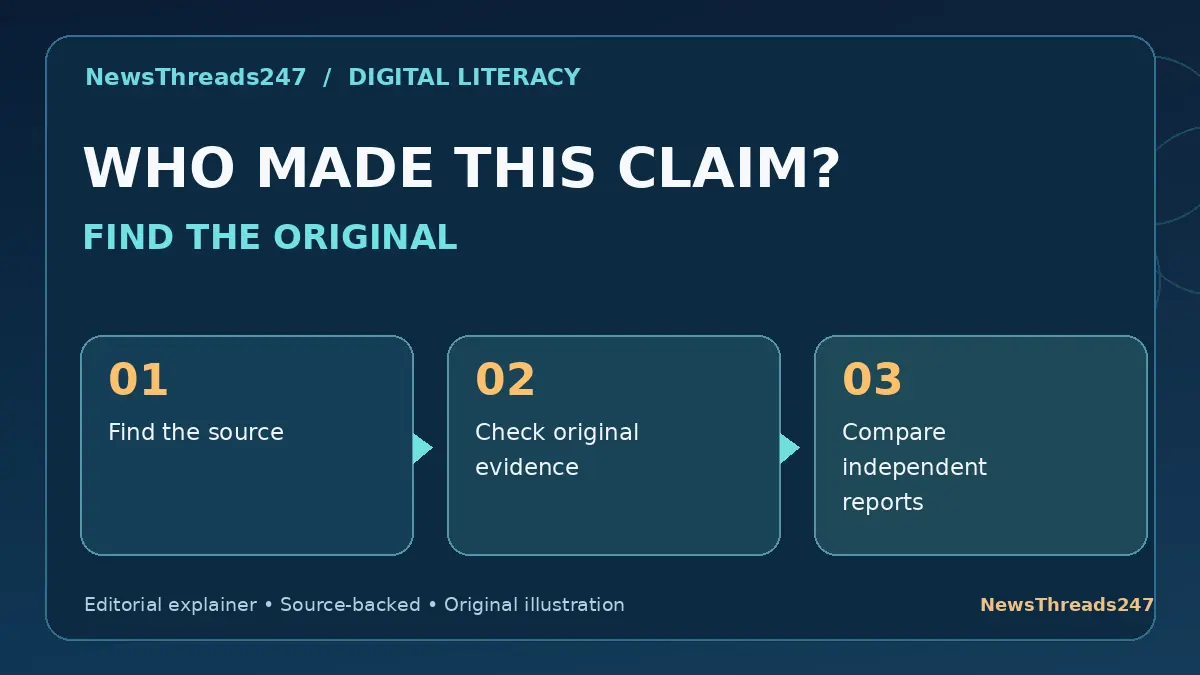
A school group forwards a screenshot claiming an exam deadline has moved. The image looks authoritative and asks everyone to pay immediately, but nobody has posted a link to the original notice. That is exactly when source checking matters most.
The following method works for claims in photographs, PDFs, videos and AI-generated graphics. Its goal is not to make students suspicious of everything; it is to connect a meaningful claim to evidence that actually supports it.
Table of Contents — Expand or Collapse
- Why a Screenshot Is Not a Source
- Step One: Name the Exact Claim
- Step Two: Leave the Post and Find the Origin
- Step Three: Check Dates and Missing Context
- Step Four: Compare Independent Evidence
- AI-Generated Images and Edited Photographs
- A Worked Example: An Exam Deadline Image
- A Worked Example: A Celebrity Quote on a Graphic
- A Five-Minute Verification Routine
- Frequently Asked Questions
- Sources and Editorial Disclosure
Why a Screenshot Is Not a Source
A screenshot of a university announcement, a celebrity quotation or an exam result can travel through hundreds of messaging groups while its original context disappears. The image looks official because it contains a familiar logo or a clean layout. But the screenshot is only a picture of a claim, not proof that the issuing organization made it.
That matters particularly for students and families deciding whether to register for an examination, submit personal data, pay a fee or change travel plans. A false deadline image may create pressure to act before anyone has checked whether the notice exists on the institution’s website.
UNESCO’s media and information literacy guidance encourages examining the creator, purpose, evidence and credibility of information. The practical task is to move from a claim seen in a feed to a source that can independently support it.
Step One: Name the Exact Claim
Before opening another tab, summarize what the post actually asserts. Is it saying an application deadline has been extended, that a product is banned, that a public figure made a statement, or that an old photograph shows a new event? Each claim needs a different kind of confirmation.
Do not assume a screenshot that contains several statements must be entirely true or false. One date might be correct while the attached advice is misleading. Another post might reproduce a genuine document but crop out a qualification that changes its meaning.
Write down the organization, date, place and claimed action. If any of those are missing, treat the absence as an information gap rather than inventing context from the colours or branding.
Step Two: Leave the Post and Find the Origin
The strongest first check is usually to leave the social platform and visit the named institution’s official website or verified account by a route you know independently. Do not trust an address typed into an image: visit the organization’s established homepage and navigate to the relevant notice or publication section.
For an examination notice, use the current official examination authority site and match the notification number, session and publication date. For a government rule, seek the department’s actual notification, statute or official release. For a product recall, check the manufacturer’s recall database and any official regulator involved.
A statement that appears only as a screenshot with no original page is not automatically false, but it remains unconfirmed. A useful answer is ‘I cannot verify this notice from the official source’ rather than ‘it must be true because many people forwarded it’.
Step Three: Check Dates and Missing Context
Old images often circulate as breaking news. A university may have issued a real notice in a previous academic year; a new viral post can erase the year or edit the date. Search for the original headline alongside the institution and inspect whether the purported update is newer than the underlying announcement.
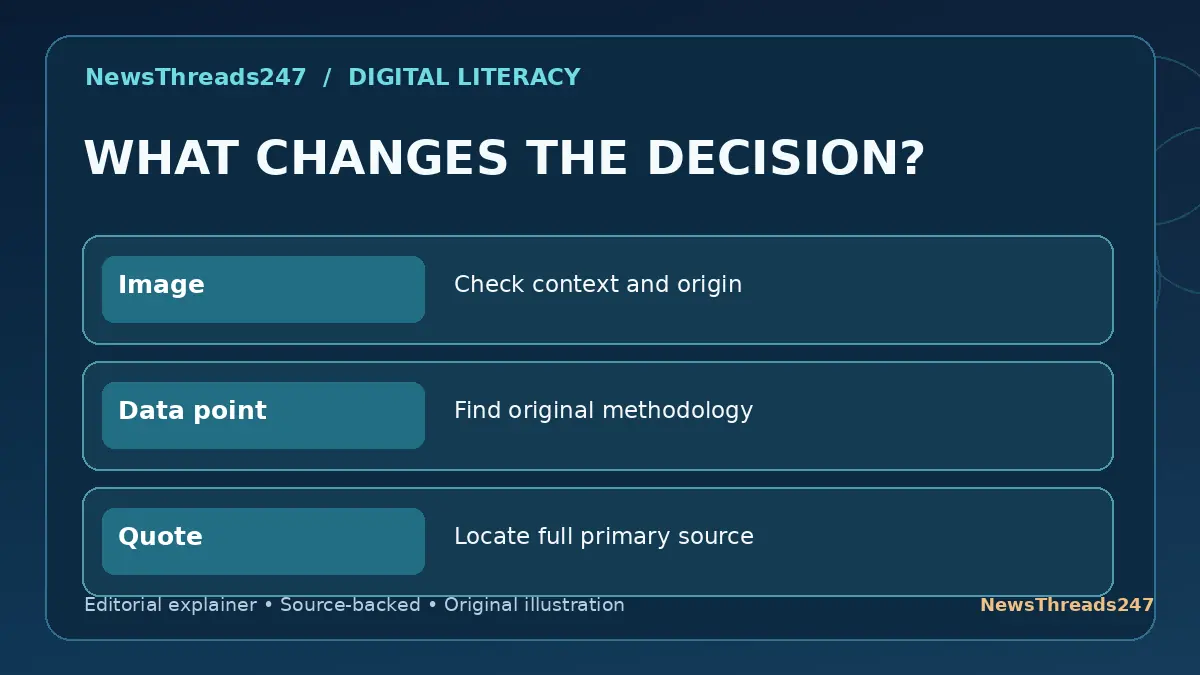
Read the entire paragraph around a quotation. A public speaker may be describing an idea they reject, quoting another person or using irony. A cropped subtitle can reverse the message. For statistical claims, examine the base period, sample, measurement and geography.
Context is especially important when a chart shows dramatic growth or decline. A truncated axis, inconsistent units or a comparison between different datasets may produce a striking image without supporting the caption.
Step Four: Compare Independent Evidence
An additional news report can help, but two websites repeating the same anonymous social post do not constitute two independent confirmations. Look for organizations that saw the source themselves, primary data or on-the-record statements with identifiable dates.
When the issue is consequential, match the exact claim against at least one primary source and a competent independent explanation where available. A genuine press release establishes what the institution announced; it does not automatically prove that an announced policy has already taken effect everywhere.
UNESCO’s 2024 study of digital creators found shortcomings in systematic fact-checking practices, illustrating why popularity and volume are weak proxies for reliability. Shares and likes can tell you that information spread—not that it was verified.
AI-Generated Images and Edited Photographs
A realistic picture no longer proves that a depicted event occurred. Image-generation tools can create plausible people, buildings and newspaper-style layouts. Conventional editing can also remove objects, change dates or combine real photographs from different events.
Visible anomalies can sometimes raise suspicion, but relying only on fingers, text mistakes or ‘AI detector’ scores is unreliable. The better starting point is provenance: where was the image first published, who supplied it, and does it appear in an authentic article or official record?
Reverse-image searches and archived pages can help locate older versions of a picture. Metadata can be useful when genuine and intact, but images shared by messaging services may have metadata removed. A lack of metadata is not proof of fabrication, and the presence of metadata is not conclusive authentication.
A Worked Example: An Exam Deadline Image
Imagine a message saying ‘The registration date has been extended until midnight tonight’ with a logo resembling the examination authority. The image contains no notification number and links to a form on an unfamiliar domain.
Do not use the embedded payment link first. Go independently to the actual examination website, inspect its latest notices and compare the exam year, notification number, eligibility and fee window. If the authority has not announced the extension, the appropriate status is unverified, not automatically accepted.
An additional safety step is to inspect the website address carefully before entering identity documents or payment details. Our fake e-challan message guide shows how official-looking messages can create similar pressure to click a dangerous link. The exact scam differs, but the verification habit transfers.
A Worked Example: A Celebrity Quote on a Graphic
A stylish graphic attributes a motivational sentence to an actor and has been shared thousands of times. The words may sound plausible. That is not enough to present them as a verified quotation.
Search for an attributable interview, speech transcript, recorded statement or authorized publication. If only quote-collection pages and social images repeat the same wording, label it unverified or avoid attribution altogether. There is no need to fabricate authority to make an encouraging message useful.
This method also protects editorial credibility. Readers can distinguish a writer’s original interpretation from a documented statement by a public person. The difference should remain visible even when the social-media design is attractive.
A Five-Minute Verification Routine
First name the claim and its alleged source. Second locate the primary notice or record through an independent route. Third compare date, location and exact wording. Fourth seek competent corroboration, especially for consequential claims. Fifth decide how to communicate the result: confirmed, false, misleading, outdated or not yet verifiable.
Do not forward sensitive personal information simply because it appears in a screenshot. Avoid reposting private phone numbers, student identification details or addresses while asking others to investigate. Remove unnecessary personal data from screenshots.
Verification is not a guarantee of certainty. Sometimes the best available conclusion is that the evidence does not establish the claim. That is a responsible finding when a misleading post could affect someone’s money, safety or education.
A reverse image search is a clue, not a verdict
Imagine a dramatic photograph is circulating with the caption that a particular school has cancelled examinations today. Searching the image might reveal that the photograph appeared in a news article five years earlier about an unrelated event. That provides useful evidence the new caption is misleading. But if reverse image search finds nothing, it does not prove the photograph is authentic or recent. Newly generated or privately shared images may simply have no searchable history.
Look for stable landmarks, signs, uniforms, weather conditions and the event’s claimed location. Each can help frame another search, but none is enough by itself. A sign may have been cropped; a date can be edited; a genuine photograph can be presented alongside a false caption. Verify the specific claim about the event through an independent source, rather than treating the picture as self-explanatory proof.
Digital provenance tools and authenticity metadata may provide additional context when available, including records of edits or origin. Yet metadata can be missing, stripped or incomplete, and a genuine file does not necessarily prove the truth of its accompanying text. Avoid the opposite mistake of declaring every image without credentials ‘AI generated’. State what can be checked and what remains uncertain.
Example: verify a supposed exam deadline extension
A message says, ‘The application deadline has been extended by three days,’ and includes a screenshot showing a school-board logo. First, write down the actual claim, exam name, session, earlier date and new date. Without those details, searching for ‘exam date extended’ may return unrelated notices from past years.
Second, type the issuing body’s official web address independently rather than following the image’s shortened link. Open its current notification page, locate the notice number and compare the complete PDF or announcement. Check who is eligible for the change: an extension of a fee-payment deadline may not mean fresh registration has reopened. Third, compare a reputable news report that links directly to the notice, and avoid sharing a cropped image if the primary document contradicts it.
Finally, preserve the source date and exact wording when explaining the result. ‘The board extended the application fee deadline for already registered candidates’ is more useful than ‘Exam deadline extended’. This example is fictional and does not assert that any real board has issued such a notice today. It demonstrates how to turn an image-based claim into a verifiable question.
Example: an inspirational quotation attributed to a celebrity
A visually polished quotation card claims an actor or athlete said something powerful about success. The background photograph may be genuine while the words are invented. Searching the exact phrase in quotation marks, checking the person’s official statements and looking for an interview transcript can reveal whether the words are traceable to a credible occasion.
Do not assume a quotation is authentic because ten fan pages repeat it. They may all have copied the same unsourced caption. Nor should a quotation be treated as false merely because it is missing from a quick search. If a primary or reliable original source cannot be found, a responsible editor can omit the attribution or say it remains unverified. This protects the reader and the person named in the image.
What to do when certainty is not possible
Not every image will have enough evidence for a definitive decision. Your options are not limited to ‘true’ and ‘false’. It may be more accurate to say ‘unverified’, ‘out of context’, ‘altered but based on a real image’ or ‘claim contradicted by the primary source’. Those distinctions prevent uncertainty from becoming a confident accusation.
For low-stakes entertainment content, declining to share is often sufficient. For a claim about medical safety, public danger, recruitment or financial payments, seek official guidance and avoid amplifying unsupported details while waiting. UNESCO’s media and information literacy resources stress evaluating sources and information critically, not merely learning a single image-detection trick.
When a suspicious message also demands installing software or paying a fine, treat the action request as its own risk. Our fake e-challan and APK safety guide explains how to check the alleged traffic fine independently. Even if the accompanying screenshot resembles an official notice, the destination link and requested software still need to be verified.
Frequently Asked Questions
Can an AI detector prove an image is fake? No single score reliably establishes the origin of every image. Source, context and independent evidence are more important.
Is a screenshot of a government letter enough? It can be a starting clue, but verify the letter number and full document through the issuing authority’s actual channels.
What if three news websites show the same image? Check whether they independently verified it or simply copied one social post.
Does a blue check mark guarantee truth? No. Account verification or a familiar logo does not verify every individual claim.
Should I share a warning before verifying it? For high-stakes claims, avoid amplifying unsupported details. Share official safety instructions when available and explain uncertainty honestly.
Sources and Editorial Disclosure
References include UNESCO — Media and Information Literacy, UNESCO’s 2024 creator verification survey, the 2025 UNESCO education issue brief, and UNESCO’s instructional material on transparent verification.
Editorial disclosure: The exam notice and quotation scenarios are invented examples for teaching verification; they do not describe any real exam authority’s current deadline or an actual celebrity statement. The accompanying visuals are original diagrams, not images of a real viral post. Refresh the article when source-verification methods or platform features materially change.