
A Class 10 student prepares for an 80-mark mathematics paper. Another student takes a 50-mark Computer Applications theory exam and assumes the remaining marks must be ‘extra credit’. A Class 12 science student spends weeks revising for a 70-mark Physics paper while overlooking the practical assessment. They are all preparing for CBSE examinations, but their subjects are not assessed in exactly the same way.
That is why the Central Board of Secondary Education’s subject-wise marks bifurcation for the 2026–27 session matters. CBSE published the relevant circular in early November 2026, and it is attracting attention on Google Trends. The circular separates maximum marks for theory, practical examinations, projects and internal assessment, and also identifies examination duration, external examiners and practical-answer-book arrangements for individual subjects. Its main purpose is to clarify the actual allocation and help schools avoid uploading marks incorrectly.
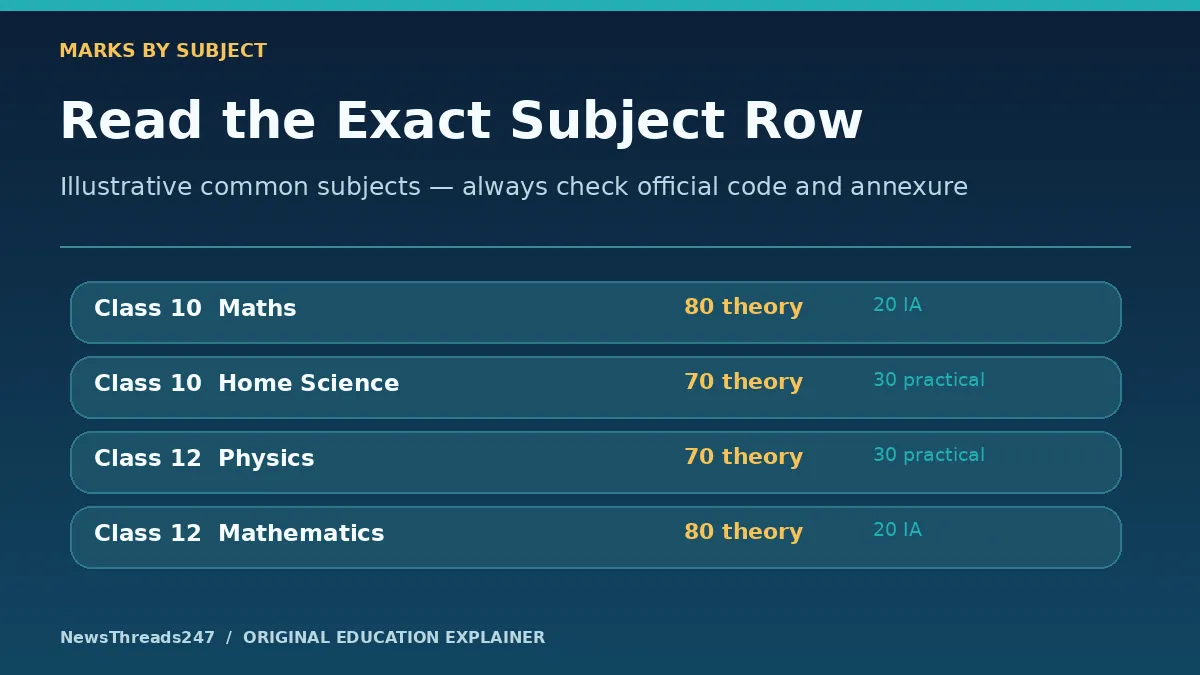
For most familiar Class 10 core subjects, students will encounter an 80-mark written exam and 20 marks of internal assessment. But it would be wrong to tell every student that their board marks always follow an 80:20 formula. Some Class 10 courses use 70:30 or 50:50, and Class 12 laboratory and skill subjects have their own patterns. The exact subject code, not a viral summary chart, decides the allocation.
What CBSE Means by Subject-Wise Marks Bifurcation
Bifurcation simply means the distribution of a subject’s maximum marks between assessed components. The total for each listed subject is typically 100 marks, but those 100 marks need not come from a single written exam. A subject may include theory plus internal assessment, a supervised practical or a project assessed under board rules.
The official CBSE notice identifies the class, subject code and subject name alongside the maximum marks for the theory paper and the remaining assessed components. It also addresses the length of the theory examination, whether an external examiner is required for relevant assessments, what sort of answer book is used, and other operational details.
This is not a new personal ‘bonus marks’ system. Internal or practical marks are part of the prescribed assessment structure. They must be earned and recorded through the method applicable to that subject. Adding 20 automatically to every theory score would be wrong, just as assuming every student has a 100-mark theory paper would be wrong.
The circular also serves schools: marks may be uploaded through specified systems and procedures, so an incorrect subject code or wrong component maximum can create problems. Students should understand their marks, while schools must follow the board’s official assessment and upload instructions.
The Common 80:20 Pattern for Class 10
For subjects such as Mathematics Standard, Mathematics Basic, English Language and Literature, Science and Social Science, the widely reported Class 10 arrangement is 80 marks for the written theory paper and 20 for internal assessment. Hindi courses also commonly follow that division. However, the exact subject name and code must be checked in the current circular.
Suppose a student scores 65 out of 80 in Mathematics Standard and obtains 17 out of 20 in internal assessment. Their example combined total would be 82 out of 100. That arithmetic is simple, but it assumes both component marks were actually awarded. The article does not imply a school can award any amount outside CBSE’s assessment procedure.
A student might ask whether the 20 marks are controlled by the board examination hall. They are not the same as questions in the three-hour theory paper. Internal assessment covers separate school-based components according to the academic syllabus and CBSE instructions. A general online article cannot specify every internal rubric without knowing the subject’s current scheme.
What matters for revision is that theory preparation and internal assessment are different workstreams. Students should practise written questions, but they should also keep track of applicable school tasks, attendance-related requirements where specified and evidence of internal work. Do not assume a late project can be submitted casually after the marks have been finalized.
Subjects Where 80:20 Does Not Apply
The most common mistake is taking the familiar Mathematics or English split and applying it to a subject with laboratory work. Class 10 Home Science, for example, has been reported in the current bifurcation as 70 theory plus 30 practical, while Computer Applications uses 50 theory plus 50 practical. Some skill courses also follow a 50:50 arrangement.
Class 10 Painting is another useful counterexample. Reporting on the official CBSE annexure describes theory, practical and internal components separately, rather than a simple two-column 80:20 division. Students should inspect the actual row, because reducing a multi-component assessment to ‘practical marks’ can hide how each part is evaluated.
For Class 12, Physics, Chemistry and Biology are commonly assessed through a 70-mark theory examination and 30-mark practical component. Class 12 Computer Science is also reported at 70:30. Mathematics, by contrast, has an 80-mark theory component with the remaining 20 accounted for under its applicable internal assessment structure.
Economics, Business Studies and Accountancy have 80-mark theory papers and separate 20-mark project or internal components under the relevant scheme. It is important not to call every component ‘practical’ when the board classifies some work as project assessment or internal assessment.
Why Theory, Practical, Project and Internal Assessment Are Different
A theory paper tests answers written in an examination under the board’s specified conditions. A practical assessment generally examines subject-specific experimental or applied work, often under supervised conditions. A project assessment considers a prescribed project or related submission and its evaluation. Internal assessment is a broader school-based component defined by that subject’s current rules.
These categories should not be merged into an informal ‘school marks’ column without explanation. The student needs to know which activities their subject actually requires. A laboratory subject may need practical records and a supervised examination. A business subject may require a project. A language or mathematics subject may have its own internal assessment structure.
A student’s sensible question is therefore not simply ‘How many marks does my school give me?’ It is ‘Which components count for my subject, what are their maximum marks, and how are they assessed?’ Those are questions the school and its current CBSE materials should be able to answer.
Teachers should follow the current academic curriculum and assessment guidance rather than reproduce a previous year’s school rubric without checking for changes. If the subject code or components have been revised, the newest official circular and syllabus take precedence.
Worked Examples: Adding the Components Correctly
Consider four fictional students, each taking a different subject. Student A gets 64/80 in a theory exam and 18/20 in internal assessment: total 82/100. Student B gets 55/70 in theory and 25/30 in practical: total 80/100. Student C gets 38/50 in theory and 44/50 in practical: total 82/100. Student D gets 66/80 in theory and 16/20 in a relevant project component: total 82/100.
Those totals illustrate how different splits can produce similar overall marks. They are not actual CBSE results and do not establish passing rules for a specific subject. A minimum requirement in theory or practical, if applicable, must be checked in the relevant board regulations rather than inferred from a combined score alone.
The model also explains why percentage comparisons can be misleading. A 60/70 theory score is not the same raw component as 60/80. A family comparing two students should distinguish marks out of the relevant component maximum from marks out of 100 for the complete subject.
Before calculating, inspect whether the official row contains more than two components. Some subjects have theory, practical and internal work separately. Omitting one component from a spreadsheet can result in a total that looks right only because the wrong denominator was used.
How to Find Your Exact CBSE Subject Code
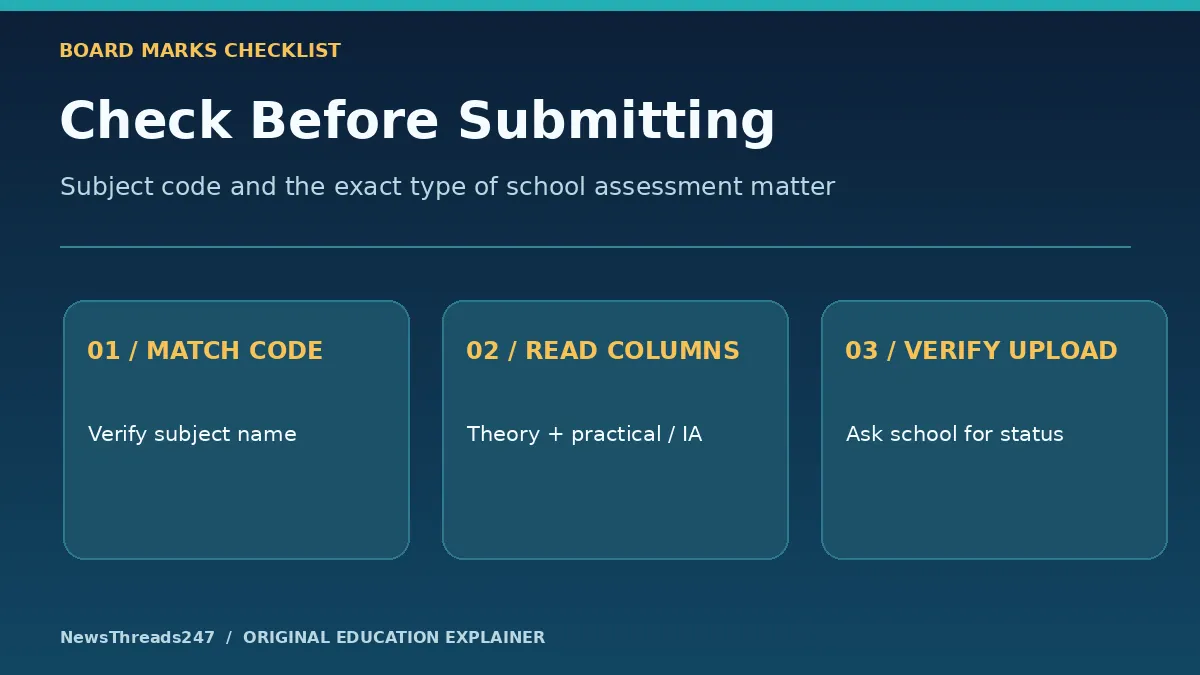
First open the CBSE official website, cbse.gov.in, and locate the November 2026 circular titled Subject-wise Marks Bifurcation of Class X/XII, Examination 2026–27. The board’s homepage identifies it among its latest notices. Download the official annexure rather than relying on a screenshot that may omit columns or rows.
Next check your own subject name and code from school records, admission information or the candidate registration or List of Candidates record. A subject label that looks familiar may still refer to a different course or code. Mathematics Basic and Mathematics Standard are one obvious example of different named entries that students should not conflate.
Find the row for your exact code in the annexure. Read the maximum theory marks, practical, project and internal-assessment columns separately. Also note the scheduled length of the theory examination and whether relevant practical arrangements require an external examiner. If a field is blank or not applicable, do not invent a mark value for it.
Keep the document’s release date in your notes. If CBSE later posts a corrigendum or school-specific guidance, the revised official instruction is more authoritative than this explanatory article. The bulletin is a dated source; a student’s current subject record is what connects it to their personal exam.
Practical Examination Dates: Winter-Bound and Regular Schools
CBSE has separately notified practical, project and internal assessment arrangements for different school calendars. Reporting on the current circulars identifies 9 November to 19 December 2026 for winter-bound schools and 1 January to 13 February 2027 for regular-session schools. Students should confirm the specific practical date announced by their own school, which operates within the applicable official window.
A practical-exam window is not a personal appointment. If the board allows a period of several weeks, a student’s school will still need to arrange its actual assessments and communicate instructions. Do not wait until the last calendar day assuming it is your examination day.
The board’s circulars for marks bifurcation and for conducting practical assessments serve different purposes. One tells you how marks are allocated; the other governs when and how the assessment takes place. Reading only the marks chart will not tell you when to report for a laboratory examination.
This distinction is especially important when a family is planning travel or school absence. Check dates with the school well ahead of time, along with required practical records or materials. If the online copy of a circular contains an apparent typographical inconsistency, seek written clarification from CBSE or the school rather than selecting a date by guesswork.
Why Schools Must Check Marks Before Uploading
CBSE has specifically cited errors in schools’ marks uploads as a reason to publish subject-wise guidance. The risk is easy to understand: when a portal expects a particular maximum for theory, practical or internal marks, using the wrong component or code can create an inaccurate candidate record.
A school needs to maintain proper records, follow the prescribed assessment instructions, use the relevant official system and verify entries before they are finalized. Students cannot personally substitute an informal score report for the school’s authorized upload, but they can responsibly ask which components have been completed and whether the school’s processes are on track.
CBSE’s earlier circulars have warned schools that uploaded marks require care and may not be freely changed after submission. That historical warning reinforces the need to follow the live 2026–27 instructions rather than assuming changes can always be made later. This article does not promise a particular correction route for errors that have already occurred.
If a student identifies an apparent discrepancy, the first step is to raise it promptly with the class teacher, practical coordinator or school examination office. Keep a clear record of the subject code, component and concern. The school should follow CBSE’s operative correction or escalation procedure rather than improvise a manual fix.
How Students Should Adjust Their Revision Plans
The marks distribution should influence time allocation, but not become a reason to neglect smaller components. A 70-mark written Physics exam merits substantial problem practice and concept review; the 30-mark practical part also requires apparatus familiarity, records, experiments and whatever competencies the applicable syllabus prescribes.
Students in 80:20 subjects can map their theory chapters against the current curriculum and sample questions, while keeping internal assessment work organized and complete. Students in 50:50 skill or application courses should not spend all their time on written revision while ignoring the practical component that may account for half the subject total.
A realistic plan starts by listing each subject, its official maximum marks by component, the school assessment date and the theory-paper date. Then record what has already been completed and what still needs practice. This helps prevent a sudden rush to finish files or projects while preparing for major written papers.
Use official sample question papers and marking schemes to understand the written assessment. NewsThreads247’s CBSE sample papers 2026–27 guide explains that separate research task; this page is primarily about marks allocation and school-based assessments.
What Parents Should Ask the School
Parents can support students by requesting clarity rather than pressing for arbitrary ‘full internal marks’. Ask which assessments remain, how the school will communicate practical dates, which subject code appears in the candidate record and whom to contact about a factual discrepancy.
It is reasonable to ask for the school’s published or communicated assessment calendar. It is not reasonable to assume every assessment is awarded automatically or that teachers can change the distribution to help an individual candidate. The purpose of the board’s allocation is to set the maximum marks and assessment route consistently.
The student still benefits from practical preparation and a study rhythm. An anxious family may focus entirely on one number—the final 100—but most preparation decisions concern separate skills and dates. Making those explicit often produces a more useful conversation than comparing classmates’ raw marks.
Frequently Asked Questions
Is every CBSE 2027 subject split into 80 theory and 20 internal marks?
No. Many Class 10 core subjects use 80:20, but subjects with practical or project components may follow 70:30, 50:50 or other patterns. Check the exact subject code in the current CBSE annexure.
Does CBSE publish a separate theory and practical maximum for each subject?
The 2026–27 subject-wise marks bifurcation circular lists theory, practical, project and internal-assessment maximum marks as applicable. Some columns will not apply to every subject.
Are internal assessment marks added automatically?
No. They represent an assessed component under the applicable syllabus and school process. The final component marks must be earned and recorded correctly.
Is Class 12 Physics 70 theory plus 30 practical in 2027?
Current reporting on CBSE’s 2026–27 circular states the commonly used 70:30 distribution for Physics, Chemistry and Biology. Confirm the exact subject row and any revised CBSE instructions.
When are 2026–27 CBSE practical assessments conducted?
The published windows are 9 November–19 December 2026 for winter-bound schools and 1 January–13 February 2027 for regular-session schools. The student’s school provides the exact practical dates.
Can students correct an incorrect practical mark themselves?
No. A concern should be raised promptly with the school examination office, which must follow CBSE’s current official marks-upload and correction procedures. No outcome or correction window should be assumed.
Sources, Verification Scope and Editorial Disclosure
CBSE official homepage — Latest Notices identifies the November 2026 marks-bifurcation circular. Official CBSE Subject-wise Marks Bifurcation PDF, 5 November 2026 is the definitive subject-code annexure and should be checked for each subject. The Indian Express, 6 November 2026 reports the assessment dates and subject examples. CBSE Previous Marks Distribution Circular (2024) illustrates why accurate school uploads are an ongoing concern and is historical context, not a replacement for the current circular.
Editorial transparency: The author did not administer, inspect or alter any student’s marks. Subject examples are drawn from official notices as described in current reporting; verify every unusual course against its exact latest CBSE code. The official November 2026 PDF was linked, while some online official PDF retrieval interfaces were temporarily unavailable during research. This article does not claim independent verification of every annexure row or individual school’s assessment timetable.
Image disclosure: All three graphics are original NewsThreads247 editorial illustrations, not photographs or official CBSE notices. Their values are simplified examples and cannot substitute for the complete subject-wise annexure.
Educational disclaimer: CBSE may issue corrections or later instructions. Official board communications and the student’s school are authoritative for registration, examinations, practical arrangements, marks reporting and grievance procedures.