
The CBSE Class 10 and Class 12 board examination date sheet for 2027 has been published. That should answer the biggest question for students: when does the examination period begin? Yet a date sheet does not automatically provide a good revision plan. The challenging part is converting a large PDF containing many subjects into a personal schedule that correctly reflects your subject codes, gaps between papers, school assessments and revision priorities.
The Central Board of Secondary Education published the official timetable on 6 November 2026. The Class 10 and Class 12 examinations begin on 16 February 2027, with papers scheduled to start at 10:30 a.m. IST. The Class 10 main examination period runs through 9 March 2027, while Class 12 continues through 9 April 2027. These are overall date ranges, not a statement that every student has a paper on the first or last day.
The board says it considered tens of thousands of subject combinations to reduce clashes, and it released the schedule well in advance. Students can use that planning time constructively, but first they need to read the actual official PDF. A viral image that lists only a few major subjects may omit a language, skill course or optional paper on which a student’s personal timetable depends.
What CBSE Announced on 6 November 2026
The official CBSE homepage lists the Class X and XII Board Examination Date Sheet, 2027 among its latest notices, dated 6 November. CBSE reporting and the national broadcaster Akashvani confirm that both classes begin on Tuesday, 16 February 2027, and that the announced starting time is 10:30 a.m. IST.
The Class 10 main examination period concludes on 9 March. Class 12 continues through 9 April. The timetable covers a substantial number of subjects: official-announcement reporting identifies 83 for Class 10 and 121 for Class 12. These totals matter because a student’s subject list is often more complex than the five or six subjects represented in a social-media graphic.
CBSE said it considered more than 40,000 subject combinations when arranging the timetable to minimize conflicts. That is a planning measure; it does not mean a candidate should assume a personal clash is impossible without checking their own registration and schedule.
The early announcement gives students and schools additional time to organize preparation, travel and assessments. It is not a replacement for subject-wise syllabus, the admission card, school instructions or any later revised circular issued by CBSE.
Official Date Sheet PDF: How to Find and Check It
Begin from the CBSE website rather than a forwarded file. The latest notices page links to the Date Sheet for Class X and Class XII Board Examinations, 2027. The official PDF filename also identifies the 6 November 2026 release. Download it directly, keep the complete file and record the publication date in your preparation folder.
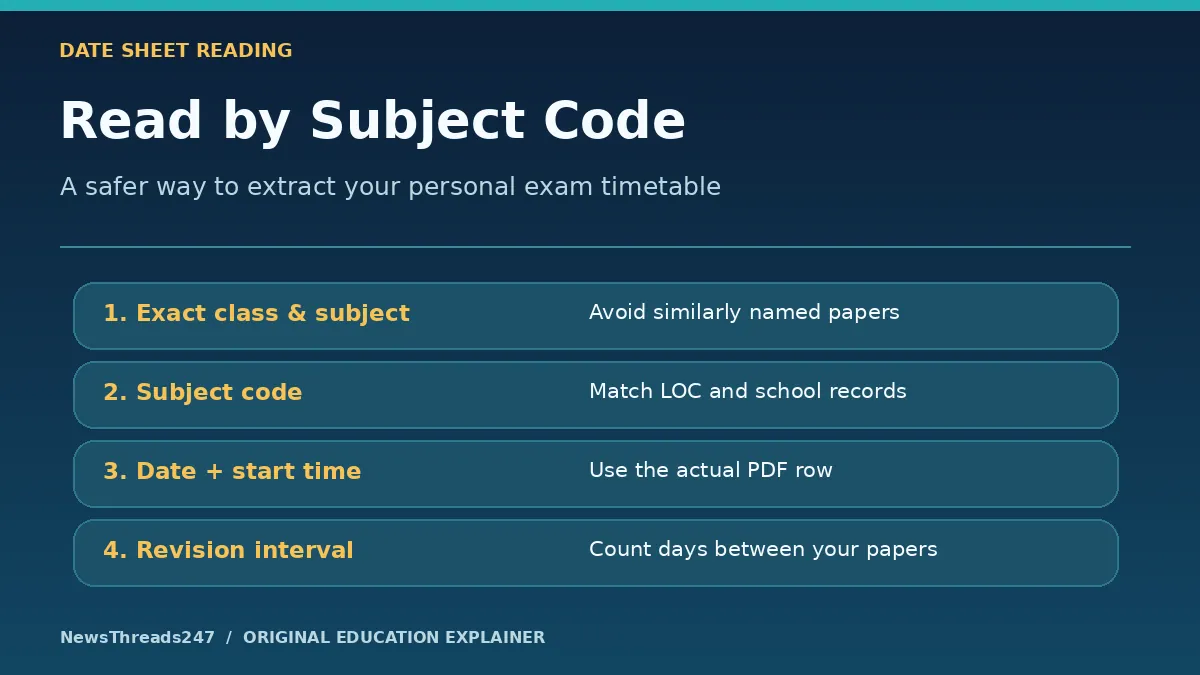
Next make sure you are reading the correct class. A combined announcement can contain large tables for both Class 10 and Class 12. It is easy to find a familiar subject name in the wrong section or copy a date for a different level. Check the heading and subject code, not only the name.
Locate every subject entered in your school’s List of Candidates (LOC) or otherwise formally registered record. This includes an optional language, additional subject or skill course where applicable. Ask the school to confirm your exact entered subjects if you are uncertain. An unofficial study-group chart may use shorthand titles that do not distinguish different subject codes.
For each correct row, copy the subject name, code, exam date and the time information. The announced overall start is 10:30 a.m., but the ending time or paper duration must be taken from the specific entry and official examination instructions. Don’t infer that every paper lasts three hours.

Subject Code Comes Before a Popular Subject Name
Two subjects can have nearly the same name but different codes or assessment arrangements. Mathematics Basic and Mathematics Standard are common examples of why reading only a headline can be insufficient. At Class 12, elective and core versions of some languages can appear separately, and skill courses may have distinct entries.
A student might receive a forwarded image saying ‘Maths — 9 March’ and assume that settles their schedule. A responsible check asks: which class, which mathematics course, what code and is that exact row present in the official 2027 PDF? The date in a secondary roundup might happen to match one major paper and still be incomplete for another candidate.
Build your personal timetable from the actual registered list rather than from an assumed stream. ‘Science student’ is not a sufficient schedule because students may take different languages, mathematics, computer subjects or optional papers. ‘Commerce student’ also does not uniquely identify every combination.
If your school says your LOC record differs from what you expected, raise it with the school examination office promptly and follow current CBSE correction rules. A publicly posted PDF does not authorize a candidate to change subjects or obtain a late registration by personal request.
Turn the Full Date Sheet Into Your Own Six-Column Table
A useful student version of the date sheet has six columns: the exact subject, subject code, theory exam date, reporting/start-time information, days after the previous personal paper, and the preparation task most likely to matter in that gap. You can create it in a notebook, spreadsheet or printed calendar.
For example, suppose a fictional student has Paper A on 16 February, Paper B on 24 February and Paper C on 1 March. There are eight calendar days between A and B and five between B and C when subtracting the printed dates. But the student does not have eight and five full uninterrupted study days; the day of an exam, travel and rest can reduce usable hours. This is only a scheduling example, not a claim about real 2027 subject dates.
Do not fill every gap with an impossible list of chapters. Put high-priority topics in the longer gaps, reserve a final review window before each paper and keep small contingency blocks for illness, travel or a weak chapter that takes extra work.
A personal timetable should fit on one or two pages. The full official PDF is a reference document; the extracted version is a daily operational tool. Keeping both prevents the problem of memorizing a classmate’s dates while neglecting your own subject selection.
Class 10 and Class 12 Need Different Planning Horizons
The Class 10 main board period announced for 2027 is shorter, ending on 9 March. Many Class 10 students therefore need a focused sequence of broad-subject revision while also making time for their individual weaker topics and school-based work.
Class 12 extends through 9 April, potentially creating longer gaps and a different mix of subject demands. A student with Physics, Chemistry, Mathematics and English may need a very different calendar from someone taking Accountancy, Business Studies, Economics and an additional language. The board’s start date is common; personal workload is not.
Students preparing simultaneously for entrance examinations face a further planning task: compare official board dates with authentic entrance exam schedules. A tentative entrance calendar is not a confirmed clash. Do not make travel bookings or miss school instructions based on predicted exam dates circulated online.
For practical subjects, the main theory-paper dates are only part of the assessment season. Projects, laboratory practicals and internal assessment can take place before theory exams. Those deadlines must appear in the same personal calendar even though they are governed by separate CBSE and school instructions.
Practical Assessments Come Before the Theory Papers
Current reporting on CBSE’s 2026–27 notices places practical and internal assessments for winter-bound schools in the period 9 November to 19 December 2026. Regular-session schools are reported to have the period 1 January to 13 February 2027. The school is responsible for communicating the exact dates within the relevant official arrangements.
This means some students may be doing projects or practical examinations months before the first theory paper on 16 February. Their study plan needs both tracks. A student who concentrates only on a board-exam countdown can overlook an assessment whose marks contribute to the same subject total.
Separate circulars cover subject-wise theory versus practical/project/internal mark allocations. Students should read those documents as well as the date sheet. A 70-mark theory paper in a science subject, for example, may accompany a 30-mark practical component, but not every course follows that pattern.
If you need the component allocation for your subjects, read our CBSE 2027 marks-bifurcation explainer. Keep the official school assessment announcement next to your personal timetable.
A Three-Pass Revision Plan From the Exam Dates
A workable revision strategy can be divided into three passes. In the first pass, rebuild understanding of the syllabus and identify chapters you cannot yet solve independently. In the second, practise with official sample questions, past papers and timed responses. In the third, revisit errors, short notes, formulas and the patterns most likely to cost marks in your personal work.
The passes do not have to occur as isolated months. For a subject with a near-term exam, all three may overlap. A chapter studied today can be practised tomorrow, reviewed after several days and tested again under timed conditions. The point is to distinguish learning from performance and performance from error correction.
Rather than spending every evening rereading everything, make an error log. Write what went wrong in a practice question: a concept gap, calculation mistake, misunderstood command word or time-management problem. Attach a specific correction step and revisit it before a mock.
CBSE publishes subject-specific sample question papers and marking schemes through its official Academic Unit. Those documents help students learn the intended question format and acceptable answers. Our separate sample-paper guide is useful when moving from revision planning to timed exam practice.
How to Use the Gaps Between Papers Wisely
The useful question is not simply ‘How many days are left?’ It is ‘How much focused time will I realistically have after travel, recovery from the previous paper and other commitments?’ A two-day gap may contain only one full study day for someone with a long journey to the exam centre.
If the interval is long, split it into concept repair, timed practice and final recall. If the interval is short, avoid starting an entire untouched syllabus from scratch and prioritize verified weak areas, concise error notes and important standard problems. Reserve enough rest to attend the next exam alert and able to think clearly.
Do not automatically assign equal time to subjects just because each appears on the date sheet. A strong subject with a long gap may need fewer hours than a weak subject with a shorter gap. The right plan responds to your actual preparation, not a generic influencer’s daily timetable.
A family can help by reducing unnecessary interruptions and checking logistics in advance. Questions about travel, meals, stationery, identification and reporting time should be settled before the last evening so that the student’s final hours are not consumed by avoidable arrangements.
Reporting Time, Admit Card and Exam-Centre Rules
The announced board exam start time is 10:30 a.m. IST, but candidates should follow their final admit card, centre instructions and CBSE’s current examination guidance for reporting and entry deadlines. Starting time is not the same as the latest time one may arrive at a secure examination centre.
Students should verify the centre address, route, transport availability and permitted materials in advance. A familiar school name does not guarantee a familiar examination entrance. If the centre is distant, consider a dry run of the route at a comparable time of day.
Do not assume a smartphone or smart watch is permitted because you use it for study. Examination authorities can restrict communication devices, and candidates should read the actual prohibited-items notice rather than a viral checklist.
Keep the official admit card and identification requirements ready as instructed by your school or board. Avoid sharing personal candidate numbers and documents publicly when asking for help with a schedule.
Watch for Revised Notices and Fake PDFs
The timetable currently available is dated 6 November 2026. CBSE can issue clarifications, corrections or revised instructions, so the safest bookmark is the board’s official notices page and current examination circulars. A copied PDF with a familiar logo could be outdated or altered.
Check the domain carefully. The official website is cbse.gov.in; the board’s academic resource site is cbseacademic.nic.in. If a link is shortened, forwarded or embedded inside an unfamiliar payment page, do not assume it came from CBSE. Download directly where possible.
Look at the date of the circular, the exact class and the subject-code table. If a document conflicts with the school’s notice, bring the conflict to the examination office rather than deciding that the more convenient date must be correct. An updated public circular, not a screenshot’s popularity, resolves official scheduling questions.
A helpful habit is to write ‘last verified on’ at the top of your personal calendar and revisit the board notices periodically. That makes the timetable a maintained preparation tool rather than a static image that might silently become obsolete.
Three Common Student Mistakes With the Date Sheet
Mistake one: copying the stream instead of registered subjects. A student searches for ‘Class 12 Science date sheet’ and records Physics, Chemistry and Mathematics while overlooking an elective, language or computer subject. The correction is to match every subject code in the LOC and the official PDF.
Mistake two: treating the first and last exam dates as personal exam dates. A student sees that Class 12 continues until 9 April and assumes they have a paper that day. The overall range includes subjects they may not study. A personalized timetable avoids counting irrelevant dates.
Mistake three: planning all revision only after the previous paper. Some gaps are short, and some students still have practical or project work pending. Revise difficult concepts ahead of the official sequence, then use inter-paper days for targeted strengthening rather than emergency first-time learning.
Frequently Asked Questions
Has CBSE released the Class 10 and 12 date sheet for 2027?
Yes. CBSE’s official site lists a date sheet released on 6 November 2026 for the 2027 board examinations of Classes X and XII.
When do the CBSE 2027 board exams begin?
Both classes begin on Tuesday, 16 February 2027, with papers scheduled to start at 10:30 a.m. IST according to the announcement. Check your individual subject entry and admit card.
When do Class 10 and Class 12 exams finish?
The overall Class 10 main examination period concludes on 9 March 2027; the Class 12 schedule extends to 9 April 2027. Individual candidates may finish earlier.
Does every paper have a three-hour duration?
No. Paper duration varies by subject. Read the applicable official date-sheet row and assessment instructions instead of assuming every subject has the same length.
Are Class 10 second-board examinations included in this main date sheet?
The February–March schedule concerns the first/main period. CBSE’s separately published Class 10 two-board-exam scheme addresses eligibility and arrangements for an additional opportunity; students should check the operative 2027 circular for dates and conditions.
Where do I find the official CBSE PDF?
Visit cbse.gov.in and select the 6 November 2026 Date Sheet for Class X and Class XII Board Examinations, 2027 notice, or use its direct official PDF linked in the source section below.
Sources, Verification Notes and Editorial Disclosure
CBSE official homepage — Latest Notices lists the November 6 date sheet release. Official CBSE Class X and XII Date Sheet 2027 PDF is the authoritative full table; students must check their exact subject rows. Akashvani News, 6 November 2026 corroborates the announced start and end dates, 10:30 a.m. start and subject totals. CBSE Class X Two-Board-Examination Scheme documents the originally introduced system; it does not replace any later 2027 direction.
Editorial transparency: Dates and board-level facts are grounded in CBSE’s current notice listing and contemporaneous public reports. The official PDF was linked but the web fetch interface did not permit complete independent review of every subject row in this session. We therefore do not reproduce an unverified full 204-subject timetable. Readers must check their own subjects directly in CBSE’s PDF and school records.
Images: The featured date-range graphic and two explanatory graphics are original NewsThreads247 illustrations, not CBSE-issued notices. The fictional revision-calendar example is not an actual published exam schedule.
Education disclaimer: No educational outcome, passing score or official schedule amendment is guaranteed by this guide. The board’s latest notices, individual admit card and school instructions control actual examination arrangements.