
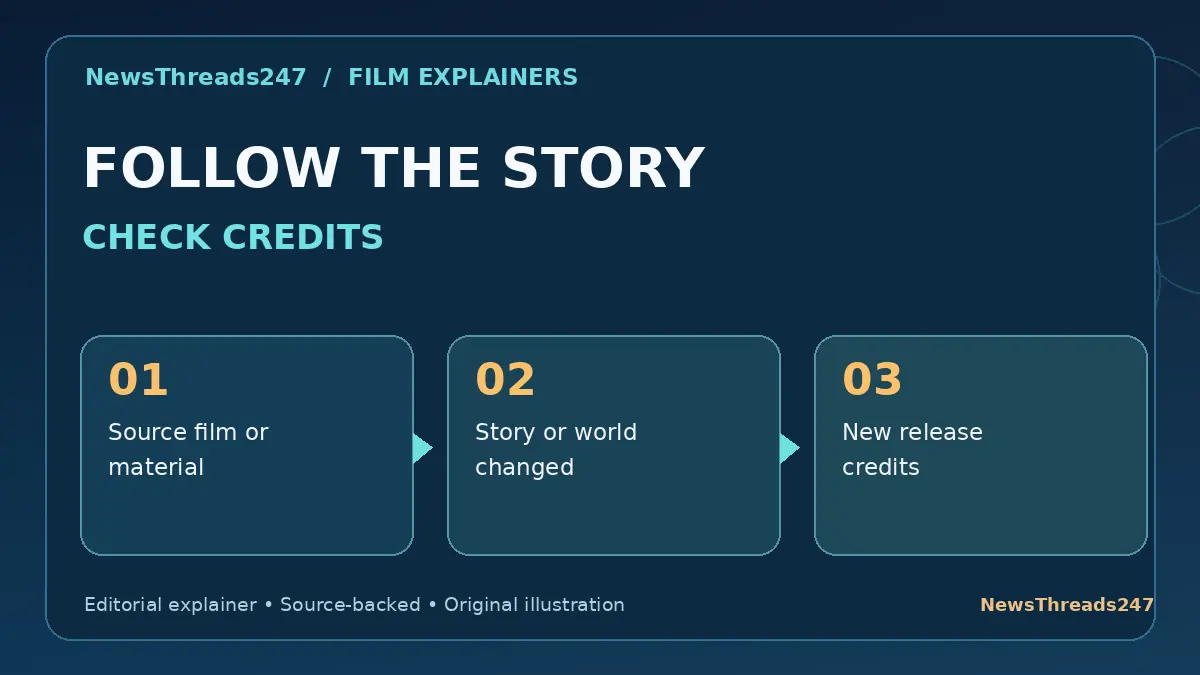
A new movie uses a familiar name, and the headlines disagree: one calls it a remake, another a reboot, while the studio promotes it as a reimagining. Those words can describe different relationships with earlier stories, even when marketing uses them loosely.
Understanding the distinctions helps viewers know when prior viewing matters and helps readers interpret creative credits without assuming every new version is a sequel.
Table of Contents — Expand or Collapse
- Why Four Familiar Labels Get Mixed Together
- What Makes a Movie a Remake?
- What Is a Reboot?
- How an Adaptation Differs
- Sequel, Prequel and Spin-Off Explained
- A Fictional Franchise Example
- What ‘Based on a True Story’ Does and Does Not Mean
- What the Writing Credits Really Tell You
- How to Decide Whether You Need to Watch the Original
- Frequently Asked Questions
- Sources and Editorial Notes
Why Four Familiar Labels Get Mixed Together
A new film uses the name of an older title, and a trailer describes it as a ‘reimagining’. Another movie brings back a familiar character but starts the story from the beginning. A third continues the last film’s events. All may be described as part of a franchise, yet remake, reboot, sequel and adaptation point to different relationships with earlier material.
The distinction matters to viewers who want to know whether they need to see the original before buying a ticket. It matters to writers because source material and screenwriting credits are not merely promotional decorations; they reflect creative contributions and contractual systems.
Industry language is not perfectly uniform across countries or studios. The Writers Guild of America has formal rules for certain writing credits in its jurisdiction, while ‘reboot’ is often a more informal descriptive term used by marketers and commentators.
What Makes a Movie a Remake?
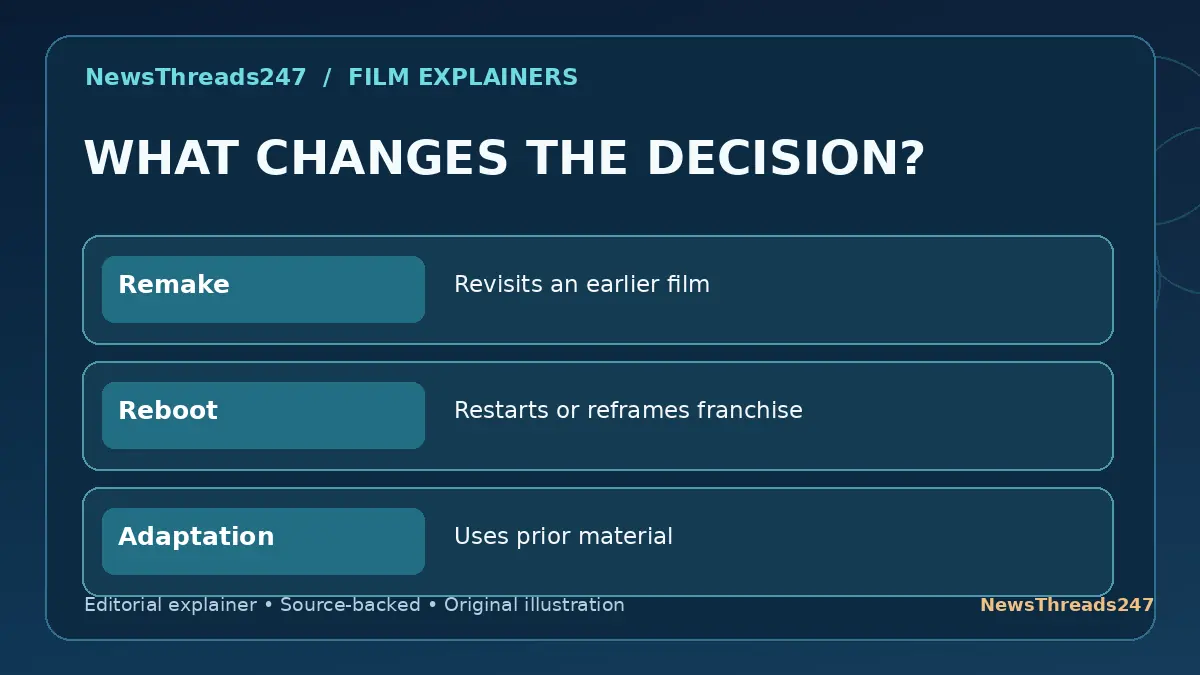
A remake revisits an earlier film’s core story. It may change actors, location, visual style or cultural setting, while retaining substantial similarities in characters, general plot and structure. Some remakes are close retellings; others transform tone or context more substantially.
The WGA Credits Survival Guide describes a remake using substantial similarity to a prior motion picture across principal characters, setting, plot, storyline, tone, events and structure. This is a formal credit context, not a claim that every viewer must score similarity against those categories.
Imagine a fictional film about a family trying to save a small theatre. Decades later another film tells broadly the same story with a new cast and city. That is a useful invented example of a remake, even though the setting and dialogue differ.
What Is a Reboot?
A reboot generally restarts or substantially reframes an established film or series continuity. It may use familiar characters or the same fictional world without asking viewers to follow the previous installment’s events as its direct history.
A studio could revisit a detective franchise, cast a new lead and tell an origin story unrelated to the earlier films’ continuity. Viewers may call that a reboot. If the new movie closely retells one prior movie’s central plot, the label ‘remake’ could also be relevant; the categories can overlap.
Because the word reboot is used flexibly in marketing, verify the actual story rather than assuming a headline settles it. Look at official synopsis, cast and creator interviews, and whether the film recognizes events from the earlier continuity.
How an Adaptation Differs
An adaptation develops an audiovisual work from existing source material such as a novel, stage play, comic, historical article or another story. A film based on a novel can be an adaptation without remaking an earlier film version of that novel.
The U.S. Copyright Office describes derivative works broadly, including motion-picture versions and dramatizations of pre-existing works. However, legal rights and writing credits are separate matters. Having source material does not automatically decide which writer receives a screenplay credit.
The WGA Screen Credits Manual distinguishes source-material credits from story and screenplay contributions in its jurisdiction. A movie’s ‘based on a novel by’ line is meaningful information about its source, but viewers should not assume it proves which scenes were written by whom.
Sequel, Prequel and Spin-Off Explained
A sequel continues a storyline or franchise from an earlier work, usually after its events. A prequel tells a story set before an existing installment. A spin-off uses characters, settings or concepts from an existing property to develop a related but distinct work.
These categories describe chronology and focus more than whether material was previously filmed. A prequel may be produced many years after the original despite taking place earlier in fictional time. A spin-off can occur during, before or after the main story.
One production can also fit more than one label. A film adapted from the second novel in a book series may be both an adaptation and a sequel to the first film. The audience should ask what relationship is relevant to the viewing decision instead of searching for one compulsory category.
A Fictional Franchise Example
Suppose a fictional 2000 movie, Harbor Watch, follows a young guard who exposes corruption at a port. A 2010 film continues the same guard’s life and depicts the consequences of his earlier decision. That would be a straightforward sequel.
A 2018 film showing the guard’s childhood before the 2000 story could be a prequel. A 2026 movie with a new cast that retells the first film’s essential plot might be described as a remake. Another 2026 movie that restarts the setting and characters in a new continuity could be called a reboot.
If the first film was itself developed from a novel, it would also be an adaptation. These examples are invented solely to explain how labels work and are not references to actual films or rights agreements.
What ‘Based on a True Story’ Does and Does Not Mean
Historical and biographical films introduce a different issue. A label such as ‘based on true events’ tells the viewer the work has a factual inspiration; it does not guarantee that every conversation, sequence or character combination happened exactly as shown.
Filmmakers often compress chronology, combine incidents and reconstruct private dialogue. For a reader trying to establish historical facts, primary interviews, archival records and official event results usually provide stronger evidence than a dramatized scene.
Ask what the film claims to depict, then identify the historical records that support its major events. A thoughtful comparison can appreciate the film’s storytelling while remaining precise about the limits of cinematic reconstruction.
What the Writing Credits Really Tell You
Credits such as ‘story by’, ‘screenplay by’, ‘based on a screenplay by’ and ‘based on characters created by’ can describe different forms of creative contribution. Their use may follow guild rules, contracts or studio practices rather than a simple percentage judged by the public.
The WGA’s current Screen Credits Manual contains detailed provisions for remakes and non-original screenplays. Those provisions apply within the Guild’s own jurisdiction; they should not be assumed to govern every Hindi, Tamil, Telugu, Korean or independent production worldwide.
Even a correct credit does not tell you whether the finished film is enjoyable or faithful. It helps establish provenance and responsibility. For interpretation, supplement it with the film’s actual story and statements from credited creators.
How to Decide Whether You Need to Watch the Original
For a direct sequel, knowing the preceding story may help you understand returning relationships and unresolved events. A reboot may deliberately welcome newcomers, whereas a remake can often stand alone even if comparison with the earlier film enriches it.
An adaptation may be understandable without reading its source novel, but readers may enjoy examining what changed and why. There is no universal requirement to consume every related work; the answer depends on how much the new film assumes prior familiarity.
If a cinema listing also advertises formats such as IMAX, Dolby Atmos or 4DX, those describe presentation rather than narrative continuity. Our cinema-format comparison covers that separate ticket decision.
The same character does not always mean the same continuity
Suppose the fictional film Harbor Watch features detective Mira and ends with her leaving the city. Five years later, a film again called Harbor Watch casts a new actor as Mira and tells her first case differently. Calling it a sequel would suggest the first film’s events already happened; calling it a reboot may be more accurate if the new film starts a separate continuity. The actor, release date and title alone do not settle the relationship. Look for the studio’s synopsis, credited source material and the story’s own treatment of past events.
Now imagine a third film follows a different supporting character from the original without retelling Mira’s story. That may be a spin-off, even if its events take place after the original film. A prequel instead moves earlier in the established fictional chronology, although it is released later to audiences. These labels describe different relationships: release order, fictional time and narrative continuity. A film can be a prequel and also function as a spin-off, depending on the character and story it follows.
Marketing language is not always a writing-credit category
A studio may call a film a ‘reimagining’ because it wants viewers to expect a fresh tone, a different perspective or an updated setting. That word is a promotional description, not proof that the film has no source material or that the original screenwriter has no rights. The Writers Guild of America Screen Credits Manual contains much more specific procedures for determining credits on remakes and non-original screenplays under its jurisdiction. Those professional rules should not be confused with the everyday terms used in trailers.
The U.S. Copyright Office describes derivative works broadly in relation to pre-existing protected material. That legal concept can include adaptations, but it does not mean every marketing label determines who receives a credit or holds a particular right in every country. Licensing, copyright status, source agreements and guild rules can vary. Viewers usually do not need to resolve these legal questions to enjoy a film, but journalists should avoid declaring that a producer ‘stole’ a story merely because two plots share familiar elements.
A three-question check before watching
First, does the new release continue the exact world and events of an earlier film, or restart them? If it continues, some prior context may matter; if it starts again, a newcomer can often begin with the new release. Second, is it principally based on a novel, historical account or other earlier work? If so, the adaptation question may matter more than the franchise question. Third, is the title promoted as a spin-off around a side character? That can be accessible as a standalone story, but look for the official description instead of assuming either way.
For families planning a cinema visit, this classification is only one decision. A remake may have different age suitability, violence, duration or format from an older version. Check the actual release’s certification and show format rather than importing expectations from the earlier film. Our IMAX, Dolby Atmos and 4DX comparison deals with the separate question of what a cinema format changes. A familiar franchise name is not a substitute for checking the ticket details.
Frequently Asked Questions
Can a movie be both an adaptation and a remake? Yes. A new film can draw from a book and also revisit the story structure of an earlier movie.
Does a reboot continue the old continuity? A reboot typically restarts or reframes the franchise, but usage is flexible, so check the official synopsis.
Is a prequel a type of sequel? Both are related installments, but a prequel takes place earlier in story time.
Does ‘based on a true story’ guarantee accuracy? No. It signals factual inspiration, not documentary treatment of every event.
Can writers of an original film receive credit on a remake? Under WGA rules, prior credited writers may participate in the remake credit determination; exact outcomes depend on the Guild’s procedures and material.
Sources and Editorial Notes
References include the WGA Screen Credits Manual, the WGA Credits Survival Guide, and the U.S. Copyright Office’s definitions of derivative works. These are sources for the described U.S. legal and credit concepts, not universal legal standards for every film industry.
Editorial disclosure: All diagrams and the Harbor Watch franchise examples are original explanatory illustrations and hypotheticals. No actual movie footage, film logo or cast portrait has been reproduced. This is media-literacy analysis, not legal advice. Review relevant credit rules when official manuals are updated.