
You have chosen the film. Now the ticket page shows three versions of the same show: IMAX, Dolby Atmos and 4DX. One costs more, another has a much later showtime, and a friend insists the most expensive seat must be the best. But these labels are not three levels of the same upgrade. They describe different parts of watching a film.
At a glance: IMAX is a large-format cinema system concerned with the screen, projection and sound experience. Dolby Atmos is an immersive audio technology; seeing “Atmos” on a listing does not by itself promise a Dolby Cinema auditorium. 4DX adds synchronised moving seats and environmental effects such as wind and water to the screening. None automatically wins for every viewer or every film.
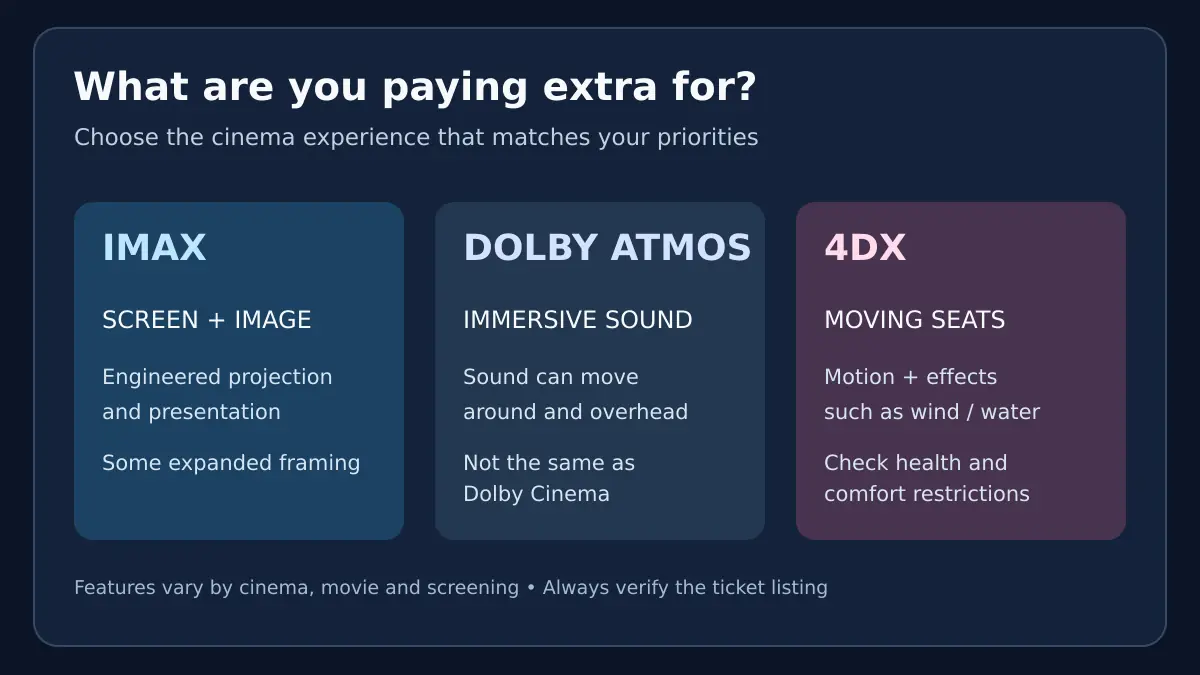
IMAX vs Dolby Atmos vs 4DX: the short comparison
| Option | What changes most | A good fit when… | Check before paying |
|---|---|---|---|
| IMAX | Large-format screen and engineered projection/audio system; some films feature expanded image framing | Big landscapes and carefully designed visuals matter to you | The exact IMAX auditorium, projection system and film presentation |
| Dolby Atmos | Sound objects can move around the room, including overhead | Music, effects and detailed sound design are your priority | Whether this specific screening is in an Atmos-equipped auditorium |
| 4DX | Motion seats and synchronised physical effects | You want an active, theme-park-like film outing | Health and accessibility warnings; seat and effects availability |
| Standard 2D | Conventional screen, seat and sound for that theatre | Story comfort, lower price or a convenient showtime matters more | Auditorium quality, seating and screening language |
A cinema ticket can bundle several of these concepts. An IMAX screen has a sound system, of course; an Atmos-equipped auditorium has a picture, too. The useful question is what the particular listing promises and whether that difference matters for the particular movie you plan to watch.
What makes an IMAX screening different?
IMAX describes a designed combination of screen geometry, projection, sound and presentation standards. The company markets its experience as a carefully tuned system rather than merely a big screen. Certain films are made with expanded IMAX framing in mind, which can reveal more image vertically in qualifying sequences. Other films shown on IMAX screens may not make the same use of expanded framing.
That difference is why “shot for IMAX” and “showing in IMAX” should not be treated as identical statements. IMAX has described both 1.90:1 and 1.43:1 expanded aspect ratios in relation to films and screens that support them; not every IMAX venue or release presents the same image ratio. If expanded framing is your reason for paying extra, check the film’s official format information and the specific theatre, not a generic advertisement.
The practical appeal is often immersion without moving your seat: a screen that occupies more of your field of view, sound designed for the auditorium and the feeling of being drawn into a large scene. It is not necessarily the best choice for someone who dislikes sitting close to a huge image or prefers a convenient smaller auditorium.
Dolby Atmos is a sound format, not a synonym for Dolby Cinema
Dolby explains that Atmos uses audio objects and overhead speakers to position and move sound around listeners in the theatre. Instead of hearing every effect only from a fixed left or right direction, the mix can create a sense of movement through the space, including above you. A good sound mix may make rain, aircraft or quiet room ambience feel unusually precise.
But there are two different terms worth separating. Dolby Atmos can describe the audio system and presentation in a range of theatres. Dolby Cinema is Dolby’s branded premium cinema experience combining Dolby Vision picture technology and Dolby Atmos sound in specifically designed venues. A listing that says only “Atmos” should not be represented as a promise of a Dolby Cinema screen, Dolby Vision projection or a particular seating standard.
Dolby Atmos may be a strong option for films with carefully designed music and sound. A quiet drama may also benefit, but not every viewer will perceive an equally dramatic change. Good conventional audio in a well-maintained theatre can still produce an excellent evening.
What actually happens in a 4DX theatre?
4DX, developed by CJ 4DPLEX, is the option that makes the seats part of the show. According to the format developer, moving seats and effects such as wind, water, scent, fog, air jets and lighting can be synchronised with onscreen action. The exact combination varies across titles and venues. It is more than watching a film with louder audio; it is an active sensory experience.
A chase sequence may come with seat movement. A windy scene may be accompanied by air. Some people find the physical effects playful and memorable, especially in action-adventure films. Others find the motion distracting when they want to watch actors’ faces, read subtitles or concentrate on dialogue.
Important before booking: Motion and sensory effects may be unsuitable for people with particular medical conditions, mobility limitations, sensory sensitivities or motion sickness. Check the operator’s posted 4DX safety rules and any age, height, pregnancy or health restrictions applicable to that location. Do not assume the same rules apply everywhere. If you cannot comfortably use a moving seat, choose another format without treating it as a lesser experience.
How to choose for the film you are actually seeing
For a visually expansive science-fiction or adventure film
Find out whether the director and distributor have identified an IMAX presentation with expanded framing. If so, compare the local IMAX venue with the standard screen. Its value depends on the film’s master, auditorium and your seat preference. A huge screen does little for someone placed where they are uncomfortable looking around.
For a concert film or a soundtrack-led drama
Look for an Atmos presentation when the film has been mixed for it and the auditorium is equipped accordingly. Listen for detail rather than just volume. A louder show is not necessarily better sound. Good speech clarity and comfortable listening levels matter, especially over a long runtime.
For a high-energy action film and an outing with friends
4DX may be a fun event if everyone wants motion and environmental effects. It may be a poor surprise for a friend who becomes nauseated on moving rides, has physical limitations or simply wants to sit still. Ask people before paying for the group. Also check whether subtitles or on-screen text will remain comfortable to follow with motion.
For an intimate, dialogue-heavy film or a family outing
A good standard auditorium can be the smartest booking. You may prefer its showtime, quieter environment, accessible layout or price. Premium formats are options, not requirements for enjoying cinema. If you are attending with children, check the film’s CBFC certificate separately from any format label; format and audience certification answer different questions.
Five things to check on the ticket page
1. Exact format: Does the listing explicitly say IMAX, 4DX, Dolby Atmos or Dolby Cinema? These are not interchangeable. 2. Exact screening: Make sure the format applies to the selected time and language version, not just another show at the same multiplex. 3. 2D or 3D: Three-dimensional presentation is another choice and may require glasses; IMAX and 4DX do not automatically mean 3D. 4. Seat position: Consider comfort and screen geometry, not only the “premium” label. 5. Safety and access: Read the format operator’s warnings and the theatre’s accessibility information before purchasing.
If hearing or vision access features are essential to your booking, follow our separate India cinema accessibility guide for captions and audio description. Advertised sound formats should never be mistaken for a guarantee of an accessibility track for a particular show.
Is the premium ticket worth the extra money?
There is no honest universal number. Prices vary by city, theatre, film, day, seat and booking platform, and this guide does not invent a premium you should pay. Decide using a simple comparison: What is the extra amount for this booking, and what new experience will I personally get? If the added cost is small and the film genuinely uses the format well, it may be worthwhile. If you mainly want a comfortable evening with someone you care about, the standard ticket may be the better purchase.
Do not assume that the same brand-name format will feel identical across all locations. Projection equipment, auditorium shape, seating and ongoing maintenance affect the result. Use recent venue-specific comments as one signal, but verify technical claims with the operator or format provider.
Frequently asked questions
Is IMAX better than Dolby Atmos?
They emphasise different things. IMAX is a cinema presentation system, while Dolby Atmos is immersive audio. Choose according to the film, actual venue and whether you value the picture or sound difference more.
Are moving seats used in IMAX?
IMAX as a format does not mean moving seats. 4DX is the option associated with synchronised motion seating and physical environmental effects.
Does “Dolby Atmos” mean Dolby Vision?
No. Atmos identifies an audio technology. Dolby Vision is a picture technology. Dolby Cinema brings both together in qualifying branded venues, but an Atmos listing alone does not establish that.
Is 4DX suitable for everyone?
No. Its motion and sensory effects can be inappropriate or uncomfortable for some viewers. Review the exact cinema’s posted health, safety and admission rules before booking, especially with children or anyone with a relevant medical condition.
Should I choose a premium format for every blockbuster?
Not automatically. Ask whether the film has an appropriate premium-format presentation, what that auditorium offers and whether the extra effects support the film or distract you.